

Metal Shear Blades: 3 Types & Selection Guide
Release time: 2026-10-22
This guide covers straight and shaped knives for sheet and plate shears, scrap shears and metallurgical cutting equipment. Circular coil-slitting tools and toothed metal-cutting saw blades need a separate tooling review.
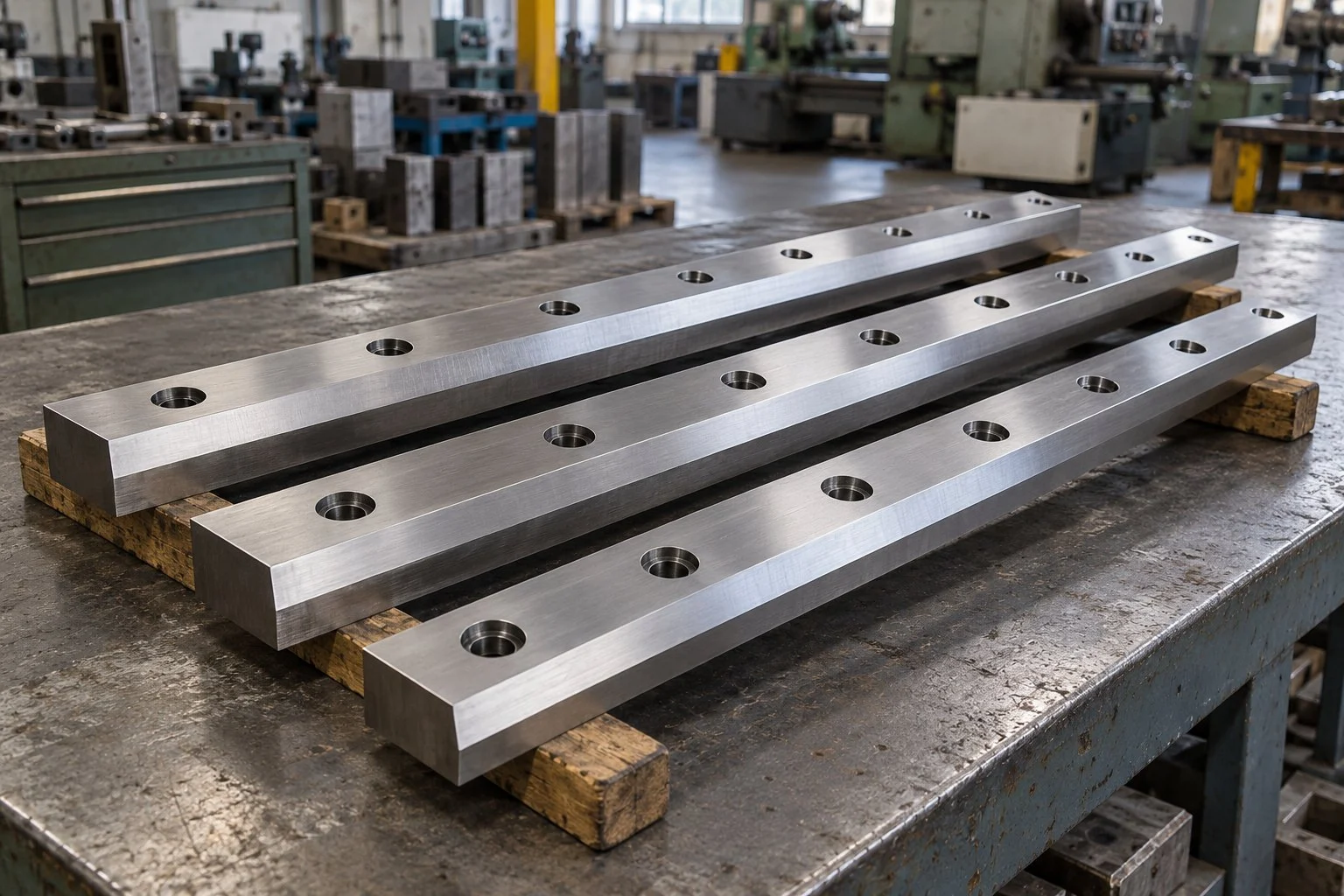
Metal shear blades at a glance
The first question is where the knife works. Similar-looking rectangular knives can belong to quite different cutting arrangements.
| Blade family | Cutting task | Details that matter in a replacement enquiry |
|---|---|---|
| Sheet and plate shear knives | Cutting flat stock to a required blank or strip | Upper and lower knife arrangement, cutting length, stock specification and thickness range |
| Scrap shear knives | Cutting incoming scrap in a defined shear or jaw assembly | Machine and knife position, feed shape, cutting profile and mating parts |
| Metallurgical shear knives | Cutting at a casting or rolling operation | Process position, stock section, material temperature and the installed knife design |
The industrial knives guide places these knives within the wider industrial cutting range. For this enquiry, keep the machine and cutting operation attached to every part reference.
3 types of metal shear blades
1. Sheet and plate shear knives
A sheet shear brings an upper and lower cutting edge past each other. The blade specification has to suit both the machine and the material schedule. Include the lower knife when identifying a replacement for the upper position, and vice versa.
State whether each position uses a continuous knife or a row of segments. For a segmented arrangement, label the sequence and retain the joint locations. A photograph of one loose segment leaves the full set length and quantity unresolved.
Use the machine model and approved part drawing to identify the design. Terms such as hydraulic, mechanical, guillotine and swing-beam help describe the equipment, but they do not specify the knife’s mounting details.
2. Scrap shear knives
For scrap processing, describe the incoming shape as well as the metal. Flat offcuts, sections and mixed scrap present different purchasing information. Give the relevant section dimensions and identify material that the machine must exclude.
NJDETE’s catalogue includes hawk-beak and double-cylinder shear blade families. Send the machine model, position map and photographs of the installed knives when asking about these parts. The catalogue family name alone does not establish compatibility with a particular shear.
3. Metallurgical shear knives
At a casting or rolling line, identify the exact cutting station. Record whether the material reaches the knife cold or at an elevated temperature, together with the stock section and production sequence.
NJDETE’s metallurgical blade range is described for continuous-casting and rolling applications. The material names listed later in this guide are enquiry references. The drawing, cutting conditions and agreed manufacturing specification determine the proposed part.
How to select metal shear blades for your machine
Start with the stock and the accepted cut
Prepare a cutting list with the material designation, thickness range and section shape. Where available, include the material certificate or specified strength range. Identify changes between production batches instead of describing the entire schedule as “steel.”
Also state what the next process needs. A fabrication buyer may need a blank that passes a width, squareness and edge-quality check. A scrap operation may be evaluating reliable separation and the size of the resulting pieces. Set the acceptance requirement for the actual job.
Identify the complete knife arrangement
Record the machine model, serial number where available, upper or lower position and part reference. For a set, give the quantity of each variant. Keep a photograph of the assembly with the drawing so the supplier can relate a loose knife to its installed position.
Check the mounting face, bolt features and working geometry together. Resolve drawing revisions before ordering a part that “looks the same.” On older equipment, previous repairs or modifications may affect which documentation applies.
Separate a wear problem from a replacement mismatch
Explain when the problem began. Did the last approved set gradually lose its edge, or did the new set perform poorly from the first cuts? Was only one section affected? Did the stock, knife position or machine setup change at the same time?
These observations help define the next inspection. Keep a labelled sample of an accepted cut and a rejected one, with their dates and positions. They give purchasing and maintenance a common description of the result.
Agree on the part and the trial before comparing offers
Ask the supplier to identify the proposed grade, drawing revision, heat-treatment requirements and inspection scope. A material substitution should appear in the offer, with the reason for proposing it.
Machine capacity and knife suitability need separate checks. Replacing a knife does not establish that a shear can process thicker or stronger stock. Confirm the permitted operation against the machine documentation and the agreed knife specification.
For a trial order, select representative stock and record the installed arrangement. Define which cut samples and dimensional checks will be retained. This makes a later repeat order easier to assess.
Dimensions to confirm before ordering
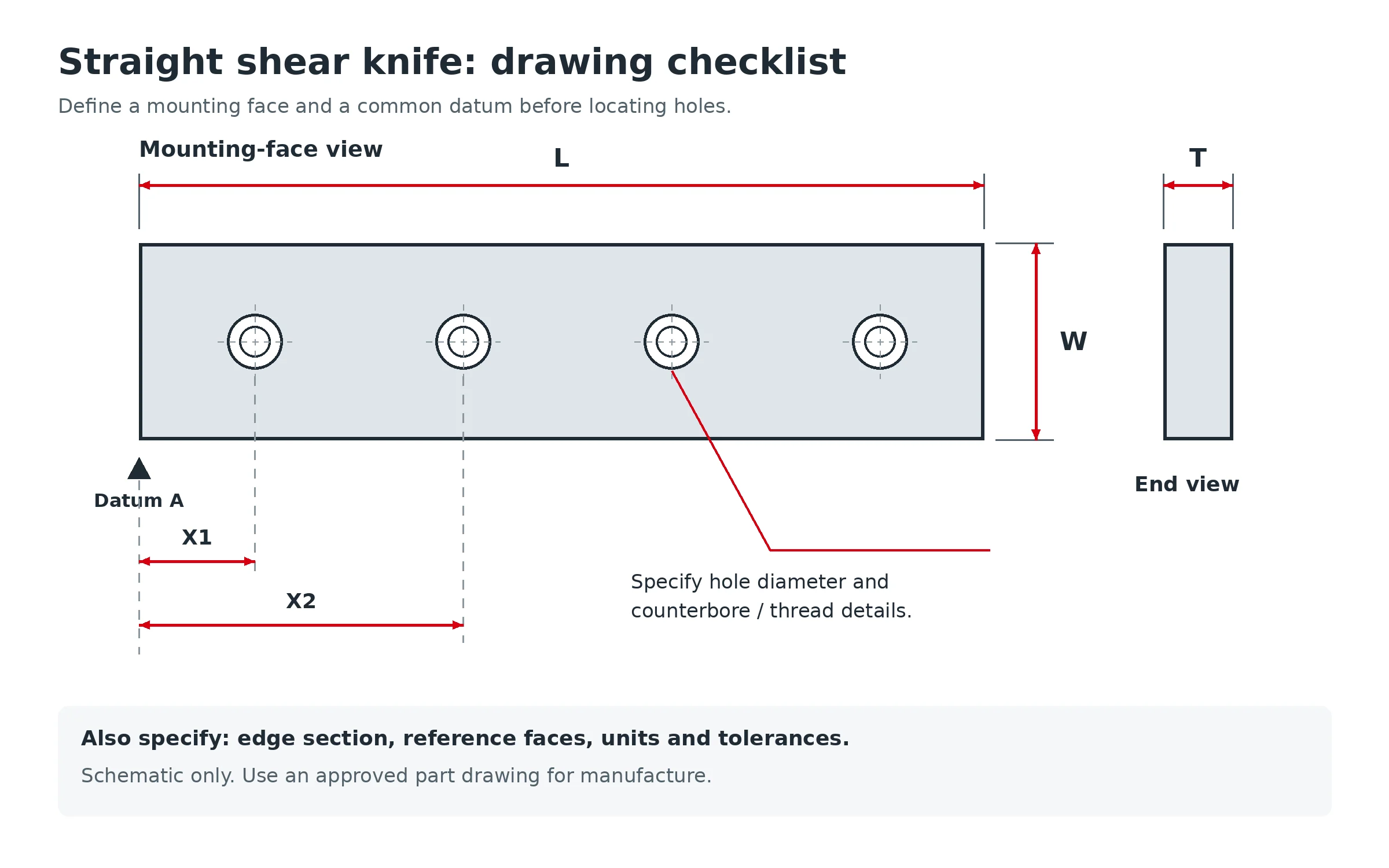
Use a dimensioned drawing with identified reference faces. For a straight knife, overall length, width and thickness are a starting point. Hole locations, seating details and the cutting section complete the part definition.
| Drawing item | Information to include | Why purchasing needs it |
|---|---|---|
| Overall envelope | Length, width and thickness, with units and required tolerances | Establishes the part size and working geometry |
| Mounting face | Seating face and any locating shoulder or recess | Identifies how the part sits in the holder |
| Hole positions | Hole-centre coordinates from stated datums | Avoids relying on a photograph or an accumulated chain of measurements |
| Hole features | Diameter, counterbore, countersink or thread details as applicable | Defines the fastener interface |
| Cutting section | Edge profile, orientation and specified edge preparation | Distinguishes parts with matching outside dimensions |
| Set layout | Upper/lower identity, segment sequence and quantity | Defines the complete delivery scope |
A worn sample needs a measurement record. Mark its current dimensions and known regrinding history separately from the required new-part dimensions. Copying the remaining height of a used knife can carry an earlier modification into the replacement order.
If the original drawing is incomplete, the custom straight and special-shaped blade guide explains how to organize a drawing or sample enquiry. Resolve the resulting specification before manufacture.
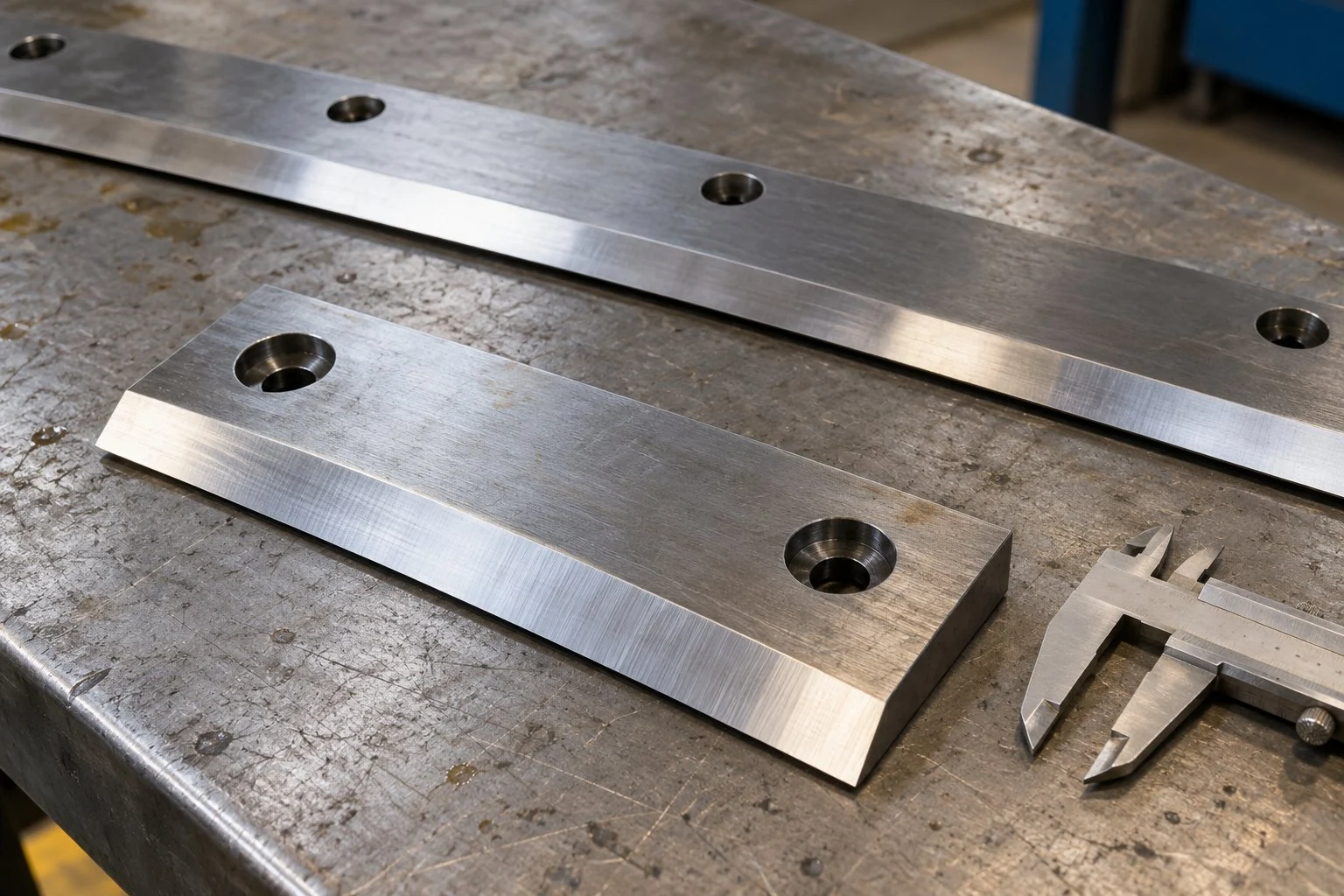
Materials for metal shear blades
NJDETE’s catalogue separates scrap-shear and metallurgical blade information. Keep that distinction when preparing a material enquiry.
| NJDETE catalogue family | Published material or hardness information | What to confirm for the order |
|---|---|---|
| Hawk-beak and double-cylinder shear blades | The described tool-steel blades are listed at 57–59 HRC; the exact grade is not identified | Exact steel designation, required hardness, test location and the approved knife design |
| Metallurgical machinery blades | 6CrW2Si, H13K, LD and 1.2379 are listed material designations | Which designation is proposed for the actual stock, temperature and cutting station |
The 57–59 HRC entry belongs to the specified catalogue family. It is not a common hardness requirement for all NJDETE metal shear blades. The metallurgical list likewise does not assign every grade to every application.
For a repeat part, give the existing material and inspection records where known. For a change, state the removal reason: progressive edge wear, local fracture, deformation or another observed condition. Ask how the proposed material and heat treatment address that condition.
Keep the grade designation exactly as agreed. For example, a quotation that says H13 should not silently replace a requirement that says H13K. Resolve equivalence or substitution in writing, together with the documents required for acceptance.
Blade wear, sharpening and replacement
Read the defect in the context of the machine
Use the table to organize an inspection with the responsible technician. A visible defect is a starting observation, rather than a complete diagnosis.
| Observation | Information to review | Evidence to retain |
|---|---|---|
| Burr or edge rollover increases during a run | Knife edge condition, stock changes and the approved clearance setting | Dated cut samples and the run conditions |
| A new knife chips in one area | Part identity, seating, local damage and the mating edge | Position-marked photographs and installation notes |
| Results worsen after sharpening | Remaining dimensions, finished profile and available machine adjustment | Grinding report and before/after measurements |
| Cut quality changes along the length | Individual segments, joints, mounting and the machine inspection findings | Position map and samples from the affected locations |
Blade inspection, removal and adjustment should follow the equipment’s isolation, handling and setup procedures. Record the findings before changing several variables at once.
Review blade gap and rake angle separately
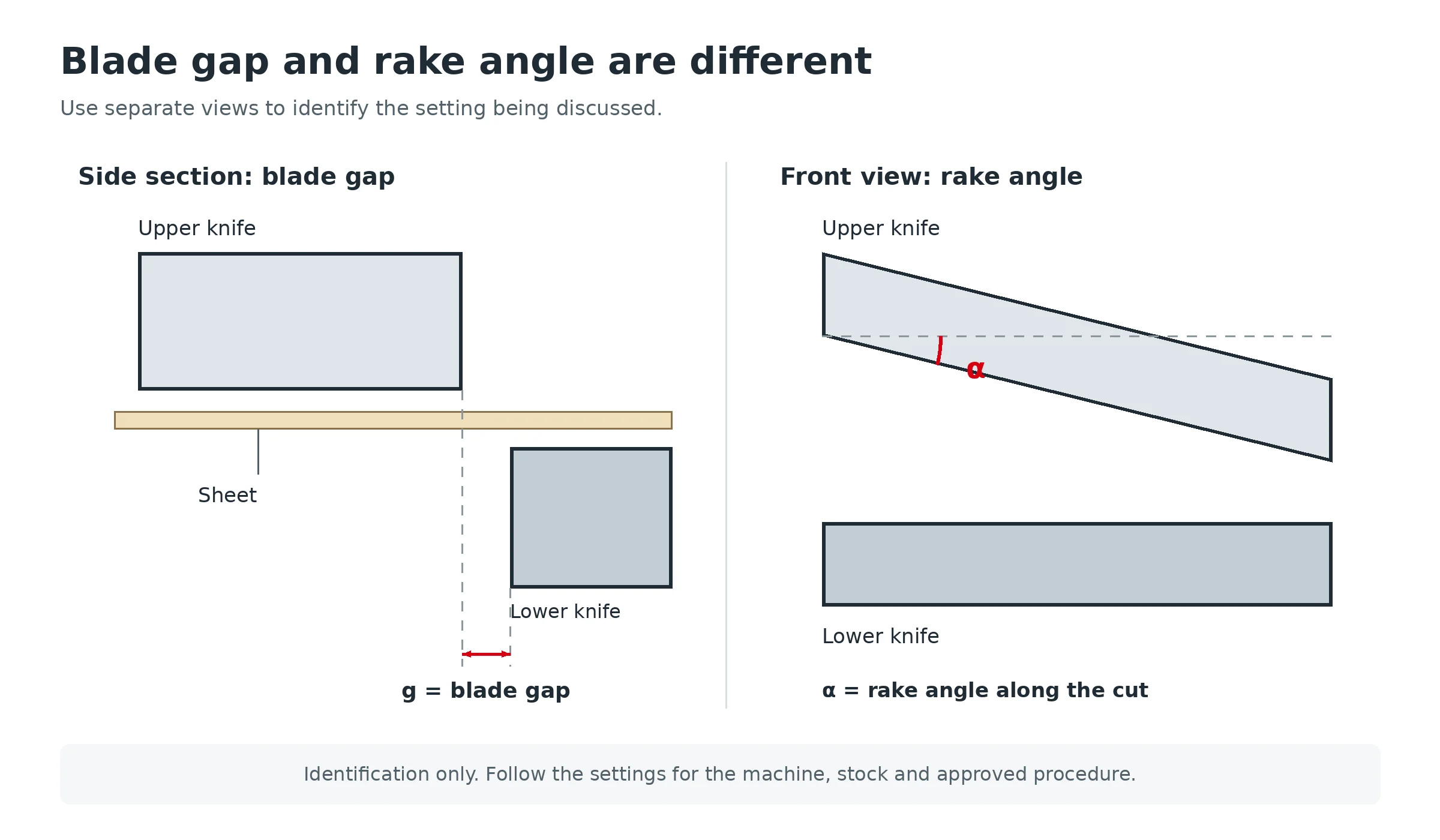
Blade gap describes the separation between the opposing cutting edges as they pass. Rake angle describes their inclination along the cut. They are different aspects of the arrangement and should have separate entries in the setup record.
Use the settings and checking method specified for the installed machine and material. A gap percentage taken from another machine does not define the setting for this one. When the stock changes, review the applicable instructions rather than keeping an unexplained setting from the previous job.
Decide whether to rotate, regrind or replace
Use another edge only when the knife design permits it and the remaining part passes the required inspection. Check orientation and hole features before treating each corner as an available cutting edge.
Before regrinding, establish which surfaces may be ground and the permitted finished dimensions. Include the mating knife and the machine’s available adjustment in that review. Grinding away visible damage is useful only if the finished part can still be installed and set correctly.
Replace a knife when it falls outside the approved dimensional or condition limits. Record why it was removed and retain that information with the next order.
Keep a record that purchasing can use
| Record field | Information to retain |
|---|---|
| Part identity | Supplier, order, drawing revision, grade and knife position |
| Installation | Date, applicable setup record and mating-knife condition |
| Production | Stock grade, thickness or section, batch and cutting conditions |
| Result | Accepted production, cut samples and the reason for removal |
| Maintenance | Edge changes, regrinding history and measured remaining dimensions |
Complete this record during an actual replacement and run. If the stock or setup changed, keep that change beside the result so a later comparison can account for it.
How to compare shear blade costs
Compare offers for the same knife arrangement. Confirm whether the price includes one knife, an upper/lower pair or every segment needed for the machine. Then compare the agreed material, inspection documents and delivery scope.
| Cost item | Comparison question |
|---|---|
| Initial supply | Are the quantity, variants and drawing revision the same? |
| Usable cutting edges | Does the approved design permit the same edge changes? |
| Sharpening | What cost and remaining-dimension records are available? |
| Changeover | What labour and production interruption occurred on the recorded job? |
| Rejected production | What output failed the agreed cut-quality checks? |
Where records support the calculation, compare total knife-related cost over a common quantity of accepted production. Keep assumptions visible when a new grade has not yet been trialled. A projected service life belongs in a trial proposal until a recorded run supports it.
Metal shear blade RFQ checklist
Send one enquiry package containing:
- Machine: manufacturer, model, serial number where available and cutting operation.
- Knife arrangement: upper/lower position, part references, segment map and quantities of each variant.
- Drawing or sample: revision, units, mounting features, cutting profile and known regrinding history.
- Stock: material designation, thickness or section range, strength information where available and cutting temperature when relevant.
- Current result: reason for replacement, position-marked damage photographs and accepted/rejected cut samples.
- Acceptance: material and heat-treatment requirements, dimensional inspection, documentation and any production trial.
- Delivery: destination, required date, packaging and whether a complete set or selected parts are needed.
Ask the supplier to list any proposed substitutions and unresolved dimensions. Clear those points before treating two quotations as equivalent.
Frequently Asked Questions
Discuss your shear blade replacement with NJDETE
Contact NJDETE with the machine details, drawing or sample and stock information. Identify the catalogue family where relevant, then state the actual knife position and reason for replacement. The enquiry review should resolve the manufacturing specification and any proposed substitution before a quotation is approved.
You can also review NJDETE’s custom blade categories for related knife families. Send the part details with your enquiry so the response can address the installed assembly.