

Slitter Blades: 3 Types & Selection Guide
Release time: 2026-10-21
If the existing blade cuts well and simply wears out, start with its approved part reference or drawing. If a new blade produces a poor edge immediately, investigate the setup and mating components before ordering a different grade.
This guide covers moving webs such as film, paper, foil and nonwovens. Metal coil slitting requires its own tooling and setup review. Toothed circular saw blades also serve a different cutting process.
Slitter blades at a glance
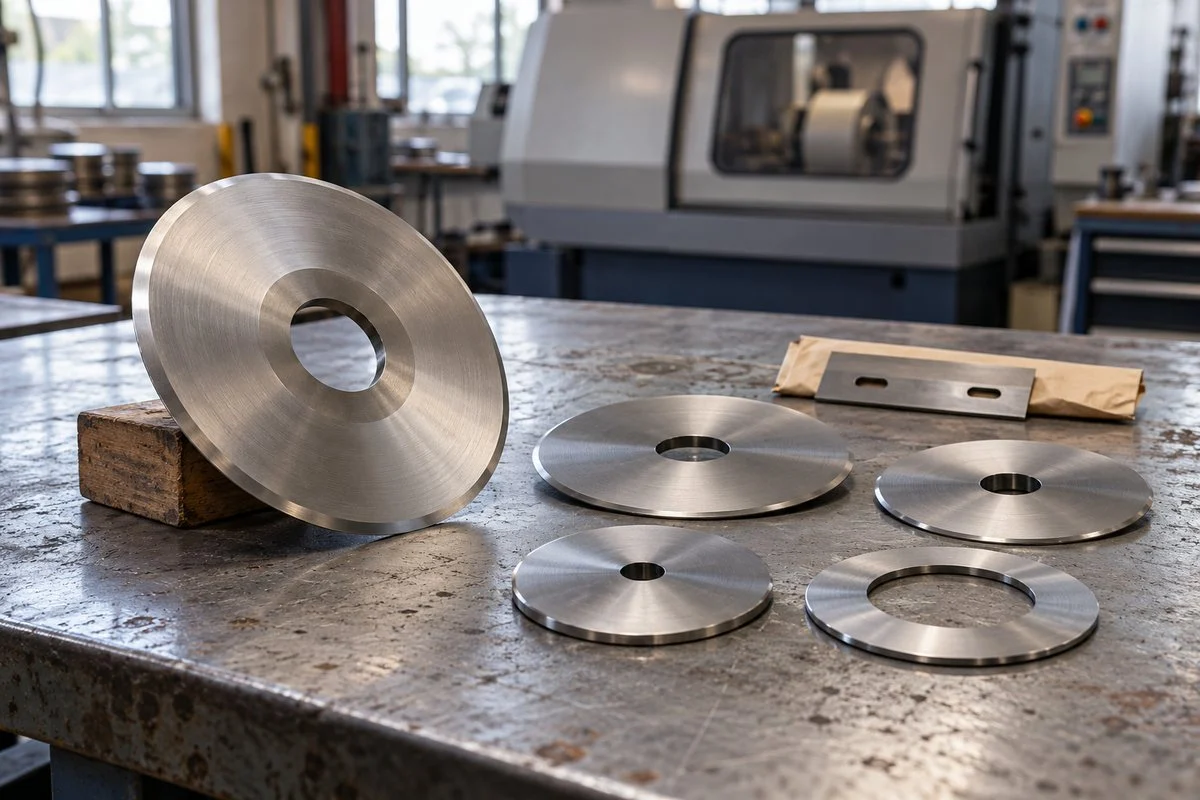
“Slitter blades” covers several arrangements. Identify which one the machine uses before comparing replacements.
| Method | Cutting arrangement | What to establish before ordering |
|---|---|---|
| Razor slitting | A sharp blade passes through the moving web, with support suited to the machine | Blade shape, clamping features, exposed edge and web support |
| Rotary shear slitting | Cooperating top and bottom cutting edges produce the slit | Both knife identities, holder, mating surfaces and specified setup |
| Crush slitting | A circular knife presses the material against a hardened anvil | Knife profile, holder loading arrangement and anvil condition |
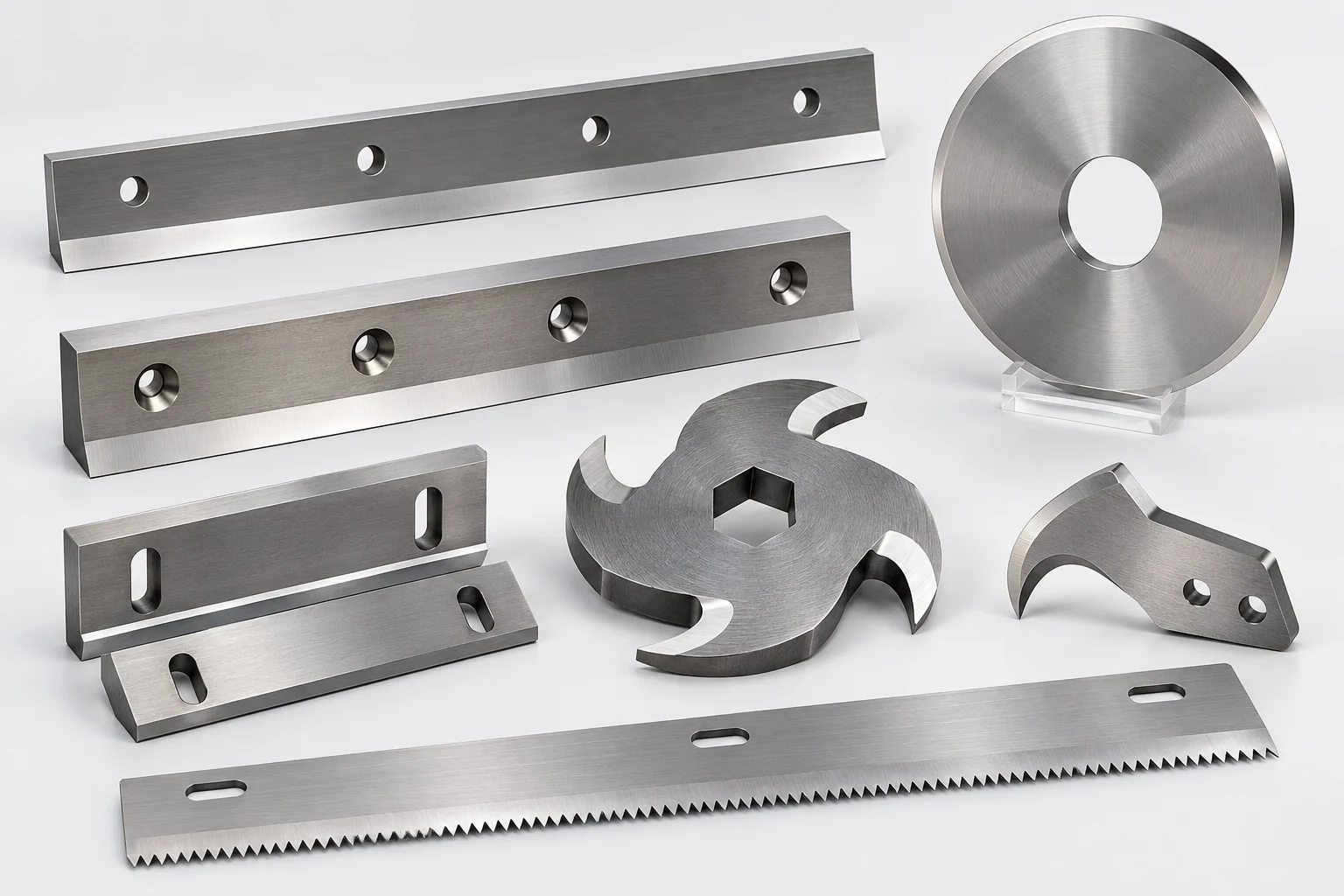
For the wider knife families used in recycling, converting and manufacturing, see the industrial knives guide. The sections below focus on web slitting and replacement specifications.
3 cutting types of slitter blades
1. Razor slitting blades
In a razor slitting assembly, the cutting edge passes through the web. Establish whether the web is supported at the cut or spans a gap, then identify the specified blade and clamp. Slots, holes and the exposed portion of the edge are part of that identification.
2. Rotary shear slitter knives
Rotary shear slitting uses cooperating top and bottom cutting edges. Specify the mating knife as well as the replacement part. Edge orientation, mounting and the installed holder need to agree before the supplier can evaluate a substitution.
3. Crush slitting knives
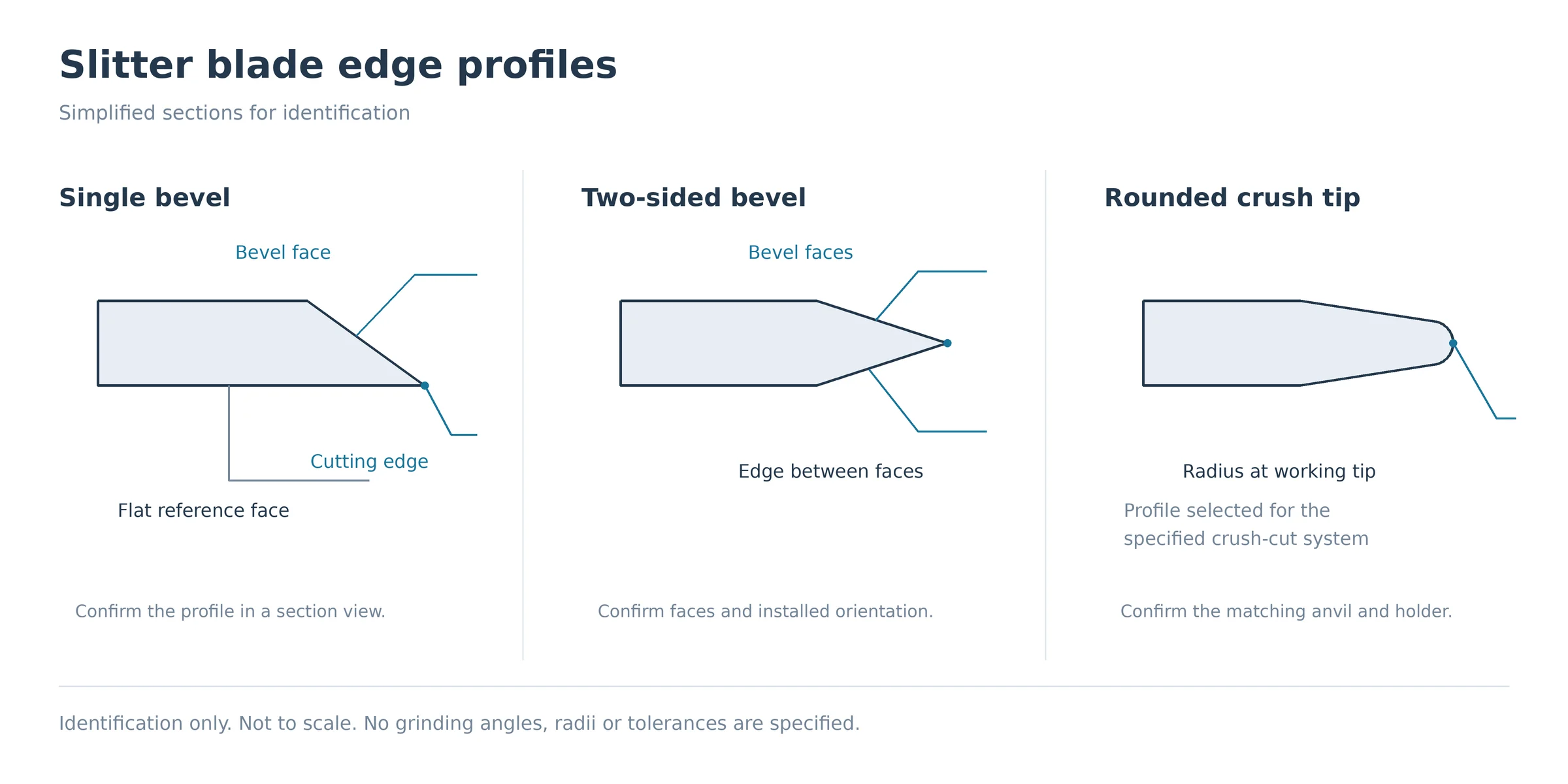
The cutting system determines which parts must work together. In a crush-cut arrangement, for example, the tip profile must suit contact with the anvil and the specified loading. Changing it into a razor-like point changes the design. Confirm the required profile before proposing a different grinding operation.
How to select slitter blades for your machine
Start with the required cutting result
Include its construction as well as its trade name. A supplier reviewing “plastic film” still needs to know the polymer, thickness range, layers, coatings and relevant fillers. For paper, provide the grade and thickness or basis weight used in production. For a laminate, identify the layers that must separate cleanly.
Explain what makes a slit unacceptable: loose fibres, visible edge damage, layer separation, incomplete cutting or an out-of-tolerance finished width. Supply a representative defect photograph and, where practical, an accepted sample for comparison.
For a wider comparison of cutting operations, see the plastic cutting blades guide.
Identify the complete installed assembly
For a replacement enquiry, photograph the installed arrangement from the machine’s approved inspection position. Identify the knife position and the component it works against. “Round blade for film” does not tell a supplier whether it is reproducing a shear knife, a crush knife or another rotary cutting design.
The holder can limit both blade diameter and the narrowest slit arrangement. A blade may fit its mounting shaft and still be unsuitable for the cartridge, guard or intended slit spacing.
| Assembly feature | What to check in the installed equipment |
|---|---|
| Cartridge and guard | Required new-blade diameter and permitted working envelope |
| Mounting and clamping | Bore fit, locating face, thickness and any additional features |
| Cutting relationship | Mating knife or anvil, edge orientation and specified engagement |
| Slit spacing | Holder dimensions and the machine’s approved knife arrangement |
| Regrinding allowance | Permitted remaining diameter, profile and adjustment range |
For NJDETE’s 200 mm catalogue entries, first identify whether the assembly calls for the 2 mm or 2.5 mm thickness. Changing that dimension is a separate approval question even when the bore is unchanged.
Record the holder model and installed cartridge with the knife reference. For an older line, ask the equipment supplier to confirm which documentation applies to the installed version. Keep approved modifications with that record.
Describe the reason for replacement
First distinguish gradual wear from local chipping, a damaged profile or a mounting problem. Send photographs of the removed edge and the part’s position in the machine. State whether the trouble affected one slit position, several positions or the entire web.
If the previous part met the requirement until its edge wore, use that approved specification as the reference. If the problem began after a blade, web, holder or setup change, record the change and the first affected run. Those two enquiries need different supporting evidence.
Agree on the specification before comparing offers
Keep part inspection and production evaluation connected. A dimensional report can establish conformity to the drawing. A controlled trial establishes whether the installed replacement meets the agreed cutting requirement under recorded conditions.
| Acceptance stage | Record to agree with the supplier |
|---|---|
| Part identity | Drawing revision, part reference and quantity of each variant |
| Mounting fit | Bore or mounting features, thickness, locating faces and specified tolerances |
| Cutting geometry | Approved profile, bevel orientation and any specified edge preparation |
| Material | Agreed designation and the documentation required by the order |
| Trial conditions | Web batch, construction, speed, holder and relevant machine settings |
| Production result | Accepted slit length or area, width checks, edge samples and reason for removal |
Choose a trial material that represents the job the knife must perform. If the line handles several constructions, identify which ones the trial covers. An accepted result on one film should not silently become approval for every laminate on the production schedule.
Retain a labelled accepted sample and record which slit position produced it. Define when samples will be taken during the trial. This makes a later discussion about gradual edge deterioration more useful than comparing an unlabelled roll with a photograph from another run.
Dimensions to confirm before ordering
NJDETE circular slitter blade sizes
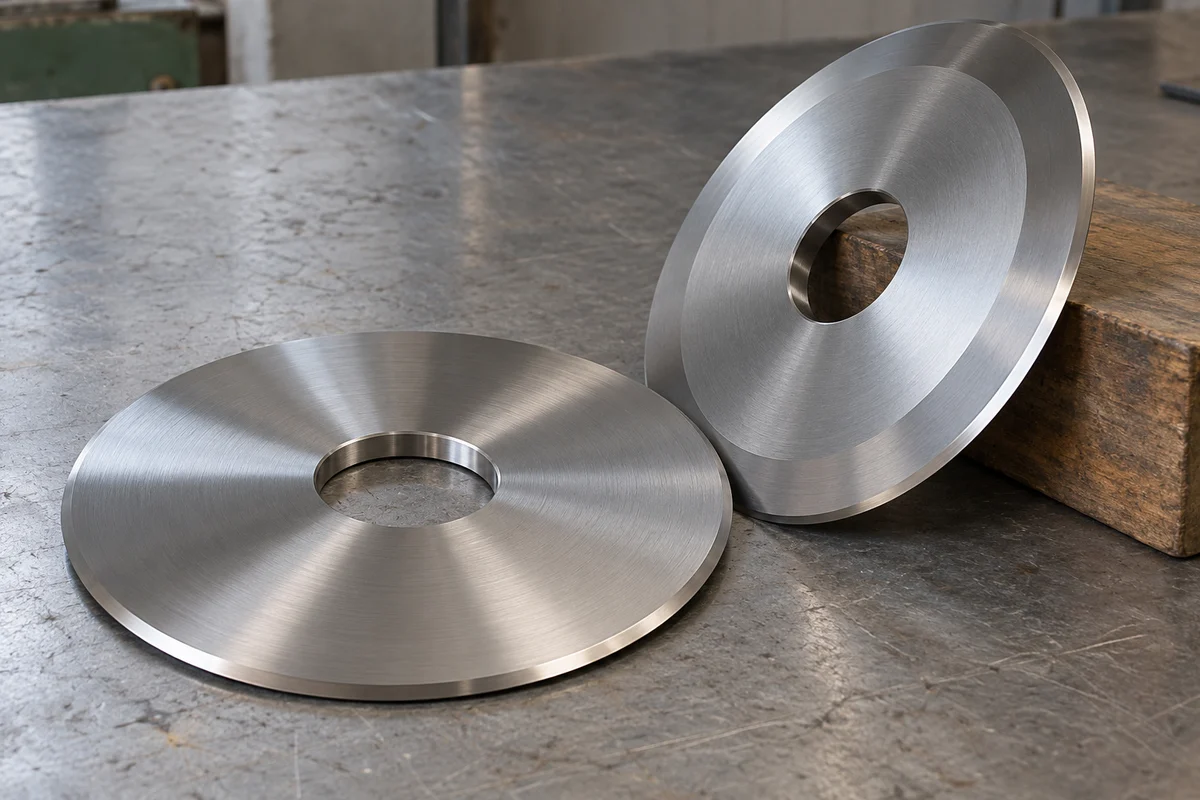
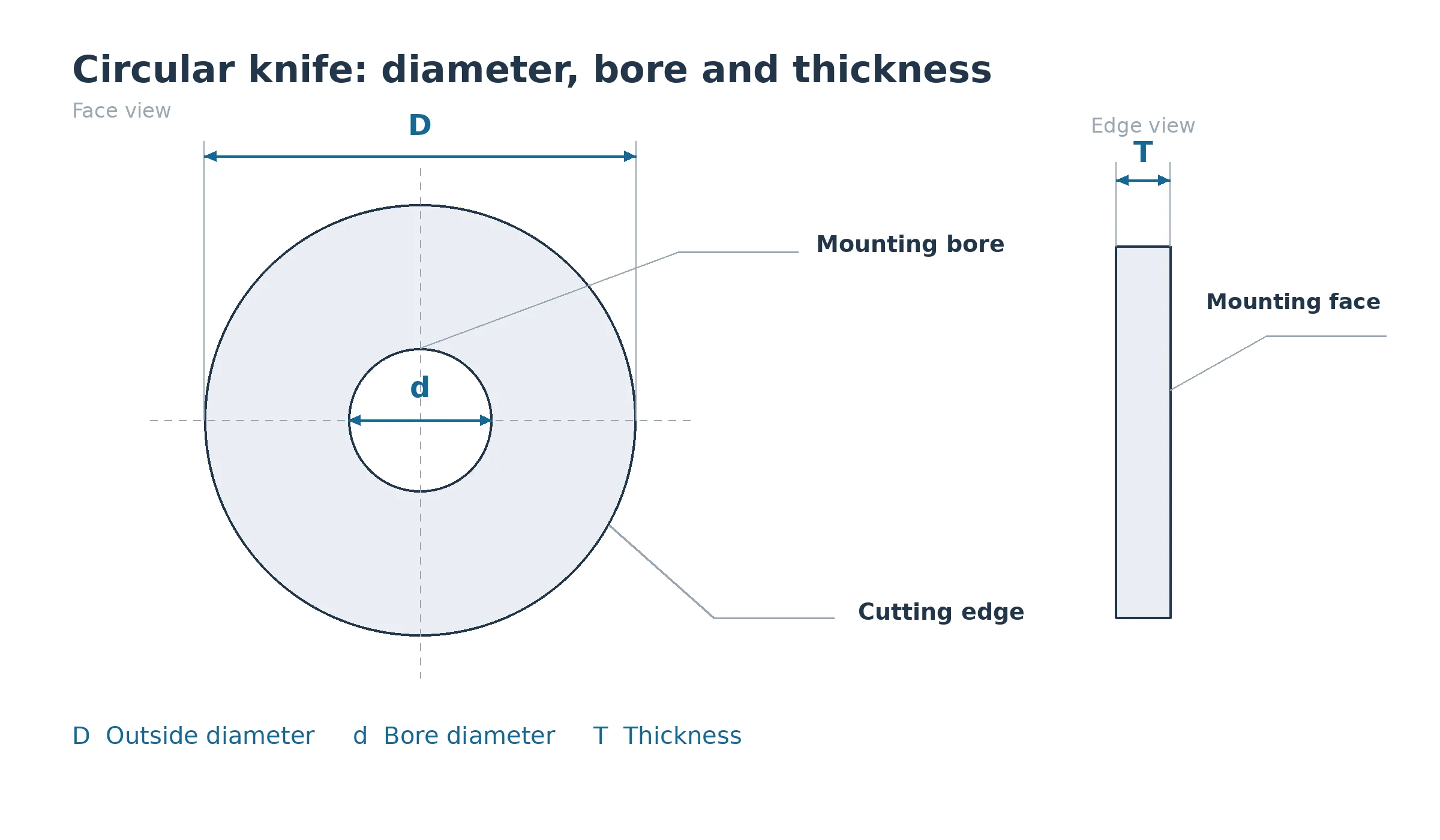
NJDETE’s circular knife catalogue lists the following tungsten carbide sizes for enquiry. Dimensions are expressed as outside diameter × bore × thickness, in millimetres.
| Catalogue size | Outside diameter | Bore | Thickness |
|---|---|---|---|
| 180 × 25.4 × 2 mm | 180 mm | 25.4 mm | 2 mm |
| 200 × 25.4 × 2 mm | 200 mm | 25.4 mm | 2 mm |
| 200 × 25.4 × 2.5 mm | 200 mm | 25.4 mm | 2.5 mm |
| 300 × 25.4 × 3 mm | 300 mm | 25.4 mm | 3 mm |
| 350 × 25.4 × 3 mm | 350 mm | 25.4 mm | 3 mm |
Use this table to identify a starting size, then check the complete drawing. These are catalogue dimensions. The table does not establish stock availability, compatibility with a particular holder or a shared bevel across all five sizes.
The two 200 mm entries show why thickness belongs in the order description. Their outside diameter and bore match, but the thickness differs by 0.5 mm. Confirm the approved assembly before substituting one for the other.
All five list a 25.4 mm nominal bore, equivalent to one inch. The nominal value still leaves the fit, locating features and mounting-face requirements to be specified. Do not derive a fit tolerance from the inch conversion.
The catalogue identifies paper, film, foil and tobacco-machinery cutting applications. Match the actual substrate and cutting arrangement to the drawing rather than treating that application list as approval for every listed size.
Check the mounting face and bevel
A circular knife needs more than an OD, bore and thickness measurement. Establish the seating face, mounting details and cutting-edge profile from the approved drawing. If there are handed variants, define the viewing direction and give each variant its own part reference.
A bevel description should agree with a section view. Do not translate a supplier’s phrase such as “double ground” into an assumed angle or edge preparation. Ask for the profile drawing when the wording leaves more than one interpretation.
With a worn sample, record the remaining diameter and known regrinding history. Keep those observations separate from the original design dimensions. A supplier should resolve the required finished geometry before copying wear or previous modifications into a new part.
The custom blade replacement guide explains how to organize mounting and profile information when the original drawing is incomplete.
Materials for slitter blades
NJDETE’s circular knife catalogue identifies tungsten carbide as the material family for the sizes above. It does not publish a specific carbide grade, a common dimensional tolerance or a measured life comparison. Set those requirements for the actual job before approving manufacture.
A material enquiry should therefore state the current grade where known, the web construction, the accepted production before removal and the defect that ended the run. Ask the supplier to identify the proposed change and the evidence needed to evaluate it.
If the objective is longer service between changes, define service life as production that still meets the agreed quality requirement. Record hours as well if useful, but explain whether the machine was cutting throughout those hours.
Slitter blade wear, sharpening and replacement
Investigate a poor slit edge
A defect photograph helps describe the problem. It rarely identifies a single cause by itself.
| Observation | Review with the responsible technician | Useful comparison record |
|---|---|---|
| Dust or a fuzzy edge on several slits | Knife condition, specified overlap, side load and web tension | Edge samples, current settings and previous accepted run |
| New knife chips soon after installation | Mounting, mating knife, engagement and signs of impact | Damage location and installation record |
| Cutting worsens after regrinding | Finished profile, remaining diameter, runout and setup | New-versus-reground part measurements |
| One position repeatedly performs worse | Local holder and mating component condition | Position map and comparison with adjacent slits |
Several conditions can produce similar symptoms. Use the table to record what happened, compare affected positions and identify the inspection needed. A photograph of chipping or a dusty edge is not enough to prove that the material grade caused the problem. Follow the applicable machine procedure when checking the assembly.
Keep settings from different machines separate. An overlap figure or pressure copied from an unrelated holder is not a replacement for the instructions governing your assembly. Inspection, removal and adjustment should be carried out by qualified personnel under the machine’s isolation and setup procedures.
Check the assembly limits before regrinding
Regrinding also needs to stay within the machine’s specified adjustment and minimum-diameter limits. A knife’s remaining material does not by itself establish that the reground part can be set correctly in the assembly.
Confirm the required profile after sharpening and keep the inspection report with the part reference. If the finished geometry falls outside the approved working range, ask the responsible technician to review replacement rather than treating a newly ground edge as proof of suitability.
Keep a replacement record that supports the next purchase
After fitting replacement slitter blades, retain the part identity and production record together. A repeat order becomes easier to evaluate when purchasing can connect the supplied specification to the accepted cutting result.
| Record field | What to retain |
|---|---|
| Machine and position | Model, holder, knife position and mating component |
| Supplied knife | Drawing revision, catalogue size where applicable and order identity |
| Material run | Substrate batch, construction and thickness range |
| Installation | Applicable setup record and approved differences from the previous run |
| Result | Accepted output, dated edge samples and the reason for stopping or removal |
| Follow-up | Inspection findings and the next approved action |
Complete the record during the replacement and production run. If the web batch, mating knife or settings changed, preserve those details with the result so a later comparison can account for them.
How to compare slitter blade costs
For quotation comparison, use the same acceptance conditions. Calculate tooling cost against accepted output over a common production quantity. Include sharpening, replacement labour, measured rejects and relevant downtime costs where records support them. Keep unmeasured assumptions visible.
| Cost component | Basis for a fair comparison |
|---|---|
| New knives | Price and quantity of the complete approved knife arrangement |
| Sharpening | Recorded sharpening cost and usable cycles within the approved limits |
| Changeover | Recorded labour and lost production for the same job |
| Rejects | Measured output rejected against the same slit-quality requirement |
| Accepted output | Length, area or another agreed unit that met the requirement |
A useful comparison is recorded tooling and changeover cost ÷ accepted output over the same production period. State which costs are included and keep the unit consistent. A price per knife and a cost per accepted roll answer different purchasing questions.
Where the records are incomplete, request a controlled trial and use the replacement record above. Do not turn an estimated life improvement into a measured saving.
Slitter blade RFQ checklist
Send one enquiry package containing:
- Machine and position: machine model, holder or cartridge model, knife position and mating component.
- Part definition: original part number or approved drawing, revision, units and quantities of each variant.
- Web information: material, construction, thickness range, coatings or fillers and representative samples where available.
- Current condition: existing knife material if known, regrinding history, defect photographs and reason for replacement.
- Acceptance and delivery: inspection requirements, proposed trial, destination and required date.
Ask each supplier to identify any proposed substitution, unresolved dimension or exclusion. Resolve those points before comparing the totals as equivalent offers.
Frequently Asked Questions
Are slitter blades and circular knives the same?
The terms overlap. Circular knives describe a shape used in several operations, while slitter blades also include razor-type designs. Specify the cutting method, machine and part identity when ordering.
Can I replace a knife with one of the same outside diameter?
Check the bore or mounting features, thickness, seating face, bevel and holder requirements as well. Matching the outside diameter leaves those features unresolved. Compare the complete approved specification.
Is carbide the best choice for every slitting application?
Select the material around the actual wear or damage mechanism and the complete knife design. A proposed carbide option needs a grade, geometry, compatibility review and evaluation plan. The material name alone does not establish a better result.
Does more overlap give a cleaner shear slit?
More overlap should not be assumed to improve the cut. Use the setting specified for the installed assembly and material, and evaluate the resulting edge. If it changes after regrinding or replacement, record that change before comparing the knives.
Should both shear knives be replaced together?
Inspect the mating knife and follow the equipment’s replacement and regrinding requirements. Document the condition of both components when comparing performance. Replacing only one part without recording its partner makes the result harder to interpret.
Can a used sample replace a drawing?
A sample can start the identification and measurement process. Wear, previous sharpening and modifications still need to be resolved. Approve the resulting part specification before manufacture, and retain it for repeat orders.
Discuss your slitter blade replacement with NJDETE
For a drawing-based enquiry, contact NJDETE with the part and application details. Identify the catalogue size where it matches your drawing, then include the bevel, mounting and material requirements. Use the initial review to establish manufacturing feasibility and the specification that would govern a quotation.
You can also browse NJDETE’s custom blade categories to identify the relevant blade family. A catalogue size or category name still needs to be matched to the actual part.