

Single-Shaft vs Double-Shaft Shredder for Plastic Waste: How to Choose
Release time: 2026-10-12
A plastic shredder can break down your waste and still leave you with the wrong material for the next process. Pieces may be too large for a granulator, loose film may feed unevenly, or whole containers may need more preparation than you expected.
Start with two questions: how will the machine engage your waste, and what output must it deliver? A screened single-shaft configuration is worth evaluating when controlled feeding and a defined discharge fraction matter. A primary double-shaft configuration is worth evaluating when the main task is gripping bulky or irregular items and reducing them before further processing.
Neither choice follows from shaft count alone. The rotor, cutters, feeding arrangement, sizing equipment and actual waste determine whether a particular machine suits your operation.
The Main Difference Is How Material Is Fed and Released
In a typical screened single-shaft shredder, a rotor cuts against fixed counter-knives. A pusher presents material to the rotor, and a screen retains material until it can pass through the openings.
A typical primary double-shaft shredder uses opposing cutter shafts to engage and reduce the feed. Many such configurations discharge without a sizing screen, so pieces can vary more in shape and dimensions. Feed assistance, screening and recirculation arrangements vary by machine.
Double-shaft, twin-shaft and dual-shaft are commonly used names for two-shaft machines. When comparing quotations, check the actual arrangement rather than relying on the product name.
| Purchasing question | Typical screened single-shaft configuration | Typical primary double-shaft configuration | What this means for you |
|---|---|---|---|
| How does waste reach the cutting zone? | A pusher presents material to a rotor | Opposing cutters engage the material; feed assistance varies | Check whether your normal feed can be presented consistently |
| How is discharge controlled? | A screen retains material for further cutting | Many primary configurations release a less controlled fraction | Define what your next machine can accept |
| What needs inspection during maintenance? | Rotor knives, counter-knives, screen and feed mechanism | Cutters, spacers, shafts and associated components | Compare access, adjustment and replacement tasks |
| What influences capacity? | Feed behavior, rotor, screen and complete drive configuration | Engagement, cutter arrangement, feed behavior and complete drive configuration | Compare output under equivalent material conditions |
| What should you avoid assuming? | A screen guarantees identical particles | Cutter thickness fixes every output dimension | Review an output sample against an acceptance requirement |
The distinction is useful for shortlisting, not a rule that every single-shaft or double-shaft machine follows. A screened or recirculating two-shaft system needs to be assessed as that complete system.
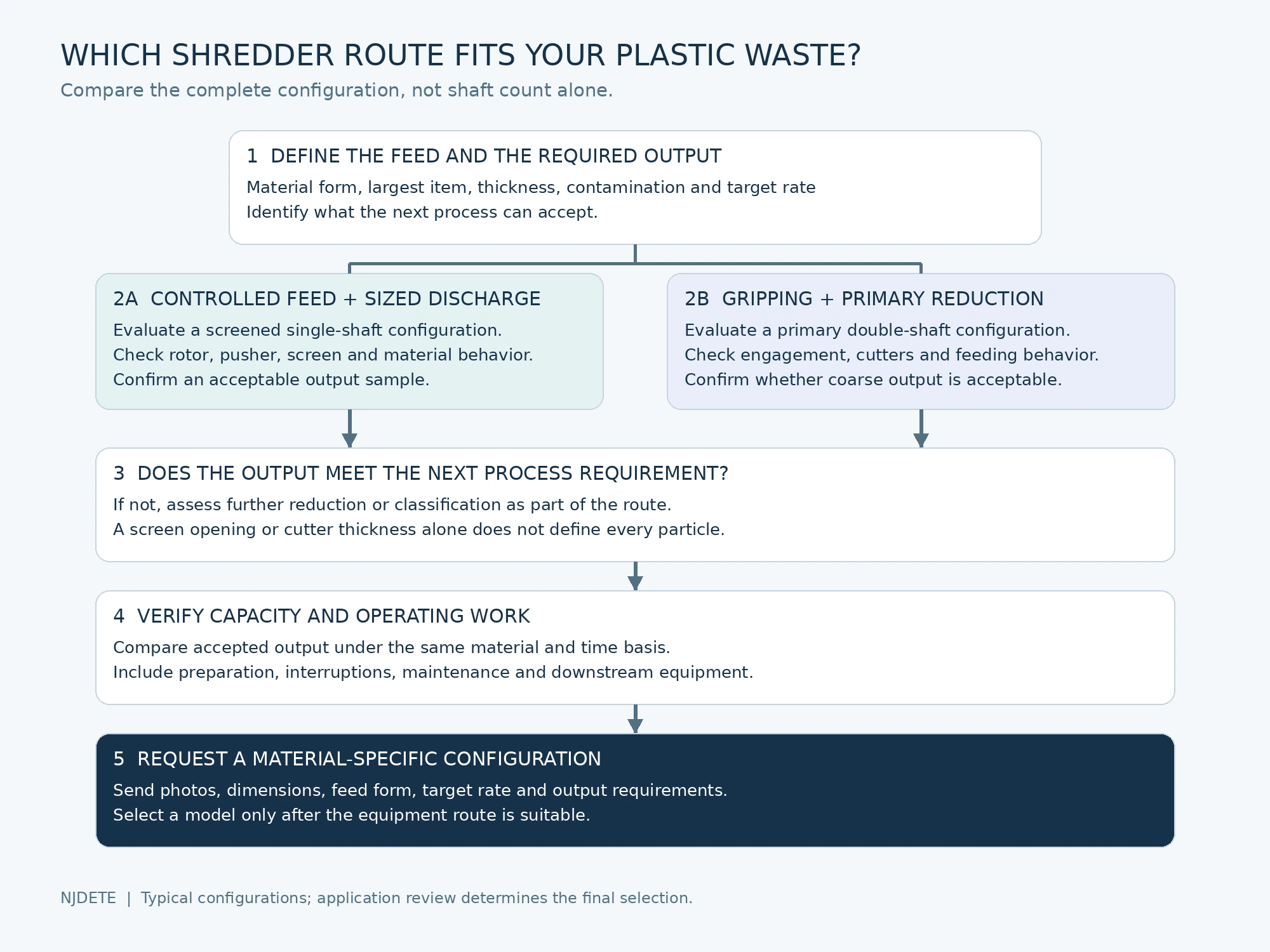
Start with the feed and required output, then compare suitable configurations under the same conditions.
Choose Around the Form of Your Plastic Waste
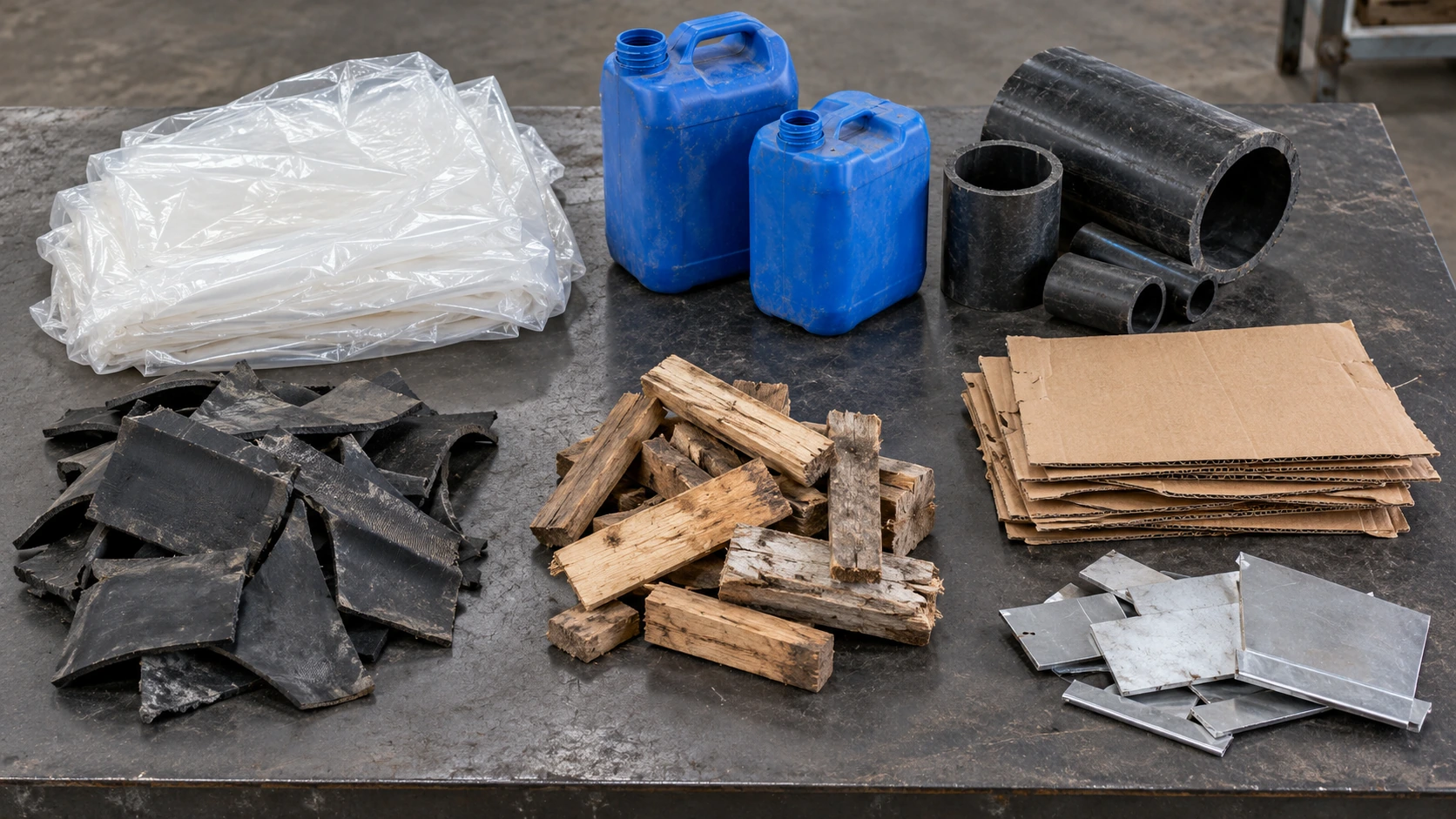
A polymer name does not describe the feeding problem. Thin PE film, a hollow PE drum and a dense PE production lump can require different handling and cutting arrangements.
Use the following questions to establish which configurations deserve further evaluation.
| Your waste | Main selection question | What to include in the application review |
|---|---|---|
| Loose film or woven bags | Can the feed remain engaged without excessive wrapping or bridging? | Typical strip lengths, loose or compacted form, moisture and attachments |
| Hollow drums, crates or containers | Can complete items enter and engage without unplanned preparation? | Dimensions, reinforced sections, nesting, residues and handles |
| Pipe and profiles | Is whole-piece feeding practical in the proposed orientation? | Length, outside dimensions, maximum wall thickness and fittings |
| Sprues and molding rejects | Do the parts behave like thin runners or thick sections? | Thickest junctions, part weight, fillers and metal inserts |
| Dense lumps or purgings | Can the configuration handle the thickest routine sections? | Composition, dimensions, section thickness and unit weight |
| Mixed production scrap | Can the feed be characterized well enough for a reliable specification? | Proportions, contaminants and the most difficult normal items |
For film, evaluate feeding and wrapping control before treating additional motor power as the solution. For large hollow items, investigate engagement and preparation labor. For dense waste, settle the permissible section and cutting load with the supplier.
For material-specific questions, see the plastic waste shredder selection guide and the plastic film shredding guide.
Let the Next Process Define Your Output Requirement
The correct shredder output is material your next operation can use. “Small pieces” is not a sufficient specification if another machine must receive them.
For storage or transport, your main concern may be handling and volume reduction. For washing, separation or granulation, receiving equipment may impose limits on piece dimensions, shape or contamination. Set those requirements before approving a shredder configuration.
A sizing screen helps control what leaves a suitable cutting system. It does not establish every dimension of a flexible or elongated particle. Likewise, cutter width in a primary double-shaft machine does not guarantee a uniform final flake size.
If you need a tighter fraction than primary shredding delivers, evaluate a further size-reduction or classification stage. Do not add another machine automatically: first establish whether the proposed output already meets the receiving process’s requirements.
| Required result | What to request from the supplier |
|---|---|
| Reduced bulk for handling | Output suitable for the agreed storage, transport or feeding method |
| Feed for an existing granulator | Material that enters it without unexpected cutting or sorting |
| Material for washing or separation | Output meeting the receiving system’s defined limits |
| A specified final fraction | An output sample and an agreed measurement or classification method |
Compare Throughput Under the Same Conditions
A capacity figure is only useful when you know the material and operating conditions behind it. Two machines carrying the same kg/h claim may have been assessed on very different waste.
Before comparing output, align the feed form, dimensions, contamination, feeding method, discharge requirement and time basis. Record interruptions and preparation work, especially where one option requires pre-cutting and another accepts whole items.
For a simple comparison:
Accepted output rate = accepted output mass ÷ elapsed time.
An illustrative run producing 240 kg of accepted material in 60 minutes gives 240 kg/h. If only 45 minutes were counted as running time, the running-time rate would be 320 kg/h. Both calculations can be mathematically correct; they answer different questions. The figures here are examples, not NJDETE test results.
For production planning, include the interruptions that belong to normal operation. For cutting-system analysis, a separate running-time measure may also help. Keep the definitions visible so an optimistic rating does not become an unrealistic shift target.
Motor power belongs in the configuration review, but it does not prove throughput. Check the complete feed, cutting, drive and discharge system against the material you intend to process.
Include Preparation and Maintenance in the Comparison
Purchase price alone can hide differences in work required before and after shredding. Compare the whole route that produces usable material.
| Cost or task | What to establish |
|---|---|
| Feed preparation | Whether items require opening, cutting, sorting or other preparation |
| Operating labor | Feeding, monitoring, clearing and material handling tasks |
| Wear parts | Knife or cutter sets, counter-components, spacers and screens where fitted |
| Adjustment and replacement | Required procedures, access and planned maintenance time |
| Further processing | Whether another stage is needed to meet the final requirement |
| Availability | Spare-part identification and lead times confirmed for the proposed configuration |
Ask which components can be repaired, sharpened, rotated or replaced, and under what limits. Do not assume every knife offers the same number of reusable edges or sharpening cycles.
If two proposals use different processing stages, compare the total configuration. A lower shredder price may not remain lower after including preparation equipment, downstream sizing and additional labor.
When to Review NJDETE’s Double-Shaft Range
NJDETE’s current published machine pages focus on double-shaft shredders. Review that range when your application calls for a two-shaft reduction stage; this comparison does not imply that every listed model can process every waste category.
The website provides compact and larger configurations with different chambers, drives and cutter arrangements. Use the double-shaft shredder model comparison to examine those differences after deciding that the machine type fits your process.
Then use how to choose a double-shaft shredder for the model-level questions: feed dimensions, configuration, operating schedule and downstream requirements. A chamber dimension describes part of the cutting space; it is not a guarantee that an equally sized object can be processed successfully.
For equipment already in service, double-shaft shredder blades are a separate replacement-parts requirement. If your line includes a plastic crusher or granulator, NJDETE’s plastic crusher blades page concerns its cutting knives, not a complete downstream machine.
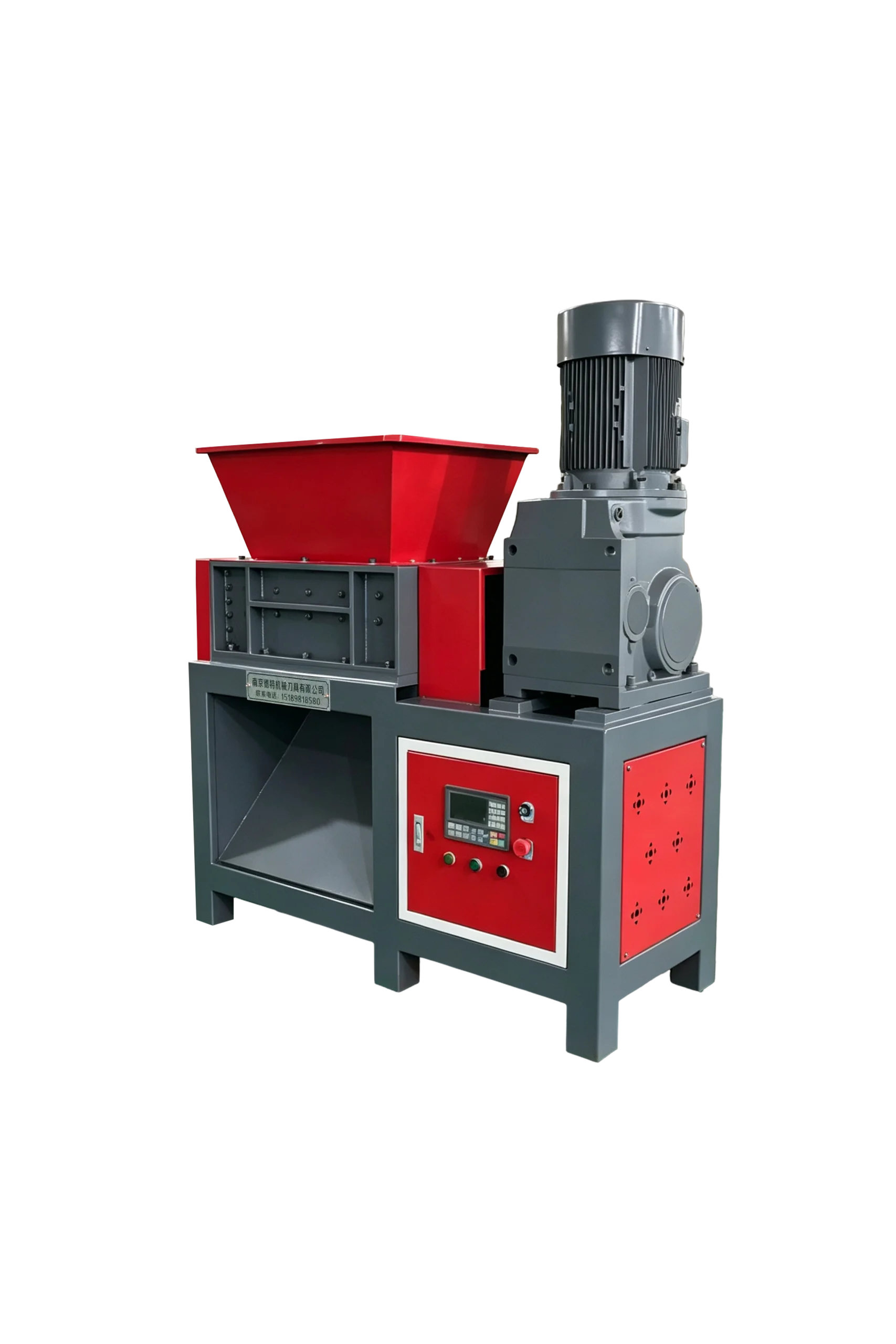
The NJDETE 500 model product image. Select the configuration from the material and process requirements, not the model name alone.
Watch the Material Feeding and Discharge
When reviewing a demonstration, look at how the material enters the cutting chamber and what leaves the machine. A video is useful for observing those actions; it does not establish capacity unless the material, output quantity and elapsed time are documented.
Watch the supplied video on YouTube
Make the Shortlist With Four Decisions
Before you choose a model, settle these four points:
- Feeding: can the proposed arrangement engage your normal waste, including the difficult routine items?
- Output: does the discharge meet the next process’s requirements?
- Capacity: can the complete system sustain the required usable output under stated conditions?
- Operating work: are preparation, maintenance and further processing included in the comparison?
Shortlist a screened single-shaft configuration when controlled presentation to the rotor and size-controlled discharge are central requirements. Shortlist a primary double-shaft configuration when engagement and initial reduction are the main tasks and the proposed discharge is acceptable.
Where both routes appear possible, compare them against the same material and acceptance criteria. The better purchase is the configuration that completes your process requirement, not the one with more shafts or a larger motor.
What to Send for a Material-Specific Review
Send photographs of the waste, maximum dimensions, typical unit weight, section thickness and any known contaminants. Add the target output rate, output requirement, operating hours and the next process.
State which facts are measured and which are estimates. If you are replacing an existing machine, describe what currently limits production: feeding, cutting, discharge, preparation work or maintenance.
Send NJDETE your material details and process requirements to discuss a suitable double-shaft configuration. If another equipment route is needed, identify that requirement before committing to a model.
Frequently Asked Questions
Is a twin-shaft shredder different from a double-shaft shredder?
The names commonly refer to a two-shaft design. Specifications and system arrangements still differ, so compare the actual cutters, feed system, drive and discharge controls rather than the label.
Can a single-shaft and double-shaft machine be compared at the same motor power?
Power alone is not an equivalent-performance comparison. Match the material, feeding method, required output and complete configuration, then compare accepted output using the same time basis.
Can I decide from photographs without a material sample?
Photos can support an initial review, particularly when dimensions and composition are provided. They may not reveal toughness, contamination or feeding behavior. Define which application questions remain unresolved and how they will be checked before final approval.
Should I buy a shredder and granulator together?
Only if the required process needs both stages. Define the final output and assess whether one configuration can achieve it or whether further reduction is necessary. A blade supplier’s product page is not evidence that a complete granulator is included in the quotation.