

Tire Shredder Machine: Feed, Output and Buying Checks
Release time: 2026-10-27
Send NJDETE your tire feed and output requirements for an application and configuration review. Include photographs showing the complete tire, sidewall, tread and any existing preparation.
Define the Tire Feed Before Selecting a Machine
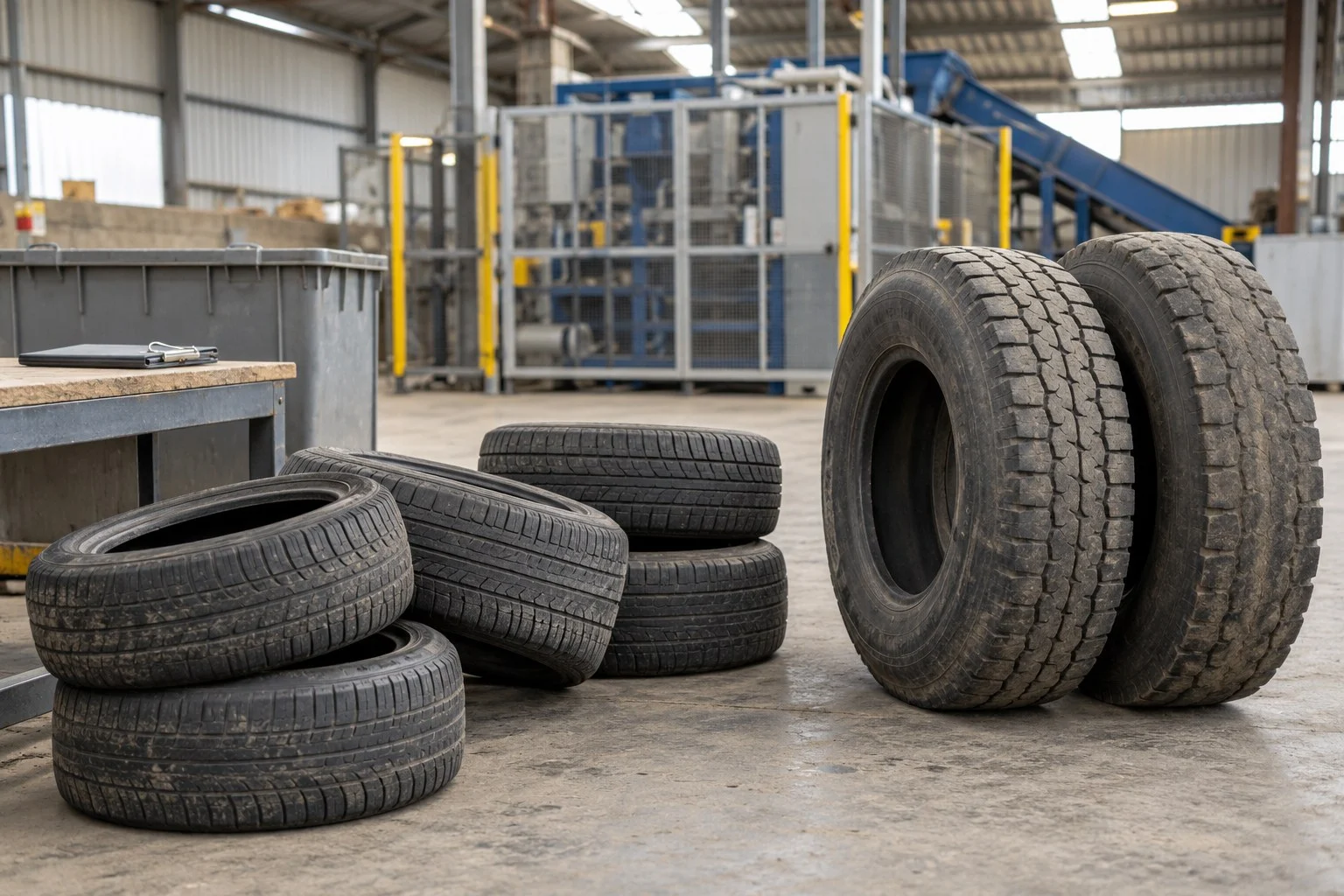
“Waste tires” covers several materially different jobs. Passenger-car, truck and off-the-road tires differ in dimensions and construction. Whole tires, sidewall rings, tread sections and existing shreds also present different loads to the feed and cutting system.
Record the normal mix and the largest or most difficult item within the agreed specification. If a proposal excludes a tire category, identify how those items will be separated and handled in the actual operation.
| Incoming feed | Information to provide | Selection question |
|---|---|---|
| Whole passenger tires | Outside diameter, width, typical mass, bead condition and normal mix | Is the complete tire accepted without the preparation excluded from the quote? |
| Truck or larger commercial tires | Largest dimensions, sidewall and tread construction, item mass and frequency | Has the proposed build been assessed for this category and its reinforcement? |
| Off-the-road or unusual tires | Individual dimensions, construction, quantity and planned preparation | Does the project require a separate preparation or processing route? |
| Prepared tire sections | Cut form, maximum section, bead removal status and exposed reinforcement | What upstream preparation is required to reproduce the quoted feed? |
| Existing tire shreds | Size range, steel and textile content, contamination and bulk presentation | Is the next machine reducing size, liberating reinforcement, or both? |
Ask what the supplier means by whole-tire processing. Does the trial tire arrive with the same bead condition and reinforcement as your supply? Is pre-cutting included? Is an oversize tire removed from the test batch? These details affect both equipment selection and labour.
A tire debeader addresses the bead component when the selected process requires it. It does not, by itself, remove all belt steel or textile reinforcement. Whether to use one must be agreed for the proposed feed, machine and process rather than treated as a universal prerequisite or an unnecessary extra.
Choose the Output Before the Processing Route
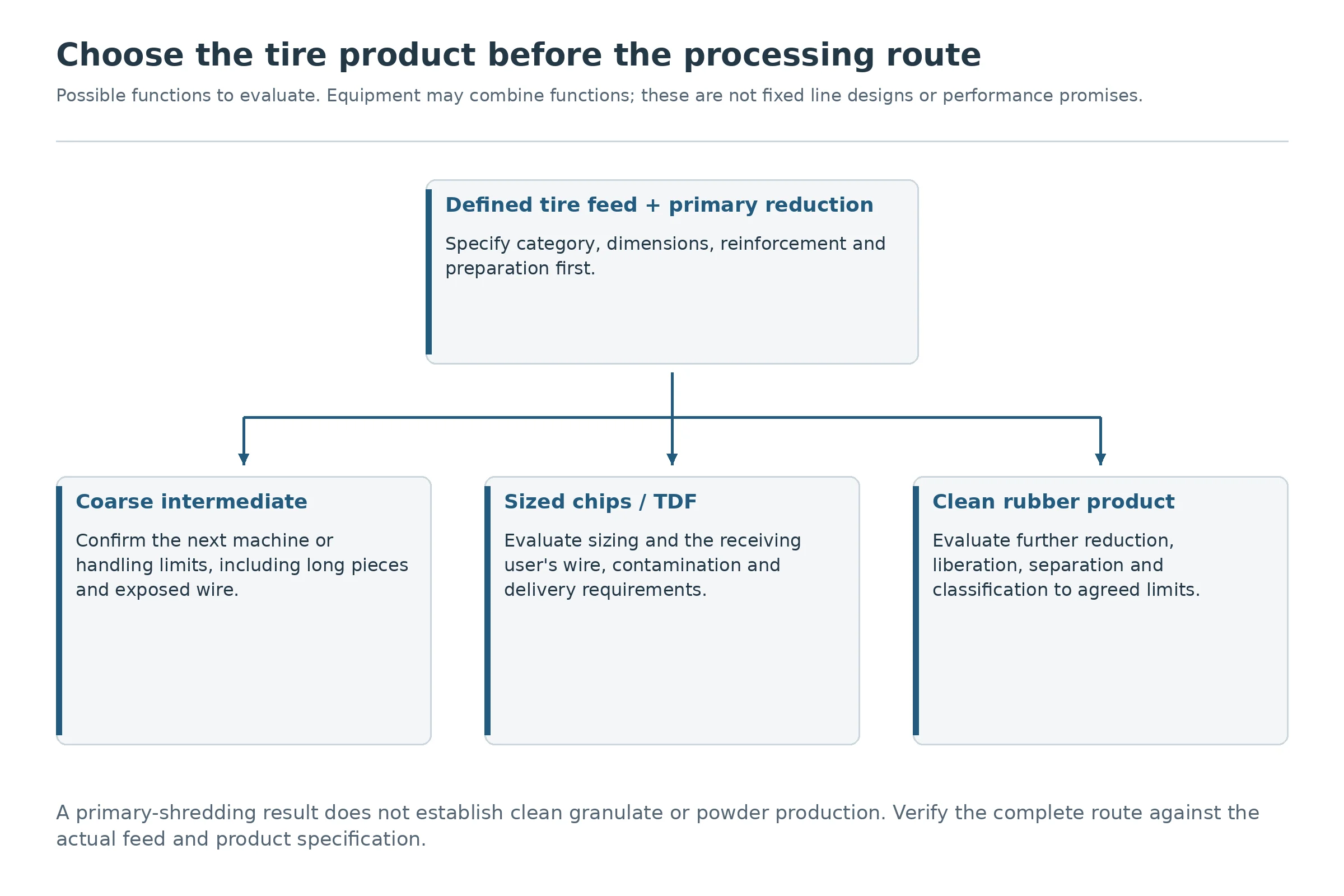
Obtain the receiving process’s written requirements before asking for a final equipment proposal. “Small pieces” is too vague to distinguish a usable product from material that needs further work.
| Required product or task | Requirements to define | Process functions to evaluate |
|---|---|---|
| Coarse reduction for handling or another shredder | Maximum dimensions, long pieces, acceptable exposed wire and receiving equipment limits | Primary reduction and the required handling arrangement |
| Tire-derived fuel, TDF | Receiving user’s size distribution, wire condition, contamination and delivery requirements | Reduction, sizing and any separation required by that user’s specification |
| Rubber chips or mulch | Defined size distribution and permitted residual steel, textile and other material | Further size reduction, reinforcement liberation, separation and screening as required |
| Clean rubber granulate | Particle-size range, fines, residual steel and fibre limits, sampling and test methods | A suitable reduction, liberation, cleaning and classification route |
| Fine rubber powder | Actual particle-size distribution and contamination requirements | Additional suitable fine-reduction and classification stages |
These are functions to specify, not a fixed bill of equipment. Different suppliers combine them differently. Compare the resulting feed and accepted product rather than assuming that a particular number of machines establishes equivalence.
For tire-derived fuel, the receiving plant determines the acceptance conditions. Do not borrow a size or wire requirement from another customer’s application. Similarly, “wire-free” and “clean rubber” need a measurable residual-content requirement and method; the phrases alone do not set a purchasing tolerance.
Separate Size Reduction From Steel Removal
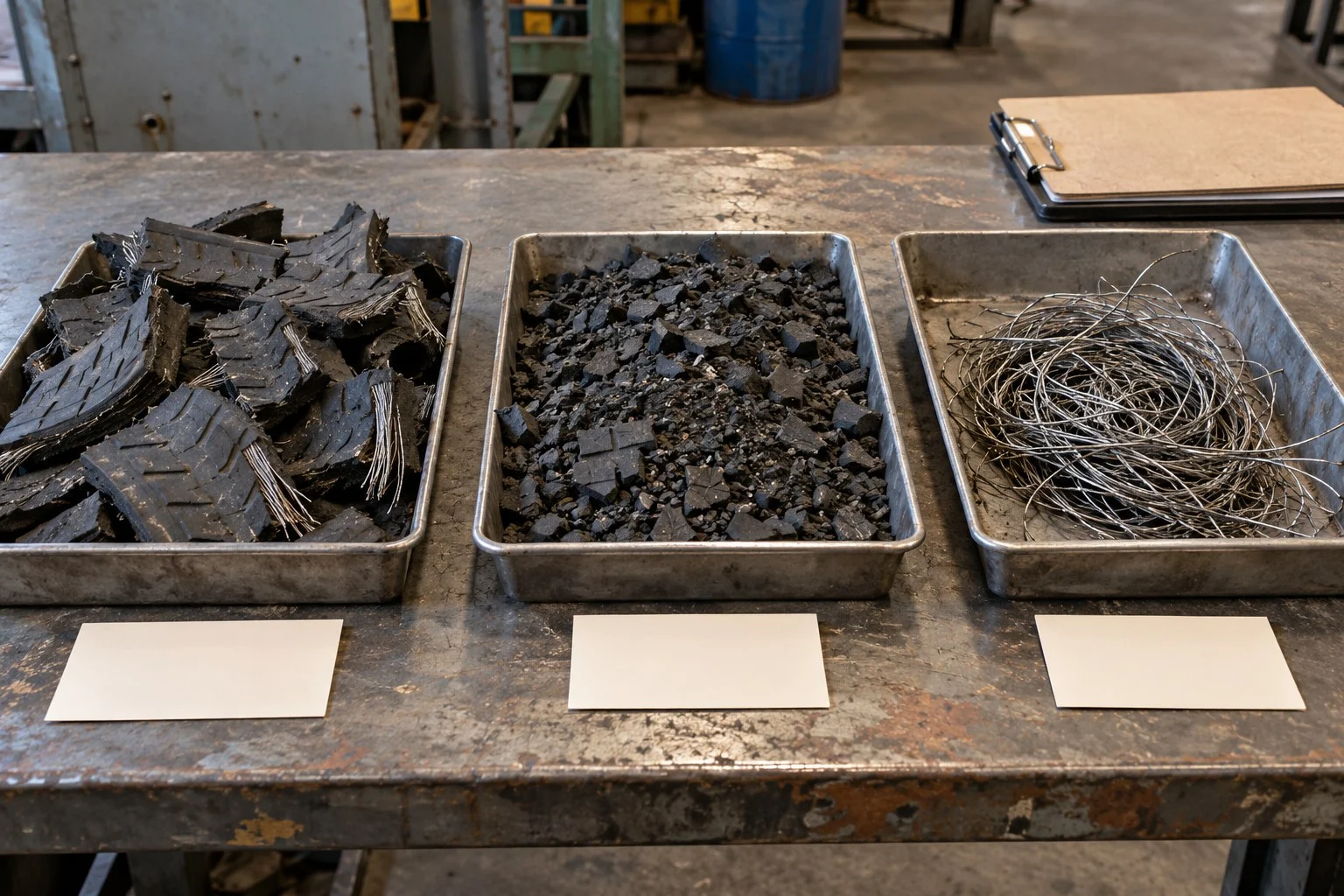
A primary tire shredder reduces the feed. Steel separation depends on the state of the reinforcement and the complete downstream arrangement. Steel still bonded within a rubber piece is different from liberated wire that a separation stage can collect.
Ask where steel becomes sufficiently liberated, how it is collected, and what happens to rubber carried into that stream. Ask the same questions about textile fibre and fines. A product photograph does not quantify these streams or prove the quality of the full production batch.
Screening classifies material for the agreed route. Oversize may be returned for further processing where the system is designed for it. That return flow consumes handling and processing capacity, so a quoted first-pass feed rate cannot automatically become the final accepted-product rate.
A rubber granulator or mill may belong downstream, depending on the incoming shreds and final product. A machine described as a plastic granulator should not be assumed suitable for steel-bearing tire pieces. The feed acceptance conditions and cutting system need to be established for that specific equipment.
What NJDETE’s Published Information Establishes
NJDETE’s catalogue includes waste tires among its application examples and lists waste tires within a broader bulky-waste system description. These references support an application discussion. They do not identify a verified whole-tire capacity for each machine in the published range.
| NJDETE reference | Published information | What the project still needs |
|---|---|---|
| Waste-tire application example | Waste tires are included in the catalogue’s material examples | Tire category, dimensions, reinforcement, preparation and the proposed configuration |
| Bulky-waste system description | Primary reduction, chain conveying, a manual sorting platform, air separation, recovered-material conveying and dust-handling modules are listed | The modules and process actually needed for the intended tire product |
| Published machine and blade range | Machine configurations and replacement blade families can be reviewed | Order-specific tire compatibility, complete scope and representative performance evidence |
The bulky-waste module list is not a documented crumb-rubber line. A reference to sorting or dust handling does not establish clean rubber yield, steel recovery or a particular discharge size. Those results need the specified process and actual evidence.
The NJDETE published model guide is useful for identifying machine configurations. Chamber dimensions, a model number and motor power do not independently establish whole-tire acceptance. Use the industrial material guide to prepare the application information, then have the proposed build reviewed against it.
Compare Tire Shredder Prices on a Complete Scope
A tire shredder machine price can cover a stand-alone primary machine or a much broader system. Obtain a defined supply list and exclusions before comparing totals.
| Quotation item | Resolve in writing |
|---|---|
| Feed preparation | Tire categories accepted; pre-cutting, debeading or sorting required; who supplies it |
| Reduction and sizing | Which stages are included; accepted input at each stage; screens and return handling |
| Separation | Steel and fibre duties, collection points, required product quality and test methods |
| Handling | Feed and discharge equipment, bins, transfer heights and control interfaces |
| Installation and utilities | Electrical supply, included auxiliaries, foundations, installation and commissioning scope |
| Wear parts and service | Exact cutter and wear-part scope, inspection basis, maintenance requirements and replenishment arrangements |
| Performance and delivery | Representative trial, accepted-output criteria, documents, packing and delivery basis |
If one proposal starts with whole tires and another starts with prepared sections, price the missing preparation task before comparing them. If one ends with coarse shreds and the other ends with cleaned granulate, resolve the product difference first.
For a small tire shredder inquiry, specify whether “small” refers to floor space, batch quantity, purchase budget or required output. It does not establish permission to feed a whole tire. Likewise, a lower daily target does not remove the need to handle the largest accepted item.
Convert the Daily Product Target Into a Feed Requirement
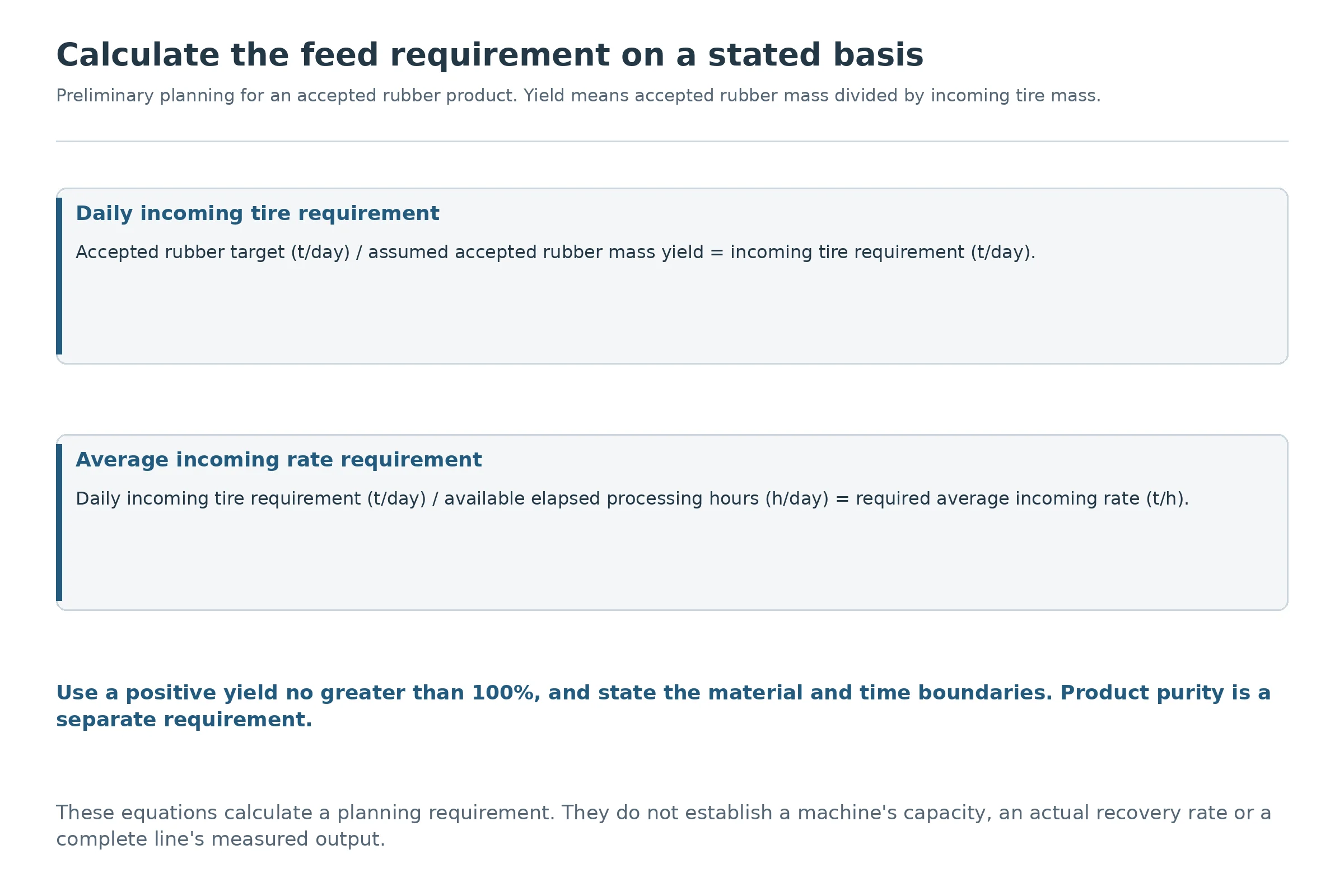
A plant selling accepted rubber granulate needs to distinguish incoming tire mass from accepted rubber mass. Steel, textile, rejects and other streams affect that relationship. Product purity and mass yield are also different quantities.
For preliminary planning, define an assumed accepted rubber yield as accepted rubber mass divided by incoming tire mass, on a consistent basis.
The calculations below use metric tonnes (t). Confirm the mass unit in each quotation before comparing rates.
Required daily incoming tire mass = daily accepted rubber target ÷ assumed accepted rubber yield.
Required average incoming rate = required daily incoming mass ÷ the available elapsed processing hours.
For example, a hypothetical plan requiring 4 tonnes/day of accepted rubber, assuming 65% accepted rubber yield and 6 elapsed processing hours/day, implies approximately 6.15 tonnes/day of incoming tires and 1.03 tonnes/hour of average incoming capacity. Accepted rubber output over that period would average approximately 0.67 tonnes/hour.
These are planning calculations from stated assumptions, not NJDETE test results or a recommended plant capacity. The 65% assumption is not a product-purity claim or a universal recovery value. Confirm yield and performance on representative feed before relying on the calculation for an order.
Use elapsed hours that reflect the production boundary being planned. If preparation, material changes or normal collection interruptions are outside that period, account for them separately. One machine’s short-run processing rate does not establish the complete line’s daily accepted output.
Request a Trial That Represents the Difficult Feed
Agree which tire categories and preparation conditions the trial must represent. Identify excluded material explicitly and keep the tested build, feed and product records together. Ask for evidence of the claimed route, not just a short clip of a tire entering a hopper.
| Trial question | Evidence to retain |
|---|---|
| Was the actual feed tested? | Tire category, dimensions, mass, reinforcement, preparation and batch identity |
| Was the proposed build used? | Unit and configuration identity, cutting system, screens and included downstream stages |
| How much usable product was produced? | Input, accepted rubber or other agreed product, separated streams, rejects, retained material and elapsed time |
| Did the product meet the buyer’s requirements? | Representative samples, distribution and residual-content results using agreed methods |
| What interrupted production? | Preparation, feed changes, return flow, collection, stoppages and adjustments included or excluded |
Record the mass and disposition of the other streams so rubber yield is not confused with total discharge. Reprocessed oversize is counted once when it finally becomes accepted product; repeated passes still consume time.
Use the shredder factory acceptance test guide for the complete weighing, timing, evidence and open-item record. This tire-specific brief supplies the feed and product requirements that a general acceptance checklist cannot infer.
Check the Installation and Operating Interfaces
Compare the space needed for the complete working process, including incoming tires, preparation, feed handling, collection, maintenance access and separated streams. A machine’s shipping dimensions leave out much of that task.
Identify the power supply and the auxiliaries inside the quoted boundary. If energy consumption matters to the decision, define which equipment is metered and calculate against the agreed accepted product. A motor rating cannot establish the full line’s kWh per tonne.
Have the supplier and responsible site specialists define guarding, access, dust and fibre handling, storage and the relevant site requirements for the actual configuration. Resolve these interfaces during specification. A general equipment article cannot certify an installation or replace the approved operating and maintenance procedures.
Frequently Asked Questions
Can one tire shredder machine make clean crumb rubber from whole tires?
Do not assume that from the machine name. Establish the required product and the included reduction, liberation, separation and sizing functions. Any combined system should be assessed against the same feed and final acceptance requirements.
Does every tire need debeading before shredding?
The answer depends on the tire category and proposed process. State the condition in the inquiry and trial. Bead removal also does not establish that all belt steel or fibre has been removed.
Will a magnet remove all steel after the primary shredder?
That cannot be assumed. The steel’s liberation state and separation arrangement matter. Agree the residual-content requirement and measurement method, then assess representative product and separated streams.
Can a small shredder process truck tires at a lower rate?
A lower rate requirement does not establish feed compatibility. The complete tire or prepared section must still fit the approved feed and cutting conditions, including reinforcement and maximum section. Confirm that application on the proposed build.
Are tire shreds suitable for any TDF buyer?
No. The receiving user defines the required size distribution, wire condition, contamination and delivery requirements. Obtain those conditions before specifying equipment or claiming that the output is an accepted fuel product.
What determines the price of a tire recycling line?
The starting feed, required product, accepted-output target and complete supply scope determine what is being priced. Preparation, sizing, separation, handling, installation and wear parts can make two apparently similar machine offers different purchases.
Prepare a Tire-Shredding Inquiry for NJDETE
Provide the tire mix and largest items, photographs with dimensions, whole or prepared condition, bead and reinforcement status, normal contamination, daily accepted-product target and the downstream buyer’s requirements. State available working time, site power, space and the equipment already installed.
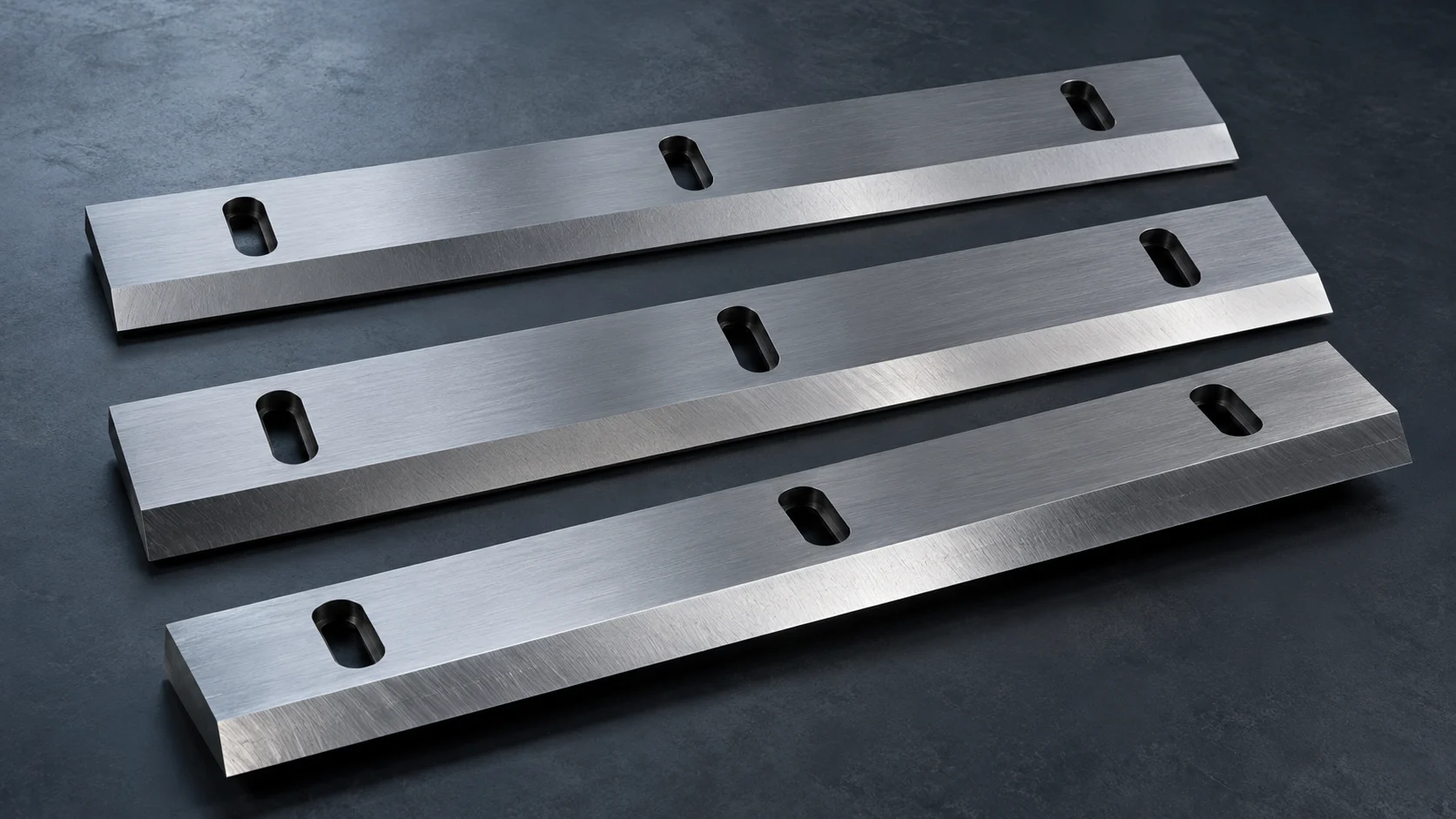
For replacement tire shredder blades, also include the actual machine, cutter drawing or sample, mounting details, quantity and removal reason. The disc-cutter design guide and replacement planning guide help define that separate parts inquiry.
Ask NJDETE to review the tire feed, required product and proposed scope. Request a written statement of accepted feed conditions, included processing stages and evidence needed before the configuration is approved.