

Packaging Blades: 4 Types & Selection Guide
Release time: 2026-10-22
First define the required result: complete separation, a connected perforation or a cut around a particular outline. These are different acceptance requirements, even when the knives look similar.
This guide covers industrial packaging machine knives for film, foil, laminates and paper-based packaging. It focuses on cut-off, perforating and shaped cutting tasks. Longitudinal web slitting and processes designed to cut by heat need their own tooling review.
Packaging blades at a glance
Identify what the knife must do to the web. Then describe the machine arrangement that produces that result.
| Knife type | النتيجة المطلوبة | Details to establish before ordering |
|---|---|---|
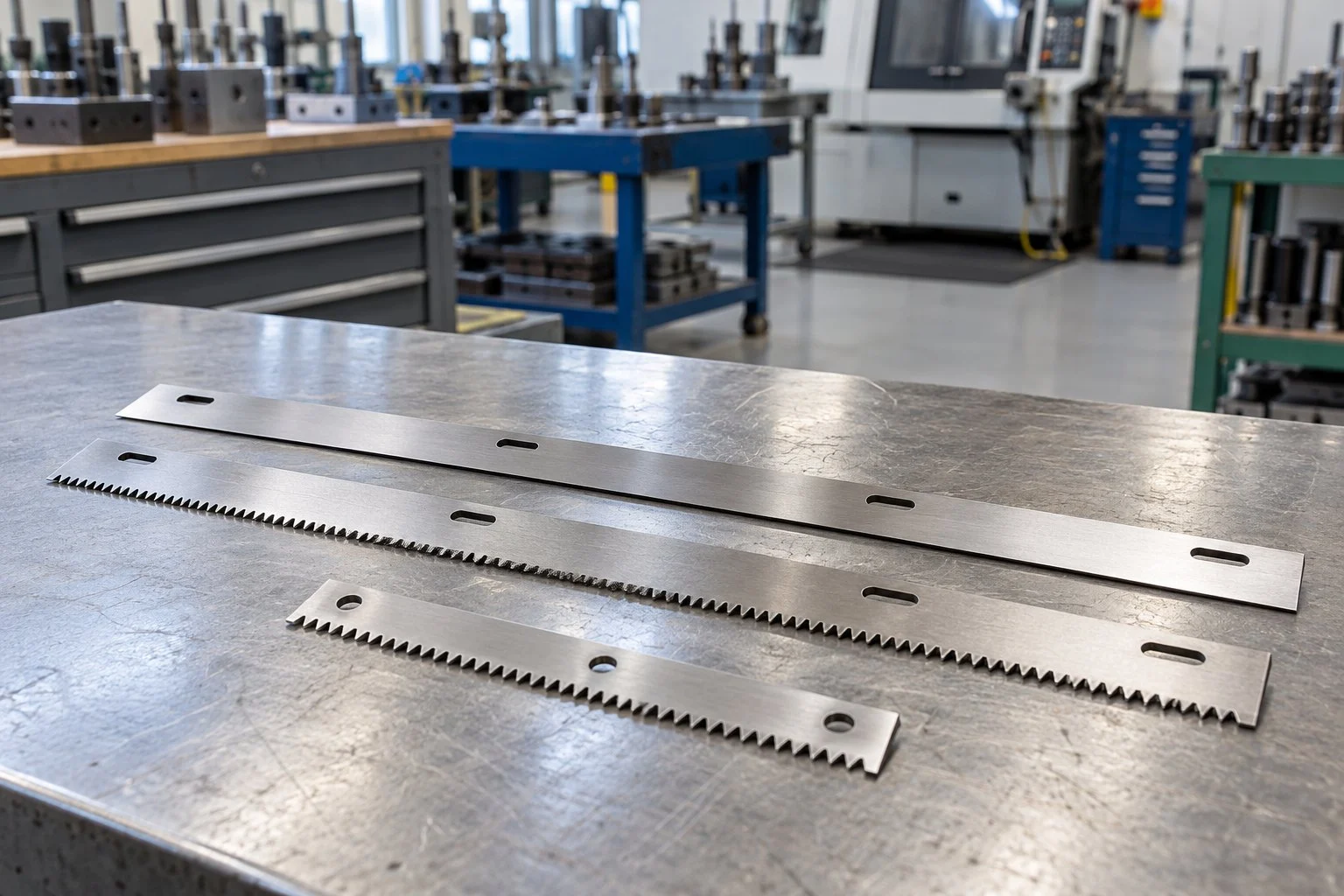
| Straight cut-off knife | Separate or trim material along the required line | Edge section, holder, mating part and supported cutting arrangement |
| Serrated cut-off knife | Produce the specified cut with a toothed edge | Tooth profile, pitch, tooth height and installed edge position |
| Perforating knife | Leave a controlled pattern of cuts and connecting ties | Cut-and-tie pattern, web construction and accepted tear behaviour |
| Shaped or contour knife | Cut around a defined outline | Complete profile, corners, mounting position and orientation |
These categories describe purchasing tasks. The drawing and machine determine the actual knife design. Use the industrial knives guide to compare the wider blade families when the cutting operation is still being identified.
4 types of packaging blades
1. Straight cut-off knives
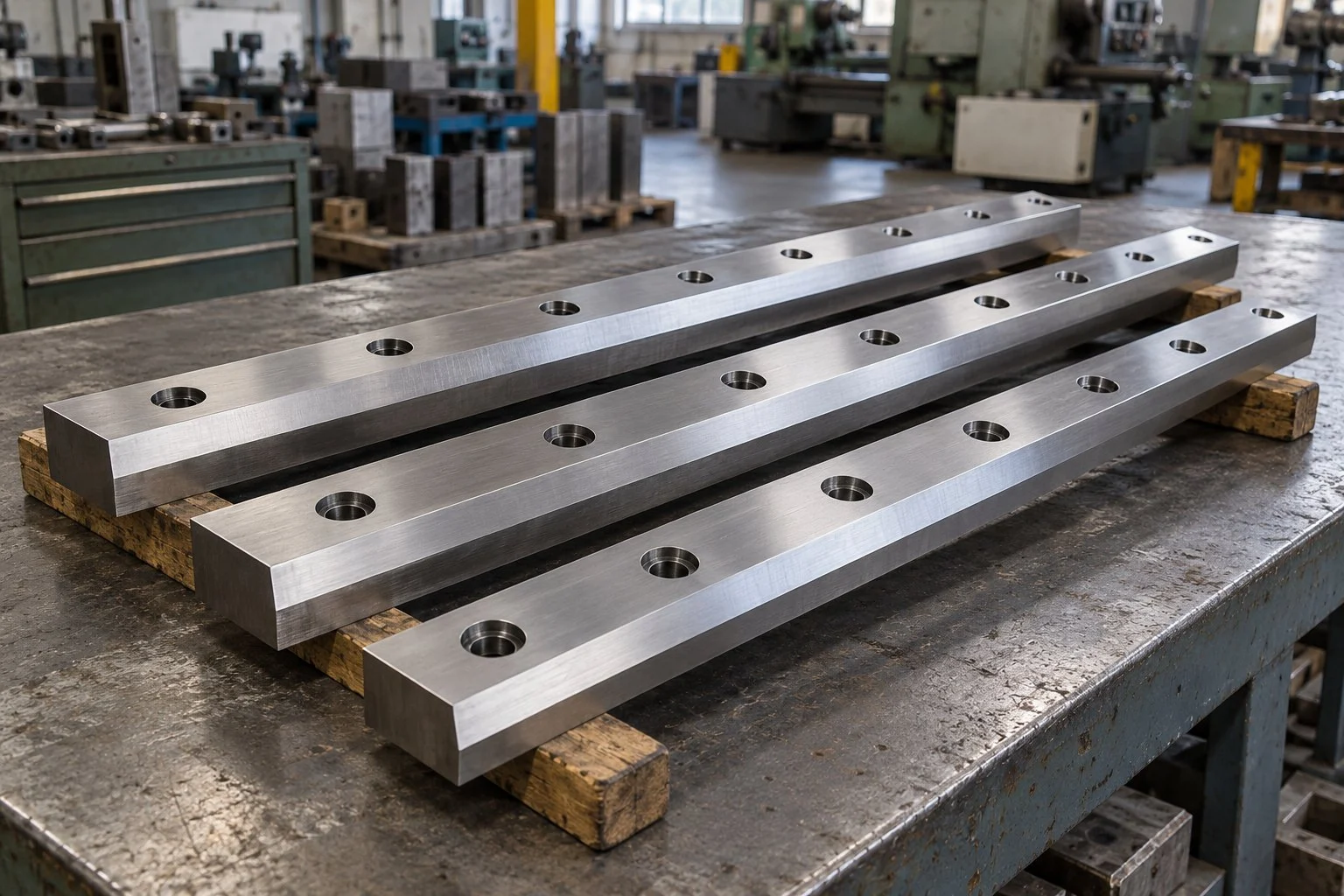
A smooth cutting edge can be used in an assembly designed to cut off or trim a web. Identify how the blade moves and what supports the material during the cut. The loose strip alone does not describe that arrangement.
Include the mating component with the enquiry. A knife working against an anvil needs different identification from one that works with another cutting edge. Keep the machine’s part references attached to both components.
2. Serrated packaging knives
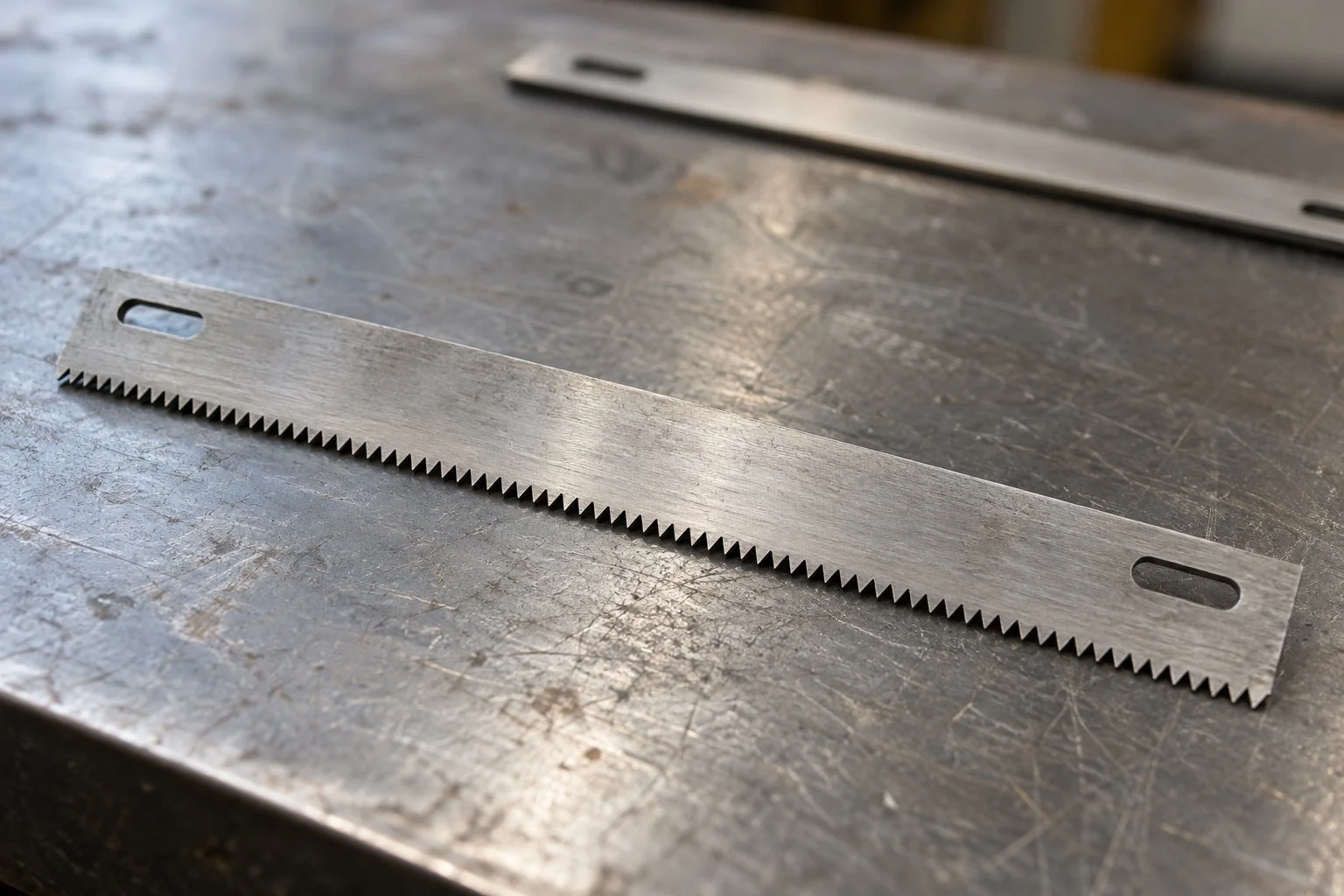
Serrated packaging blades have a repeating tooth profile. On a replacement drawing, define that profile in relation to the mounting holes or slots. “Fine teeth” leaves the pitch, height and shape unresolved.
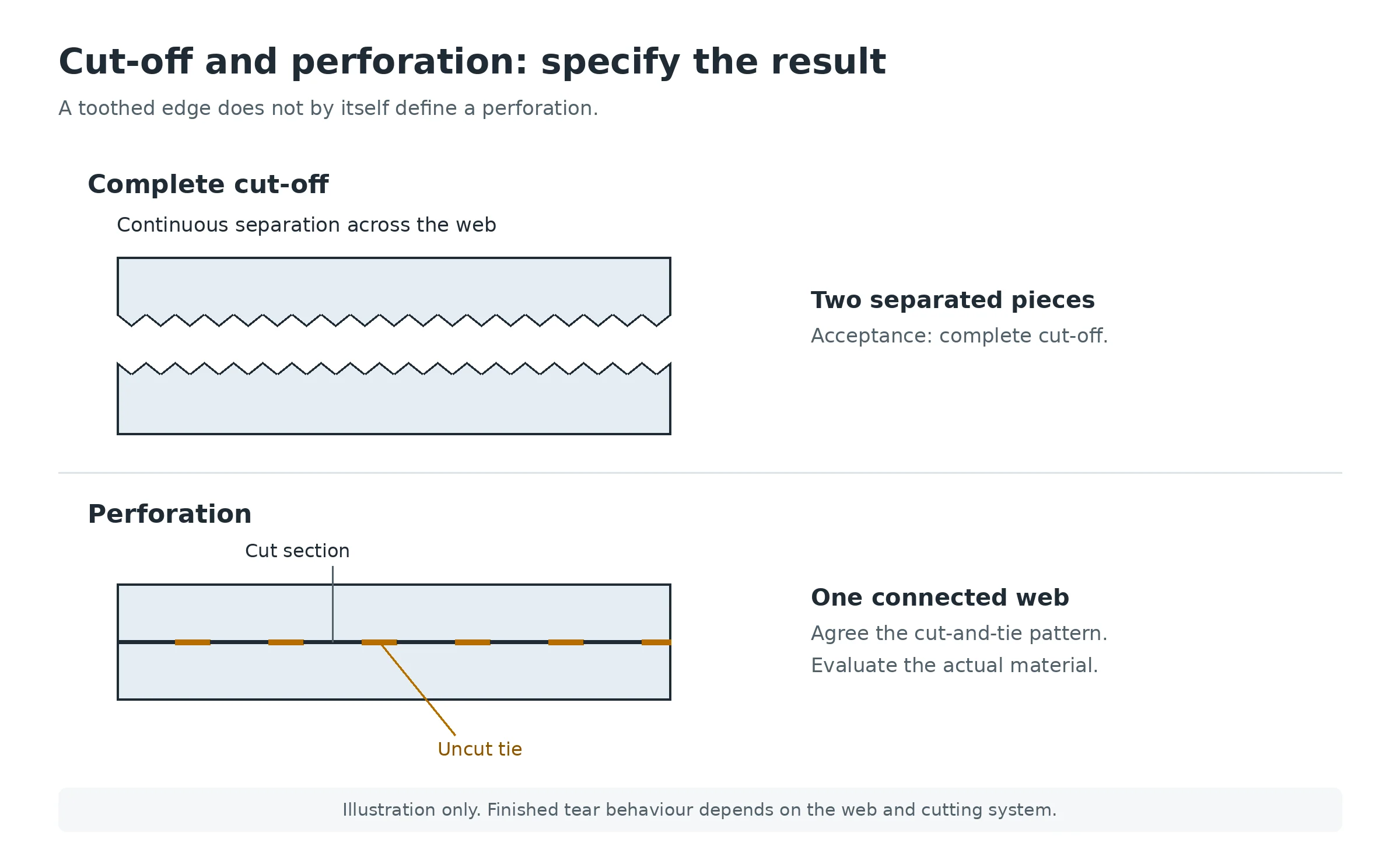
A toothed edge can be intended to separate the web completely. Do not assume that a saw-like appearance means the knife should leave a perforation. Send an accepted cut sample so the supplier can see the required result as well as the old knife.
3. Perforating knives
Perforating blades create interrupted cuts with material left between them. Those connecting ties keep the web or adjacent packs together until separation is required.
Specify the cut pattern and the required tear behaviour on the actual packaging material. A pattern that works on one laminate has not automatically been accepted for another. The finished web sample and the approved knife drawing should describe the same task.
4. Shaped and contour knives
Some packaging operations need a cut around an outline, such as a tray or formed-pack profile. Identify the whole contour, orientation and mounting arrangement. Overall length and width leave corners, reliefs and local profile details unresolved.
If the line instead slits a continuous web along its length, use the slitter blades selection guide to identify that cutting method. Keep the slitters and cross-cutting knives as separate part references in the purchasing list.
How to select packaging blades for your line
Define an accepted package
Retain a sample that shows the required edge. State whether the package must separate completely, remain connected or include a particular opening feature. Identify the position of the cut relative to the seal and printed registration marks where relevant.
Keep cutting acceptance and seal acceptance separate in the trial record. A pack can separate cleanly and still fail the line’s seal-quality checks. Record both results when the knife works within a sealing-jaw assembly.
Describe the actual web
Give the film or laminate construction, thickness range, coatings and relevant layers. If a material description says PET/PE, include the available layer information and the actual roll or batch used for evaluation. For paper-based packaging, identify coatings and any laminated layers as well.
Record the layers presented at the cutting position. Folds, gussets or an overlap can change the local stack even when the roll material has not changed. Photograph that position from the machine’s approved inspection location.
Identify the installed assembly
State the machine manufacturer, model and part number where available. For vertical form-fill-seal equipment, identify the bagger knife position; for horizontal form-fill-seal or flow-wrapping equipment, identify the knife and its mating anvil or cutting component.
Include the holder or jaw reference, mounting method and viewing direction. Record which face seats against the holder. If the assembly has handed variants or more than one knife, give the quantity and identity of each.
Heating also needs a precise description. A knife mounted near heated sealing jaws is not, by that fact alone, a hot-cutting blade. For a process specifically designed to cut by heat, include the heating arrangement in a hot cutter blade enquiry.
Explain when the problem started
If the approved knife gradually wore, retain that specification as the reference. If a replacement performs poorly immediately, record what changed: the knife, mating part, material batch, holder or setup.
Separate startup observations from results at the intended production conditions. Keep the run speed, relevant temperature conditions and setup record with the cut samples. That gives a supplier more to review than an unlabelled photograph of torn film.
Dimensions and tooth details to confirm
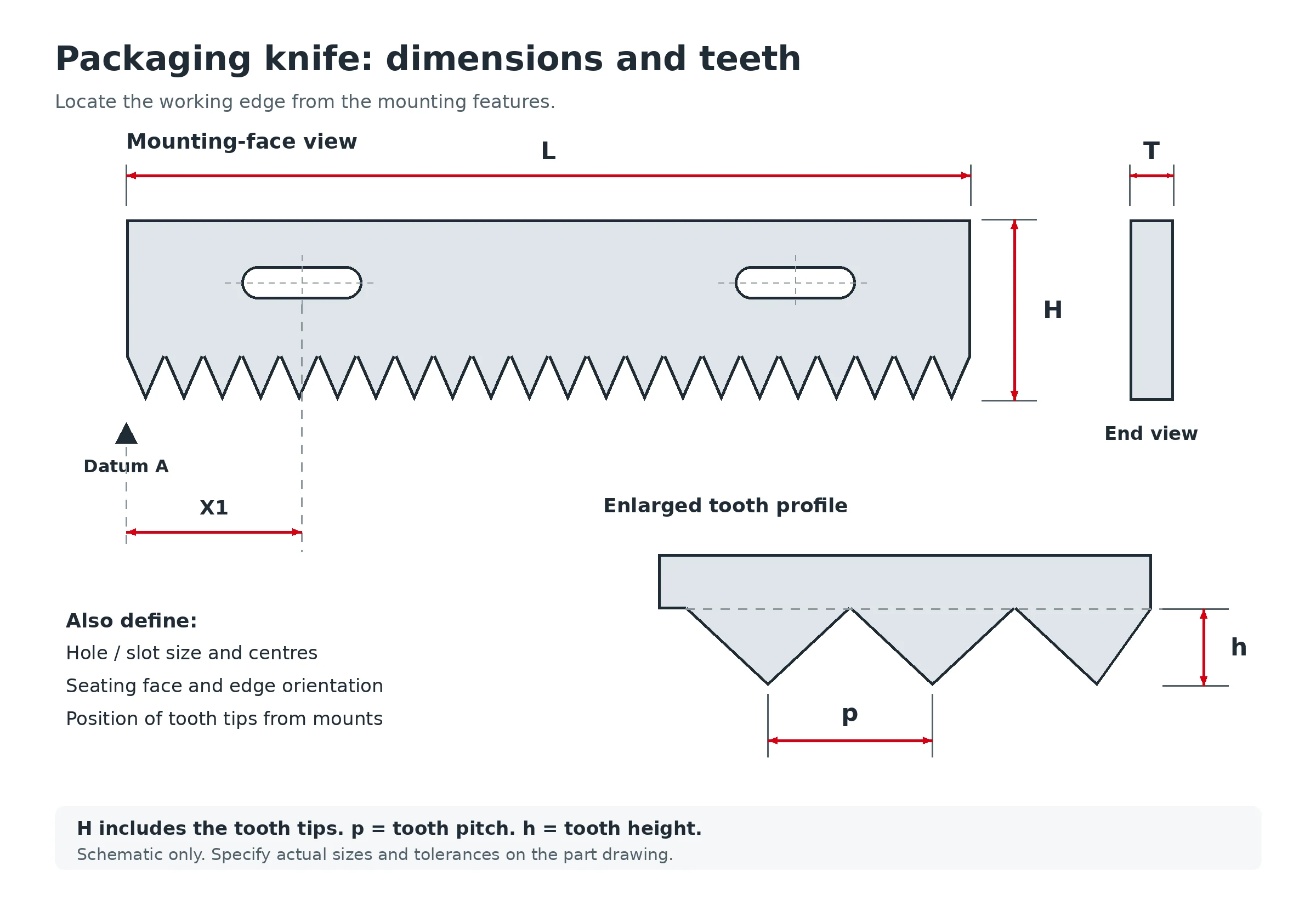
A packaging knife drawing should locate the working edge from the mounting features. Two knives can share the same outside dimensions while presenting their tooth tips at different positions in the holder.
| Drawing item | Information to define | Purchasing check |
|---|---|---|
| Outside size | Length, overall height or width, thickness and units | State whether height includes the tooth tips |
| Mounting features | Hole or slot geometry, coordinates and any locating feature | Measure from identified datums |
| Working edge | Position of the edge or tooth tips relative to the mounting references | Compare the installed geometry, including specified exposure |
| Tooth profile | Pitch, height, shape, root details and any special tooth | Use an enlarged profile or section view |
| Perforation pattern | Cutting sections and interruptions on the approved design | Match the required finished-web pattern |
| Orientation | Seating face, bevel direction and left/right variants where applicable | Define the viewing direction and part identity |
Treat a used sample as evidence to interpret. Mark worn teeth, existing damage and previous sharpening. Keep remaining dimensions separate from the required new-part dimensions so the replacement does not reproduce wear.
For an incomplete drawing, the custom blade replacement guide explains how to organize profile and mounting information. Resolve the finished specification before releasing manufacture.
Materials for packaging blades
NJDETE’s food and packaging machinery blade catalogue lists the following material references. They identify options for discussion; the actual part needs an agreed designation and manufacturing requirement.
| NJDETE catalogue references | Information to resolve for the order |
|---|---|
| SK2 and SKD-11 | Selected designation, heat-treatment requirement and approved edge geometry |
| SUS-440C and 420-J2 | Selected designation, cleaning environment and required inspection documents |
| TC and SKH | Full material designation, specific grade and application approval |
The catalogue also shows multiple tooth forms. It does not provide one common hardness, tooth pitch or tolerance for the whole range. Keep those requirements on the actual part specification.
For a material change, describe what ended the previous run: progressive wear, chipped teeth, deformation, surface deterioration or another recorded condition. Ask the supplier to state what it proposes to change and how that change will be evaluated.
For equipment associated with food, distinguish cutting the packaging from contact with the product itself. State the contact conditions, cleaning process and documents your operation requires. A material name or a polished appearance does not complete that specification.
Cutting problems, sharpening and replacement
Collect evidence before changing the knife specification
Use the observations below to organize a review with the responsible technician. Similar defects can arise under different conditions.
| Observation | Information to review | أدلة مفيدة |
|---|---|---|
| A narrow bridge remains after cut-off | Knife condition, working-edge position, mating part and local material stack | Cut sample with the bridge position marked |
| Film tears before separation is complete | Material support, feed and cutting sequence, edge geometry and wear | Approved observation record and accepted/rejected samples |
| A new knife cuts poorly from startup | Part revision, orientation, seating and specified setup | New-versus-approved part comparison |
| Cutting varies across the knife length | Local seating, contamination, tooth damage and mating-surface condition | Position-marked photographs and inspection findings |
| Separation improves but the end seal becomes unacceptable | The sealing and cutting assembly under its approved setup procedure | Both cut and seal results from the same run |
Use the equipment’s isolation, handling and setup procedures when inspecting or replacing knives. Preserve the findings before changing several variables together.
Review the knife and mating parts as an assembly
Where a knife works against an anvil, record the anvil’s identity and condition. Keep the holder seating surfaces in the inspection record as well. Follow the assembly’s specified replacement requirements when deciding which components to renew together.
Knife position, jaw or shaft clearance, loading and temperature are different settings. Use the machine’s approved procedure for the installed design. A setting copied from another wrapper does not define the correct adjustment for this line.
Check finished geometry before approving sharpening
For a serrated knife, sharpening can affect the tooth profile and the position of the working edge. Agree on which surfaces may be ground and the permitted finished geometry before sending a set for regrinding.
Confirm that the finished knife can still be mounted and set within the assembly’s approved limits. Keep its inspection record with the part reference. A sharp loose blade is only one part of evaluating whether it can return to service.
Retain a replacement record
| Record field | What to retain |
|---|---|
| Knife and mating parts | Order identity, drawing revision, position and orientation |
| Packaging material | Construction, batch, thickness range and local stack |
| Installation | Applicable setup record and changes from the previous run |
| Production result | Accepted output, dated cut samples and applicable seal checks |
| Removal or maintenance | Reason for removal, damage position and sharpening history |
Complete the record during an actual change and production run. If the film, mating part or setup changes, keep that detail beside the result for the next purchasing review.
How to compare packaging blade costs
Ask each supplier to quote the same part revision, quantities and delivery scope. Identify whether the offer includes just the knife or also the mating component, an inspection report and any agreed trial support.
| Cost item | Basis for comparison |
|---|---|
| Initial supply | Same knife variants, quantities and manufacturing requirements |
| Changeover | Recorded labour and production interruption on the defined job |
| Regrinding | Actual cost and usable finished geometry after each operation |
| Rejects | Packs or web output rejected against the same cut and seal requirements |
| Accepted production | A common recorded unit, such as accepted packs or usable web length |
Compare recorded knife-related cost over the same quantity of accepted production where the data supports it. Keep projected life improvements visible as trial assumptions until a run establishes the result.
Packaging blade RFQ checklist
Send one enquiry package containing:
- Machine and position: equipment model, OEM part number where available, holder or jaw reference and mating component.
- Required result: complete cut-off, perforation or contour, with an accepted sample and the relevant package checks.
- Part definition: drawing revision, units, quantities, mounting features, edge position and tooth or profile details.
- Web information: construction, thickness range, folds or gussets at the cut, coatings and representative samples.
- Current condition: existing material where known, removal reason, damage photographs and sharpening history.
- Operating conditions: intended production speed, relevant heating conditions and the applicable setup record.
- Acceptance and delivery: inspection documents, production trial if required, destination and required date.
Ask the supplier to identify any proposed material substitution, changed tooth profile or unresolved dimension. Resolve those points before comparing the quotations as equivalent offers.
الأسئلة الشائعة
Can a serrated packaging knife make a complete cut?
Yes, a serrated knife can be part of an assembly intended to separate the web completely. A perforating knife has a different required result: interrupted cuts with material left connected. Specify the accepted web edge and approved knife design.
Do packaging blades have a standard replacement size?
Use the machine part number or approved drawing. Length, height and thickness alone leave mounting features, edge position and tooth geometry unresolved. Compare the whole specification before treating two parts as interchangeable.
Is stainless steel always the best packaging knife material?
Select the material for the actual cutting and cleaning conditions, with the required geometry and inspection documents. NJDETE’s catalogue lists several material references, but does not rank them for every application. Define the reason for a proposed change and evaluate it on the actual job.
Why does a new packaging knife leave film uncut?
Check part identity, installation, working-edge position, mating components and the material at the cut. A new edge does not establish that those conditions match the approved arrangement. Retain a position-marked sample and the setup record for review.
Can a serrated knife be sharpened and reused?
Confirm the permitted grinding surfaces, finished tooth geometry and mounting adjustment range for that part. Retain measurements after the operation. Do not assume a fixed number of sharpening cycles for every packaging knife.
Does a clean cut prove the end seal is acceptable?
Record both checks separately when cutting and sealing share an assembly. A successful separation does not establish that the pack passes the line’s seal-quality requirements. Keep results from the same material batch and production conditions together.
Discuss your packaging knife replacement with NJDETE
اتصل بـ NJDETE with the machine reference, drawing or sample, packaging material and required cutting result. Identify any change from the previous approved knife so the enquiry can address the actual replacement task.
For related custom parts, review NJDETE’s custom blade categories. Agree on the knife shape, mounting details, material and inspection scope for your line before approving manufacture.