

Carbide Blades vs Tool Steel: Industrial Knife Selection
Release time: 2026-10-24
Before paying for a material upgrade, establish why the current knife leaves the machine. A rounded edge, a chipped edge and an out-of-tolerance reground knife call for different responses. Comparing purchase prices before answering that question can make the more expensive knife the less economical choice.
For an application review, send NJDETE the knife drawing and a description of the current failure. Include photographs of the used edge and the material being cut.
What Does “Carbide Blade” Actually Specify?
Industrial tungsten carbide knives normally use cemented carbide: hard carbide particles held by a metallic binder. Grade selection changes the balance of wear resistance and toughness. “Tungsten carbide” therefore identifies a family of materials, rather than one fixed performance level.
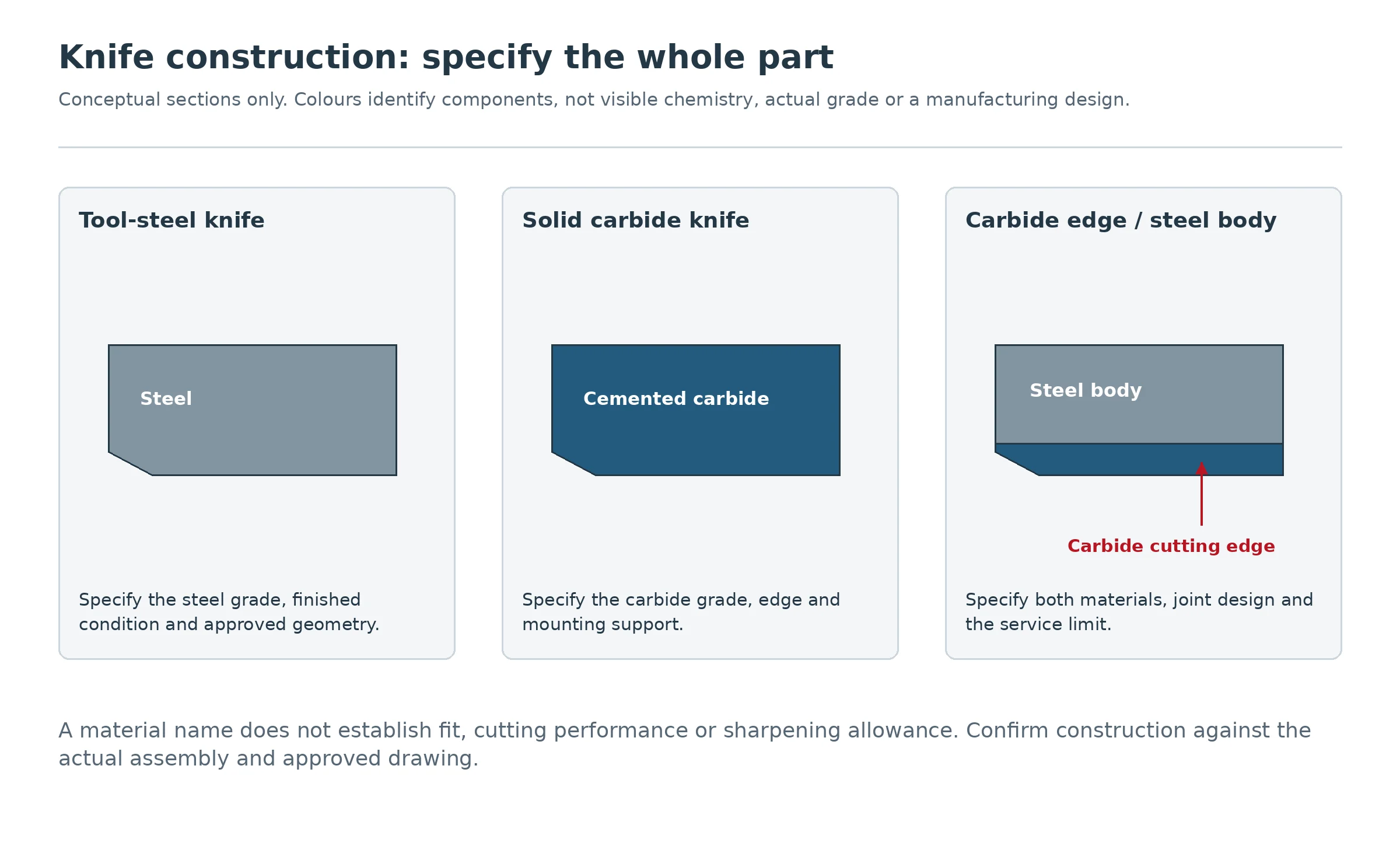
Construction matters just as much. A solid carbide circular knife, a steel-bodied knife with a carbide cutting insert, and a tool-steel knife are different products. The quotation should identify which construction is offered. A photograph or an outside dimension cannot establish this.
| Construction | What the buyer needs to establish | What should not be assumed |
|---|---|---|
| Solid carbide knife | Carbide grade, finished geometry, mounting support and inspection requirements | That any carbide grade fits the same impact or bending conditions |
| Carbide edge or tip on a steel body | Edge material, body material, joint design, supported edge length and service limits | That a carbide-tipped knife is interchangeable with a solid carbide design |
| Tool-steel knife | Exact steel designation, heat-treatment specification and required geometry | That the steel name alone establishes finished hardness or toughness |
| High-speed-steel knife | Exact HSS grade, finished condition and application requirements | That “HSS” specifies one grade or guarantees a particular service life |
HSS belongs to the tool-steel family. A carbide vs HSS comparison is useful only after the buyer identifies the particular grades and cutting arrangement. It does not establish a universal winner for slitting, trimming, granulating and shredding.
The construction options above explain terminology. They are not a statement that every option is available for every NJDETE knife.
Choose Against the Reason for Replacement
Record the removal reason in concrete terms: unacceptable slit edge, increased cutting load, a visible chip, loss of required dimensions, or a scheduled change. “The blade is worn out” hides distinctions that affect the purchase.
| Observation from the current process | Useful first check | Implication for the material decision |
|---|---|---|
| Gradual rounding with consistent feed and repeatable cut quality deterioration | Edge condition at a defined quality limit; accepted output before removal | A controlled carbide trial may be justified |
| Local chips or cracks after an abnormal event | Inclusion, impact, clamping, contact and edge support history | Correct the cause before assuming greater wear resistance will help |
| Similar damage at the same location on successive knives | Holder contact, alignment and mating-component condition | Replacing the material alone may repeat the damage |
| An apparently sharp knife still produces poor cuts | Actual setup, web or workpiece support, contamination and mating knife | Confirm that material wear is the limiting factor |
| Reground knife no longer seats or adjusts correctly | Remaining dimensions, datum position and holder adjustment range | Establish the service limit and replacement geometry |
| Deposits, staining or attack around the working edge | Process chemicals, cleaning method and actual material compatibility | Review compatibility separately; neither family is universally corrosion resistant |
These observations guide an investigation. They do not identify a steel or carbide grade without inspecting the part and process.
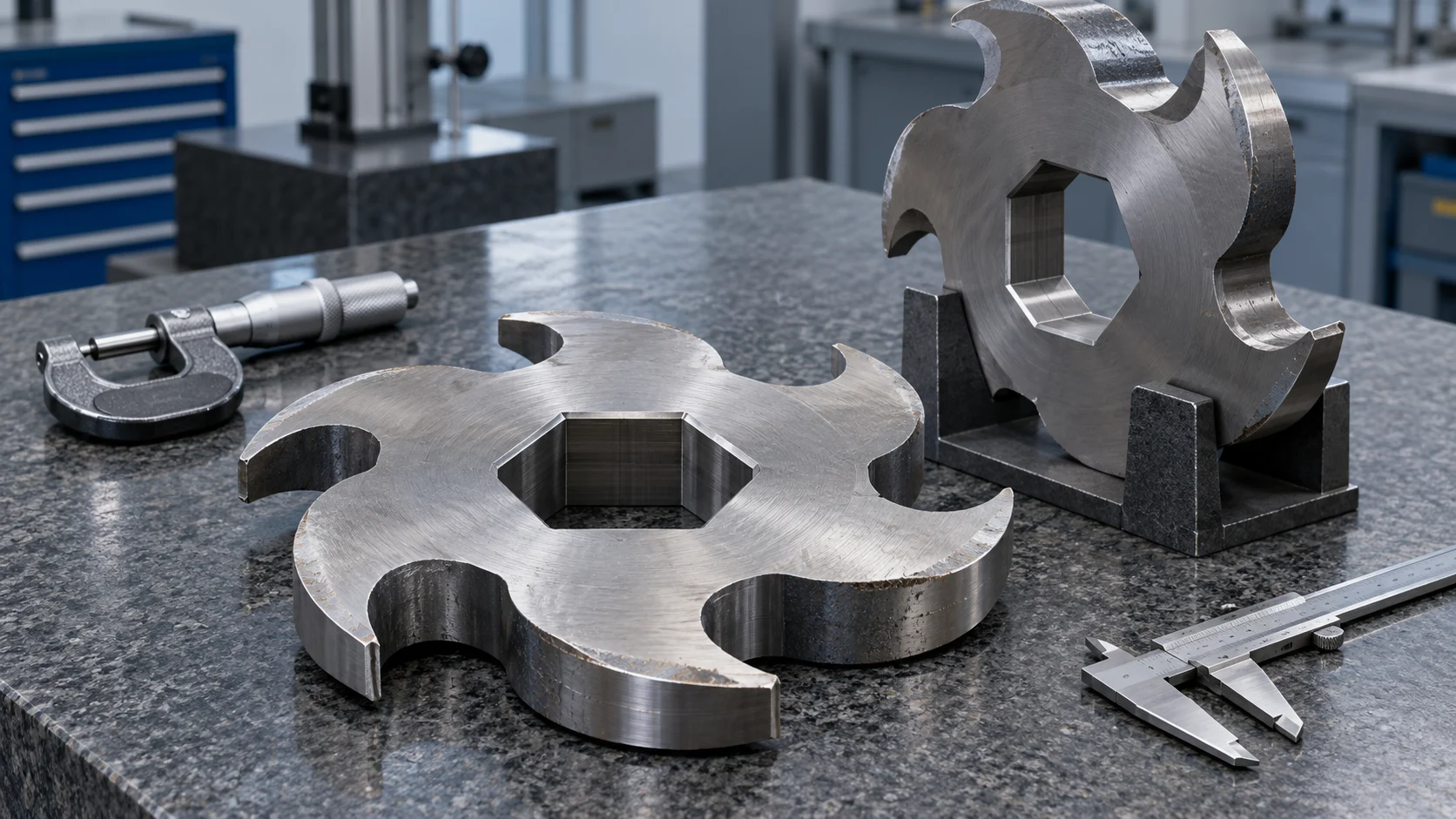
For heavily loaded shredder cutters, use the separate shredder blade materials guide. A result from thin-film slitting does not establish suitability for a cutter exposed to mixed feed and impact.
NJDETE Catalogue References and Their Limits
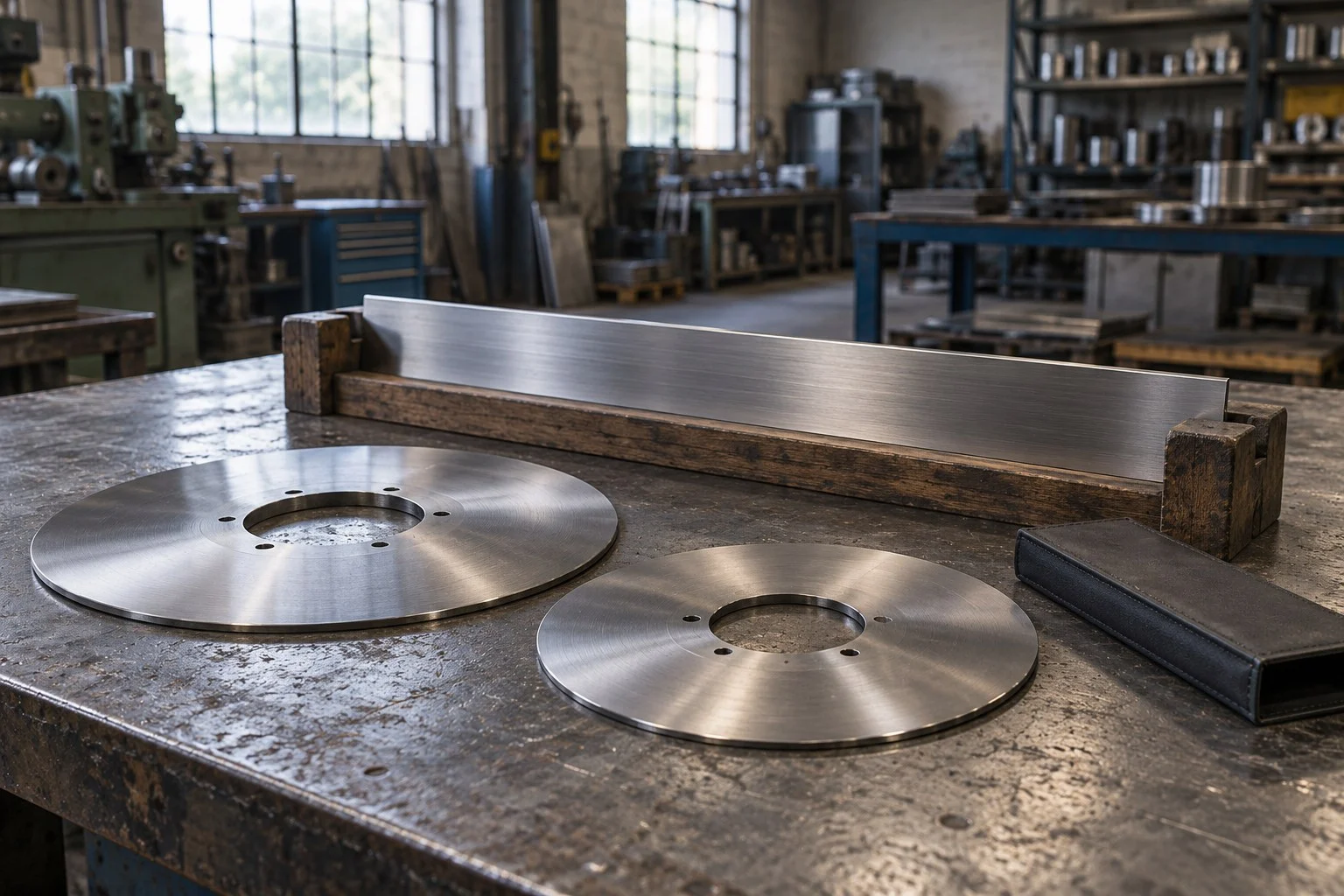
NJDETE’s catalogue lists tungsten carbide circular knives for paper, tobacco machinery, film and foil slitting. It also lists steel options for custom straight and special-shaped blades. These are useful starting references for an inquiry, provided the final quotation specifies the individual part.
| NJDETE catalogue family | Listed information | Information to confirm for the order |
|---|---|---|
| Tungsten carbide circular knives | Tungsten carbide; paper, tobacco machinery, film and foil slitting applications | Actual carbide grade, construction, edge geometry, tolerances and mounting conditions |
| Custom straight and special-shaped blades | 9CrSi and Cr12MoV among the listed steel designations | Appropriate grade, heat treatment, finished hardness and drawing requirements |
| Custom straight and special-shaped blades | W6Mo5Cr4V2 and W18Cr4V among the listed designations | Exact specification and suitability for the required cutting and service conditions |
| Custom straight and special-shaped blades | 3Cr13, 4Cr13 and 7Cr17 among the listed designations | Required corrosion resistance, wear behaviour and finished properties for the actual process |
The catalogue does not publish one verified service-life multiplier, carbide binder percentage or finished hardness range for all these knives. These values need part-specific confirmation. The listed steel designations are not an equivalence table, and this table does not mean every grade suits every shape or application.
Two listed circular-knife dimensions illustrate why a material description is incomplete:
| Catalogue reference, mm | Outside diameter | Bore | Толщина |
|---|---|---|---|
| 180 × 25.4 × 2 | 180 mm | 25.4 mm | 2 mm |
| 200 × 25.4 × 2.5 | 200 mm | 25.4 mm | 2.5 mm |
Matching these three dimensions does not confirm bevel, side finish, flatness, runout, holder fit or compatibility with the mating knife. For cutting methods and the wider circular-knife dimension list, see slitter blade selection.
Check Geometry Before Changing Material
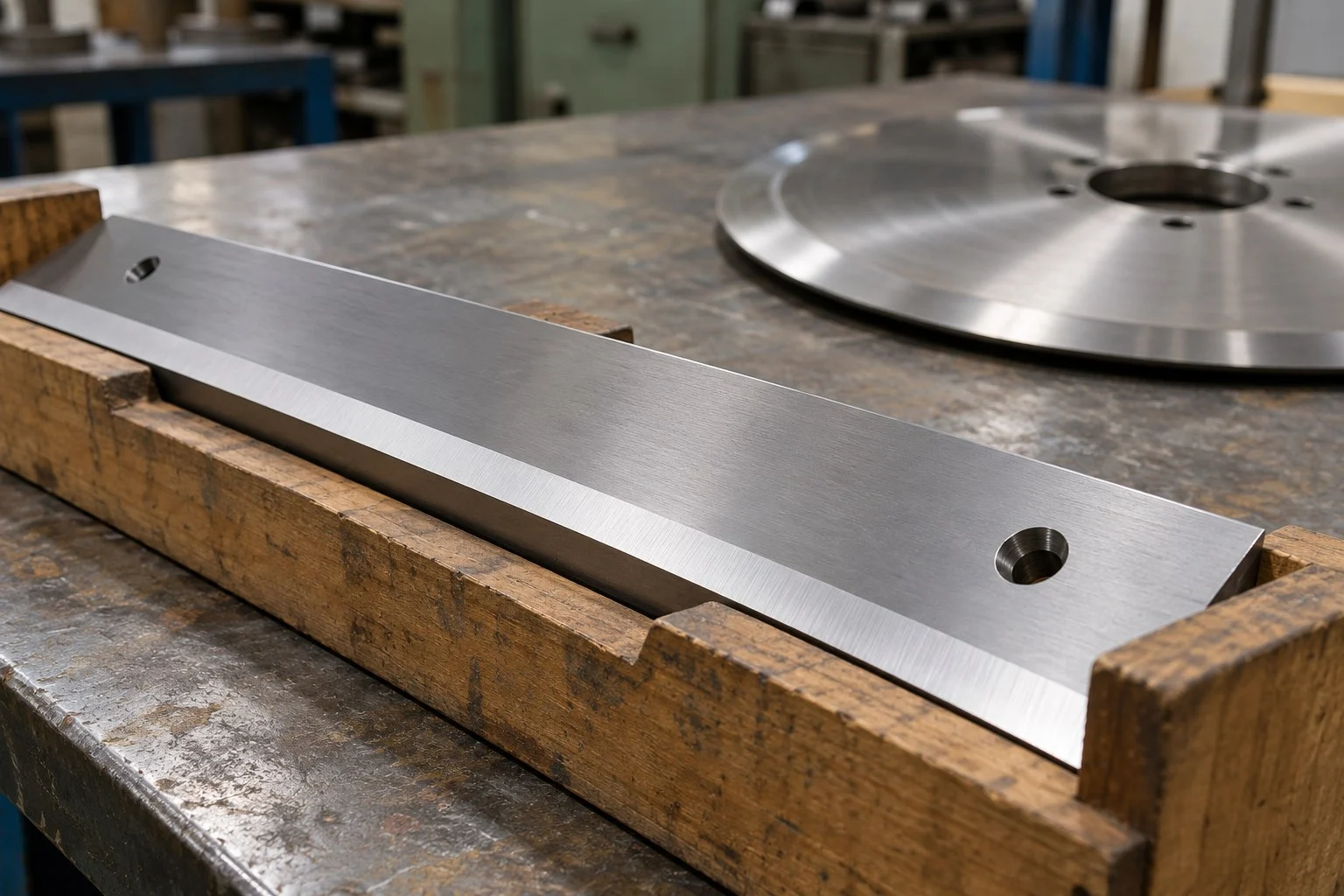
A replacement should locate against the intended mounting face and remain within the holder’s adjustment range. Record outside or overall dimensions, bore or mounting holes, thickness, seating face, cutting-edge position and the mating arrangement. Include the drawing revision; an old sample may already have lost material through service.
For a tipped knife, establish the available cutting-edge section and the limits after regrinding. Do not specify the same sharpening allowance as a solid knife without checking the construction. For a thin circular knife, confirm the clamping and support arrangement rather than treating the bore as the only mounting feature.
Hardness figures also need a test method and scale. A carbide value reported on one scale cannot be ranked against a steel HRC value simply by comparing the printed numbers. Ask for the relevant finished-part specification, not a generic “higher hardness” claim.
Compare Quotations on the Same Basis
A lower price can reflect a different construction, less inspection, a smaller service allowance or an excluded mating component. Resolve these differences before using price to select a supplier.
| Позиция в предложении | Ask each supplier to identify |
|---|---|
| Material and construction | Exact grade or agreed material specification; solid, inserted or tipped construction |
| Finished geometry | Drawing revision, bevel, edge position, mounting datums and critical tolerances |
| Supplied condition | New finished knife, blank, reground knife or matched set |
| Inspection | What will be measured, the method, and the record supplied with the part |
| Service plan | Regrinding feasibility, return geometry, remaining-size limits and responsibility |
| Trial scope | Material, process conditions, acceptance limit and how abnormal events will be recorded |
| Commercial scope | Quantity, packaging, freight, delivery basis and any excluded work |
An offered “equivalent” grade needs an agreed specification or documented comparison. A similar name is insufficient. Likewise, receiving a material certificate does not prove that the finished knife meets the mounting and cutting requirements.
Run a Material Trial That Answers the Buying Question
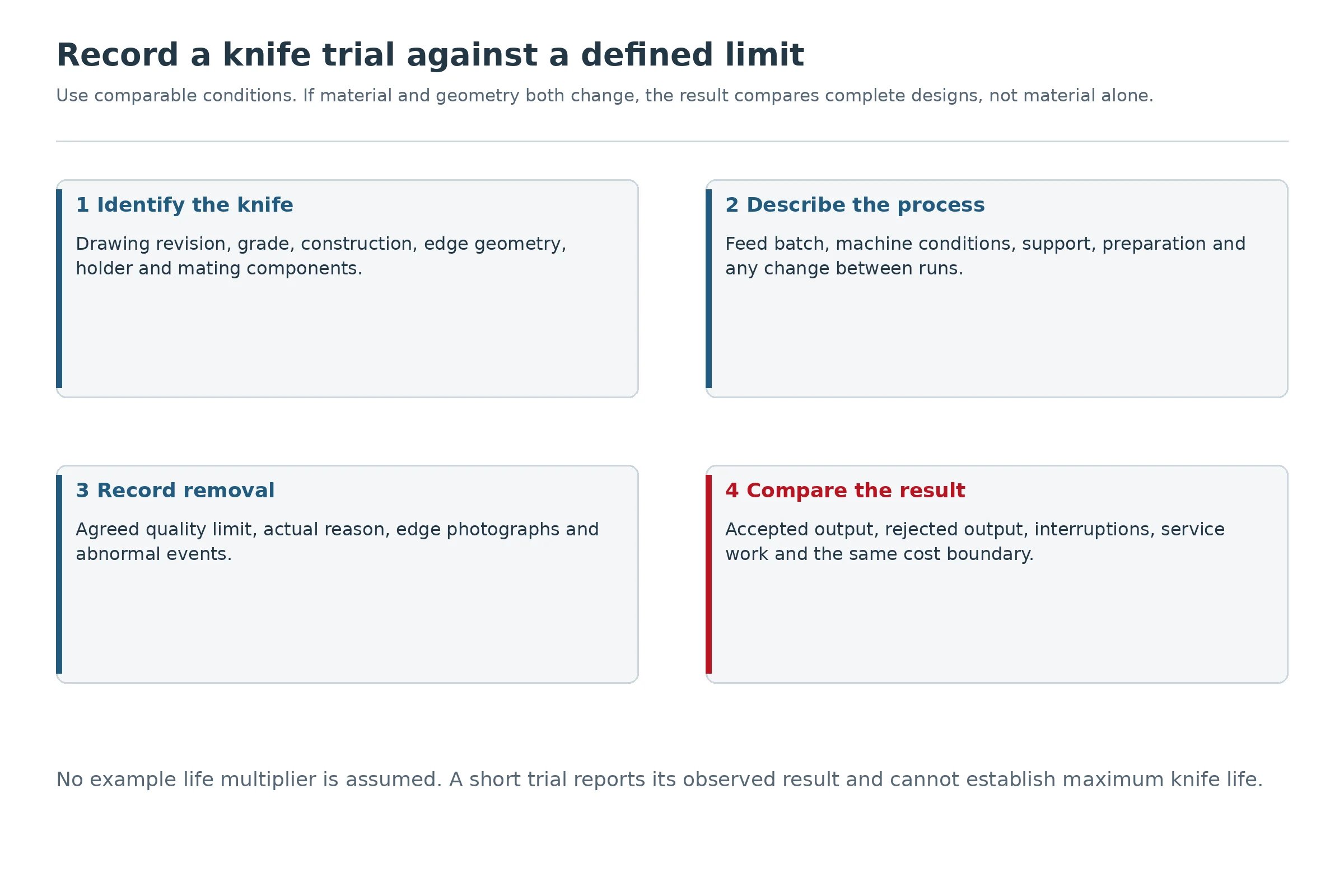
The practical question is whether the candidate knife produces more acceptable output at a justifiable total cost under the intended conditions.
- Define the baseline. Record the current knife, drawing revision, material batch, machine and the reason for removal. Keep the rejected-output definition with the record.
- Set a removal limit before the trial. Use a measurable cut-quality or process limit appropriate to the product. Agree how a chip, contamination event or setup fault will affect the comparison.
- Keep the comparison fair. Use comparable feed and document speed, support, mating components and setup. If both material and geometry change, call it a comparison of knife designs; it cannot isolate the material effect.
- Measure accepted output and interruptions. Record production quantity, rejected quantity, knife changes and the actual work included in each change.
- Inspect at the same decision points. Retain comparable edge photographs and the removal reason. Do not run a damaged knife simply to complete a planned batch.
- Review repeatability before a large order. One short successful run establishes a result for that run. It does not establish maximum life, every material grade or every shift condition.
Use an agreed inspection and operating procedure. The test should not depend on changing guards, clamping beyond the design, or running outside the machine’s approved conditions.
Calculate Cost per Accepted Output
Compare the same unit: accepted metres, sheets, cuts or tonnes. Select the unit before testing and use it for both knives.
Knife-related cost per accepted unit = agreed knife-related costs over the comparison period ÷ accepted output over the same period.
The numerator can include the knife purchase allocation, regrinding, handling and agreed changeover costs. State what is included. If lost production is valued separately, avoid charging the same changeover loss again through another cost line. Use a common treatment of any remaining knife life at the end of the comparison.
A knife with a higher purchase price can be economical if the measured reduction in changes or rejects offsets it. That conclusion needs the plant’s records. A published multiplier from a different knife, material or machine is not an NJDETE performance guarantee.
Часто задаваемые вопросы
Are carbide blades always better than steel blades?
No. They are candidates when wear resistance addresses the actual limitation and the construction is suitable for the loading and support. Repeated impact, local contact or unstable mounting needs investigation before a material upgrade.
Is HSS the same as tool steel?
HSS is a category within the tool-steel family. Both terms still need an exact grade and finished-part specification. Neither name alone establishes the service life of the knife being quoted.
Can a steel knife be replaced with carbide at the same dimensions?
Matching outside dimensions is only the first check. Confirm construction, edge geometry, mounting support, mating components and the service plan. The replacement needs approval against the actual assembly.
Why can a carbide knife chip before it becomes dull?
Possible contributors include impact, contamination, inadequate support, unintended contact and an unsuitable edge or grade. A photograph of the chip helps locate the problem, but it does not establish the cause by itself.
Can carbide knife blades be sharpened?
Some designs can be reground by an appropriately equipped specialist, within the construction and remaining-size limits. Confirm the method and returned geometry before ordering. Do not assume the existing steel-knife sharpening process is suitable.
How much longer will a carbide knife last?
There is no reliable universal multiplier. Compare accepted output to an agreed removal limit on comparable feed, and retain the actual trial record. A change in knife geometry or process conditions needs to be reported with the result.
Ask NJDETE to Review the Replacement
Send the current drawing or sample identification, machine and holder details, material being cut, photographs of the used edge, accepted-output requirement and typical removal reason. Add order quantity, destination and any inspection documents required.
For a straight or special-shaped part, include the mounting face and edge position; the custom blade guide explains the drawing inputs. For a wider comparison of knife families, start with the industrial knives guide.
Request a knife material and replacement review from NJDETE. Identify whether you need a like-for-like replacement, a documented alternative or a comparative material trial so the quotation answers the right buying question.