

Hot Knife Blades: Selection & Replacement Guide
Release time: 2026-10-23
Hot knife blades at a glance
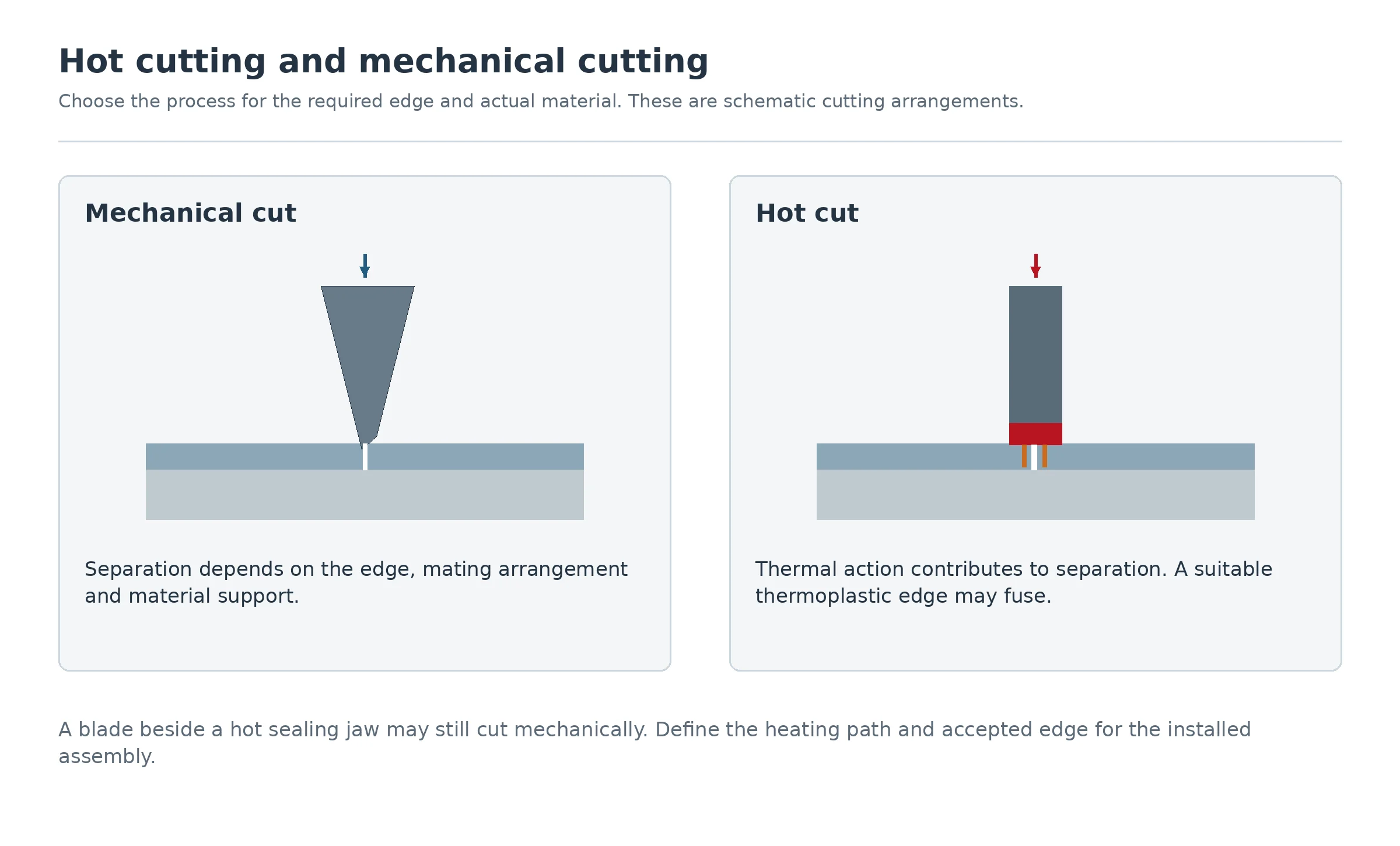
A hot knife uses a heated cutting region as part of the separation process. On a suitable thermoplastic textile, the cut can also fuse fibres along the edge. That result depends on the material and the complete process, including how the work is supported and presented to the blade.
| Вопрос по покупке | Information that helps resolve it |
|---|---|
| Is heat part of the cutting method? | Machine drawing, heater arrangement and a description of the cutting cycle |
| What result is accepted? | Representative cut sample, dimensions and edge requirements |
| Will the replacement fit? | Mounting features, seating face, edge position and heating interface |
| What must the blade withstand? | Actual blade exposure, cycle, material contact and cleaning conditions |
| How will the order be released? | Agreed drawing, material designation, inspection requirements and trial scope |
A knife positioned beside a heated sealing jaw may still perform a mechanical cut. For that arrangement, the packaging blades selection guide helps separate the cutting and sealing requirements. The industrial knives guide provides the wider comparison of blade families.
When to consider hot cutting
Thermoplastic fabric, webbing and similar materials
Hot cutting may be worth evaluating when the required result includes a fused edge. Identify the fibre, weave, coating and any backing. A fabric containing different fibres or layers can respond unevenly, so keep the actual construction with the enquiry. Evaluate separation and edge condition together. A cut that prevents loose threads may still leave an edge too stiff, thick or distorted for the next operation. Retain a sample showing what your assembly, sewing or packaging step will accept.
Foam and plastic profiles
Give the polymer or foam identity, density where relevant, thickness and required contour. “Foam” includes different materials and structures. A result on one sample does not qualify another material with the same general name. State the permitted edge condition and dimensional change. If the part needs a closely defined profile, include its inspection method and the condition in which it will be measured. Keep any cooling or conditioning requirement in the trial record.
Coated, laminated or heat-sensitive work
Describe all known layers. Where heat damage, discolouration, coating disruption or emissions make the proposed process unsuitable, review another cutting method with the equipment and material suppliers. Material suitability and extraction requirements need to be settled before a heated trial. Use the material information and the installation’s approved controls. Do not identify an unknown plastic by heating a sample.
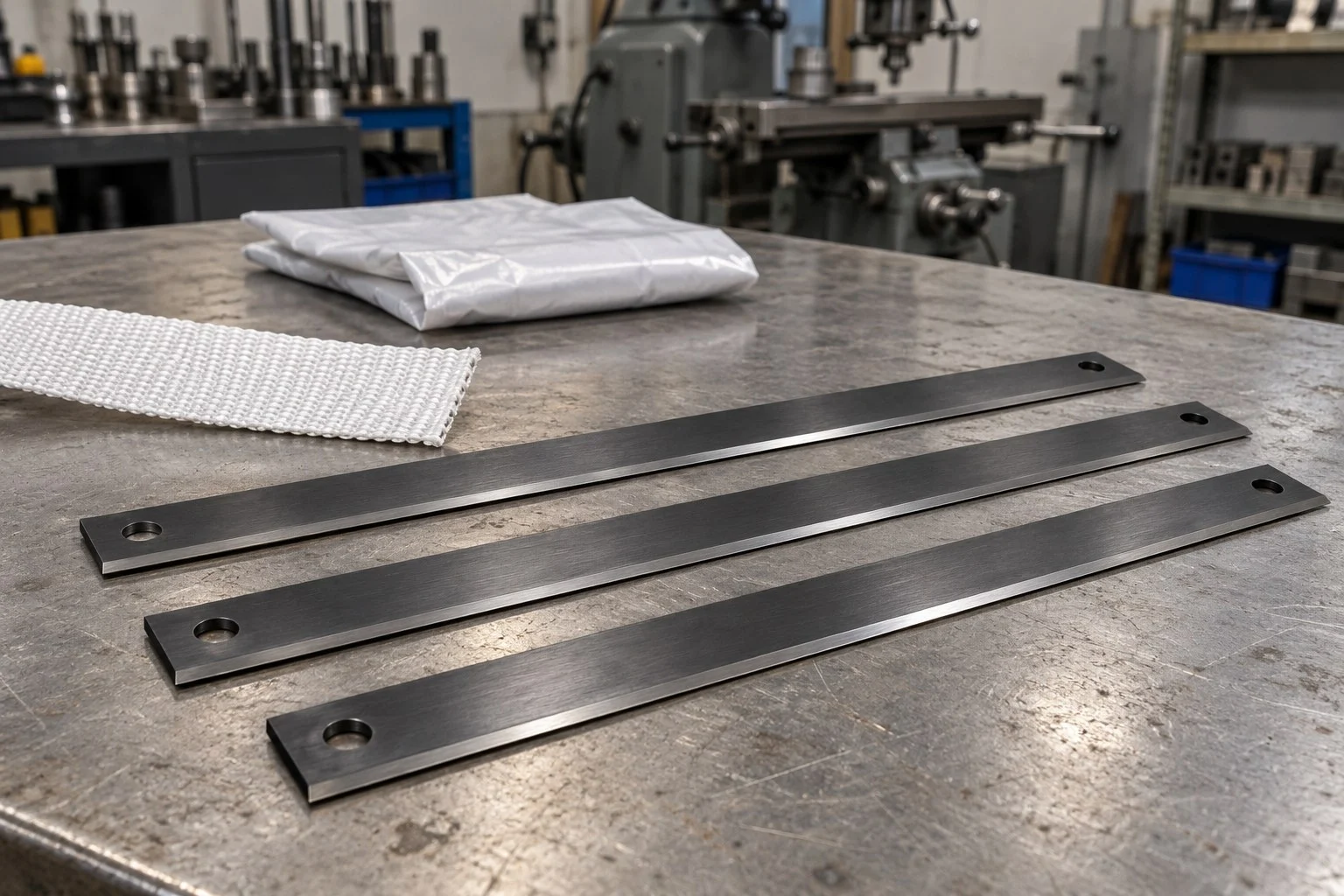
NJDETE hot cutter blade specifications
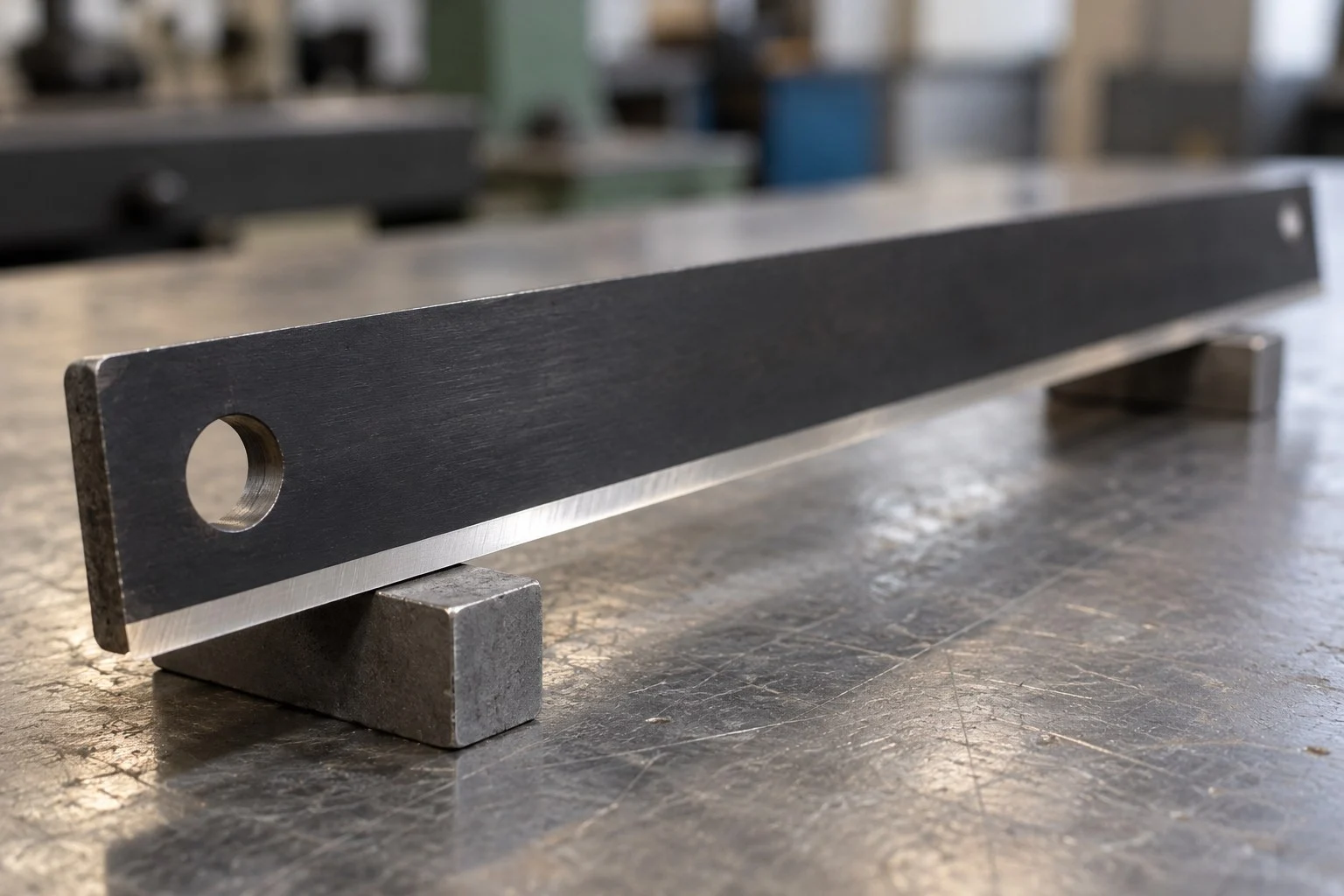
The following information appears in NJDETE’s current hot cutter blade product description. It is the starting point for a part enquiry; dimensions and operating requirements still belong on the approved order.
| Published item | NJDETE description | What to confirm for your part |
|---|---|---|
| Материал | Высокопрочная легированная сталь | Full steel designation and manufacturing requirements |
| Surface treatment | Черное окисление | Required finish and condition of contact or seating surfaces |
| Dimensions | Customizable length, width and thickness | Drawing, units and tolerances |
| Mounting | Монтажные отверстия на обоих концах | Hole pattern, datums, seating face and installed edge position |
| Temperature statement | Up to 300°C | Meaning of the limit for the blade, cycle and heating arrangement |
| Listed applications | Thermal cutting of foam, plastic strips, chemical-fibre fabrics, synthetic materials and packaging accessories | Specific material construction and accepted cutting result |
The 300°C statement does not specify a continuous-duty test, a setting for every material or a complete machine rating. Ask how it applies to the proposed steel, blade exposure and cycle before using it in a purchase specification. Likewise, “high-strength alloy steel” is not a complete material designation. If a repeat order relies on a particular grade and treatment, retain those details with the drawing revision. Agree any substitution before manufacture.
Dimensions and heating details to confirm
Locate the working edge from the mounting features
Measure or specify the features that control how the blade sits in the machine. Overall length alone leaves the working edge and holder relationship unresolved.
| Drawing detail | Required information |
|---|---|
| Blade envelope | Length, width, thickness and units |
| End mounting features | Hole or slot geometry and coordinates from identified datums |
| Working edge | Position relative to mounting features, edge profile and any bevel |
| Seating face | Which surface locates against the holder |
| Heating interface | How heat reaches the blade and which contact features must match |
| Installed working length | Portion of the blade that contacts the material |
| Orientation | Viewing direction and any left/right or upper/lower variant |
| Inspection | Features, tolerances and documents required before release |
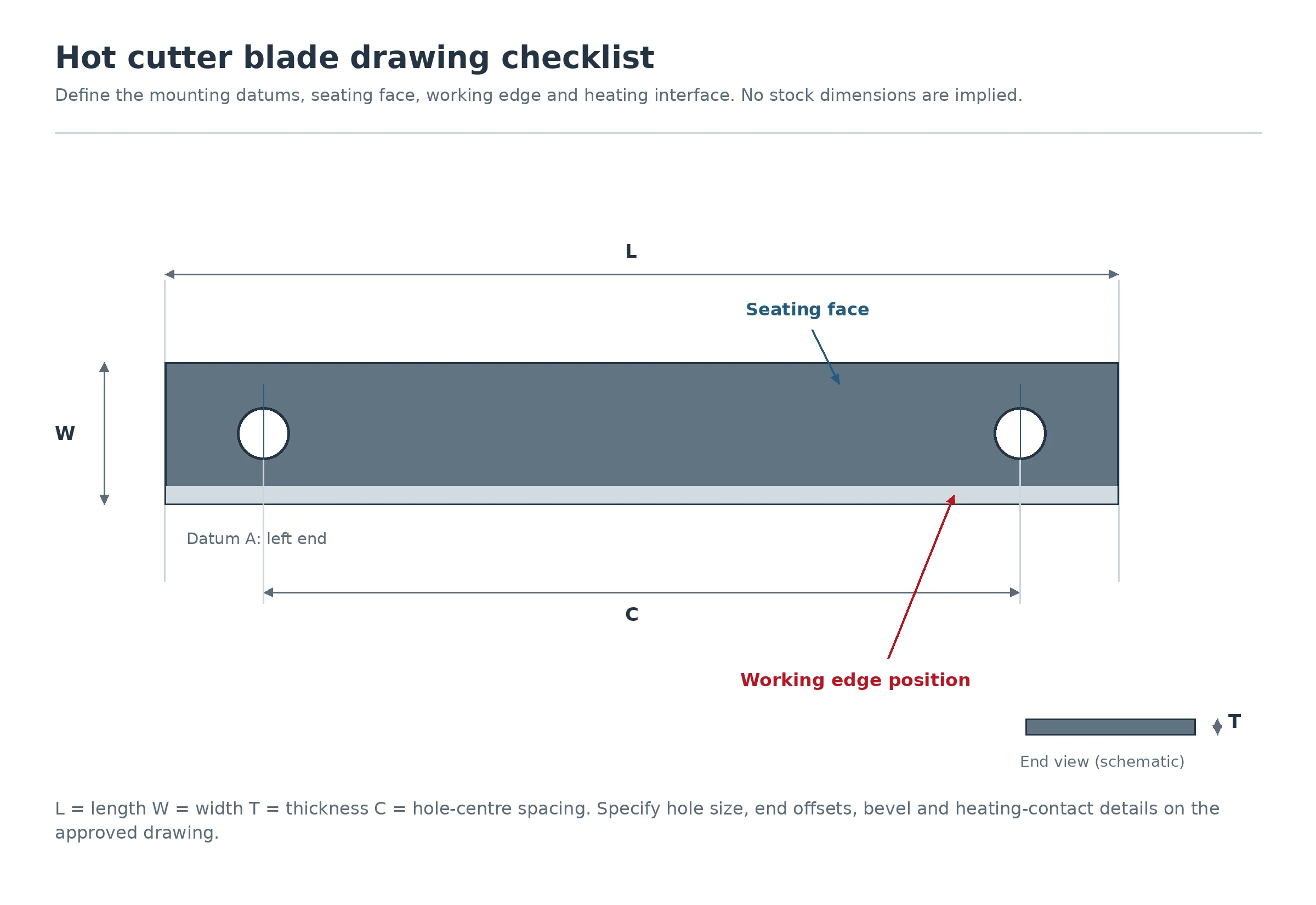
For a used sample, mark wear, distortion and previous grinding. Its remaining outline may differ from the original specification. The custom blade replacement guide explains how to organize a drawing or sample enquiry when some information is missing.
Identify the heating arrangement
State whether the blade is heated through an electrical connection, by contact with another heated component or through another defined arrangement. Include the holder and relevant part references. A similar end-hole pattern does not establish electrical or thermal compatibility. Record where the installation measures temperature and how the value is described. A controller reading needs its sensor location and operating context to be useful. Include the approved heating cycle, intended production rate and cleaning method with the enquiry.
Temperature, contact time and the accepted edge
Raising temperature is a poor first answer when the reason for an incomplete cut is unknown. Review the blade identity, heating performance, material stack, working movement and support together. For a controlled trial, define the material batch, thickness or layer count, the installed blade and the equipment’s permitted operating conditions. Keep the cut samples tied to those conditions. Change one agreed factor at a time within the approved procedure. Inspect the result when it reaches the condition used by the next operation. If the process requires a cooled edge, immediate separation alone is an incomplete acceptance check. Record edge shape, dimensions and any sticking during handling.
| Trial observation | Информация, которую необходимо сохранить |
|---|---|
| Complete separation | Material and layers cut, working region and any uncut bridge |
| Fused textile edge | Continuity of the edge, loose fibres and suitability for the next operation |
| Dimensional result | Drawing feature, measurement condition and actual reading |
| Surface condition | Sticking, discolouration, roughness or coating disturbance |
| Repeatability | Samples identified across the agreed run, including startup where relevant |
Agree rejection criteria before evaluating alternatives. If two suppliers describe a “clean cut” differently, their quotations are not yet based on the same accepted result.
Investigating sticking, rough edges and incomplete cuts
Use the defect to organize the review. A photograph can show a problem, but it seldom establishes the cause on its own.
| What you see | Checks to discuss with the responsible technician | Полезные доказательства |
|---|---|---|
| A bridge remains after cutting | Installed edge position, heating across the working length, material stack and cutting movement | Sample with the bridge location marked |
| Material adheres to the blade | Actual material construction, surface condition, heating cycle and contact conditions | Batch information and dated samples |
| Edge distortion or discolouration | Thermal exposure, material response and the approved process range | Conditions attached to each sample |
| Cut quality varies across the width | Blade straightness, mounting, heating distribution and work support | Location-marked observations |
| A new blade performs poorly immediately | Drawing revision, seating, orientation and heating-interface compatibility | Approved-versus-new part comparison |
Use the equipment’s isolation, cooling and handling procedure before accessing the knife. A blade may remain hot after the heater is switched off. Keep trial observations separate from the maintenance steps required to inspect it. When a problem follows a material change, keep the old and new material identities available. When it follows a blade change, preserve the removed part and its order record. Those comparisons help avoid replacing a serviceable blade to address a process change.
Replacement, sharpening and material changes
Establish what ended the previous run
Describe the removal reason: progressive edge wear, mechanical damage, distortion, surface deterioration or an unresolved cutting defect. Include where it occurred along the working length. A replacement discussion should distinguish an exact repeat from a proposed design change. Ask the supplier to identify any change to the steel, finish, edge geometry or mounting features. Keep the agreed revision with the inspection record.
Review finished geometry before regrinding
Sharpening can move the working edge relative to the mounting holes. Confirm the permitted grinding surfaces, remaining dimensions and installed adjustment range for the actual part. Inspect the seating and heating-contact features as required by that design. There is no common number of sharpening cycles for every hot knife blade. The useful question is whether the proposed operation leaves an acceptable part that can still be mounted, heated and used as specified.
Compare cost over accepted work
Quote the same blade revision, quantity, inspection scope and delivery terms. Where records support a running-cost comparison, include blade supply or regrinding, attributable changeover cost and rejected work over a defined quantity of accepted cuts or usable product. Keep projected life improvements as trial assumptions until actual production establishes the result. Record a simultaneous change in material, machine setting or holder alongside the outcome.
What to include in a hot cutter blade RFQ
Send one enquiry containing:
- Machine and blade identity: manufacturer, model, installed position and existing part reference.
- Part definition: drawing or sample, revision, units, quantity, end mounting features and edge geometry.
- Material being cut: polymer or fibre, layers, coatings, dimensions and representative samples.
- Heating arrangement: holder or connection details, temperature measurement location and approved cycle.
- Accepted result: separation, edge finish, dimensions and downstream requirements, with an accepted sample.
- Reason for replacement: wear or defect observations, damage location and grinding history.
- Order requirements: agreed material designation, inspection documents, trial scope, destination and required date.
Ask which details remain unresolved before treating an offer as a like-for-like replacement. A short clarification before manufacture is more useful than a low unit price for a different part.
Часто задаваемые вопросы
Are hot knife blades and hot cutter blades the same thing?
The names overlap in purchasing language. Identify the actual blade, holder and heating method. Handheld tips, fixed blades and machine-mounted strips can require different interfaces even when all are described as hot knives.
What temperature should a hot knife use?
Use the approved range for the material, blade and machine arrangement, then evaluate the accepted cut under that procedure. A published maximum is not a universal setpoint. Keep sensor location, cycle and material details with the trial.
Can NJDETE’s 300°C statement be used as a continuous rating?
The product description does not define continuous exposure conditions. Confirm the proposed steel, heating arrangement, cycle and loading before treating that statement as a continuous-duty rating for an order.
Can a hot knife cut every plastic or foam?
Qualify the actual material and process. Polymer identity, layers, additives and the required edge can change the decision. Confirm suitability and extraction requirements before a trial, and review another cutting method where heating is unsuitable.
Why does a replacement fit but cut differently?
Check working-edge position, geometry, seating and heating-interface compatibility against the approved part. Matching the outside dimensions or mounting holes alone leaves important features unresolved.
Can hot knife blades be sharpened?
Have the actual design assessed for permitted grinding surfaces, remaining dimensions and heating or mounting requirements. Retain the finished inspection record. Reuse depends on the acceptable final geometry, not a fixed sharpening count.
Discuss your hot cutter blade with NJDETE
Связаться с NJDETE with the drawing or sample, heating arrangement, material construction and accepted cut. Include the reason for replacement so the discussion can address the part and the process together. Review the NJDETE hot cutter blade for the published product description and specify the final manufacturing and acceptance requirements for your application.