

Cuchillas rectas y de formas especiales a medida: guía de recambio
Release time: 2026-10-09
A replacement knife can match the outline of your old part and still fail to cut correctly. The mounting holes may be right, but the bevel could be on the wrong face, the cutting point could sit in a different position, or the sample could have lost material through repeated sharpening.
For custom industrial blades, define the cutting profile relative to the mounting features—not just the overall length and width. Identify the seating face, bevel direction and working position, then agree on the material and the drawing used for production.
NJDETE’s catalogue includes straight and special-shaped blades made to drawings or samples. This guide explains what to establish when replacing a nonstandard machine knife, especially when your only reference is a used part.
Start by Choosing Between an Exact Replacement and a Design Change
If the existing knife fits and cuts satisfactorily, your starting task is to reproduce its approved specification. If you want to change the profile, steel grade or cutting result, identify that as a separate proposal.
Mixing the two makes an order harder to check. A supplier needs to know whether a different edge is a manufacturing error or an intentional change.
| Your situation | Best starting information | Decision to resolve |
|---|---|---|
| Existing design works | Current drawing, part identity and quantity | Is this the current approved revision? |
| No drawing, but an old knife is available | Photos of both faces and the side, measurements and sharpening history | Which features still represent the original part? |
| Knife fits but cutting quality is poor | Existing specification, defect photos and operating conditions | Is the issue related to wear, setup, feed material or a proposed design change? |
| New cutting task | Material, desired cut, machine interface and a design brief | Which geometry and acceptance criteria need engineering review? |
A change request should explain the result you want. “Make the knife better” leaves the supplier without a clear specification or a way to judge success.
What Makes a Special-Shaped Knife Specification Complete?
The outside silhouette describes only part of the knife. Its working geometry depends on how that silhouette relates to the holder and the material being cut.
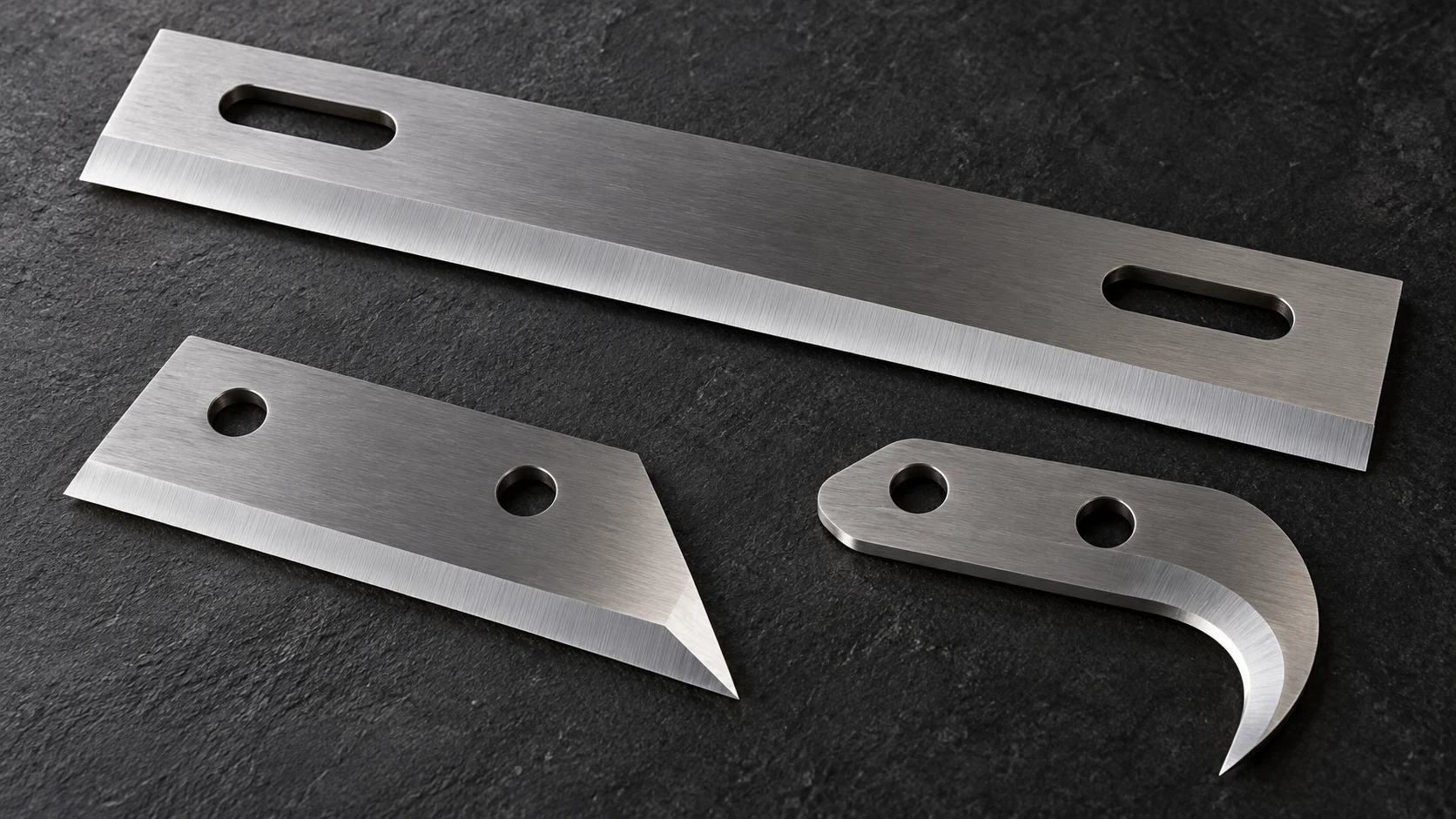
For a hooked knife, the tip location and curve can matter more than the overall length. For a straight knife, the position of the edge relative to the mounting slots may determine whether the part has the intended adjustment range.
| Feature | What it means for your replacement | Information to include |
|---|---|---|
| Presupuesto global | Whether the part fits the available space | Length, width, thickness and units |
| Cutting profile | Where and how the knife engages the work | Curves, angles, tip position and edge segments on an approved drawing |
| Mounting pattern | Whether the knife fastens to the intended holder | Hole/slot count, sizes and positions from defined references |
| Seating face | How the part locates when clamped | Identify the mounting face and relevant surface requirements |
| Bevel and edge direction | Which face and edge do the cutting | Side view, bevel specification and orientation |
| Critical fit dimensions | Which variation would affect the assembly | Agreed tolerances based on the design |
| Identidad de la pieza | Prevents similar variants being mixed | Part number, revision and quantity for each variant |
Locate the cutting edge from the approved mounting references. A hole pattern dimensioned from one edge and a profile dimensioned from an unrelated outline can leave their relationship unclear.
If your drawing has missing dimensions, mark them for review rather than estimating them from a scaled screenshot. A photograph can help identify the part; it cannot establish a precision tolerance.
Confirm the Cutting Face Before Calling Two Parts Identical
A single-bevel knife can look similar from above while differing on its opposite face. Likewise, two handed variants may share the same dimensions but occupy different positions in an assembly.
Provide both faces and the side profile. Identify the working position using the machine’s part reference or an assembly view. Terms such as “left-hand” and “right-hand” should refer to an agreed viewing direction rather than a guess based on a photograph.
A clear ordering description identifies:
- the part number and assembly position;
- the face that seats against the holder;
- the bevel location and cutting direction;
- the quantity of each distinct variant.
If two knives are intended to be different, give each its own order line. Calling them “two identical knives” can erase the distinction the supplier needs to manufacture.
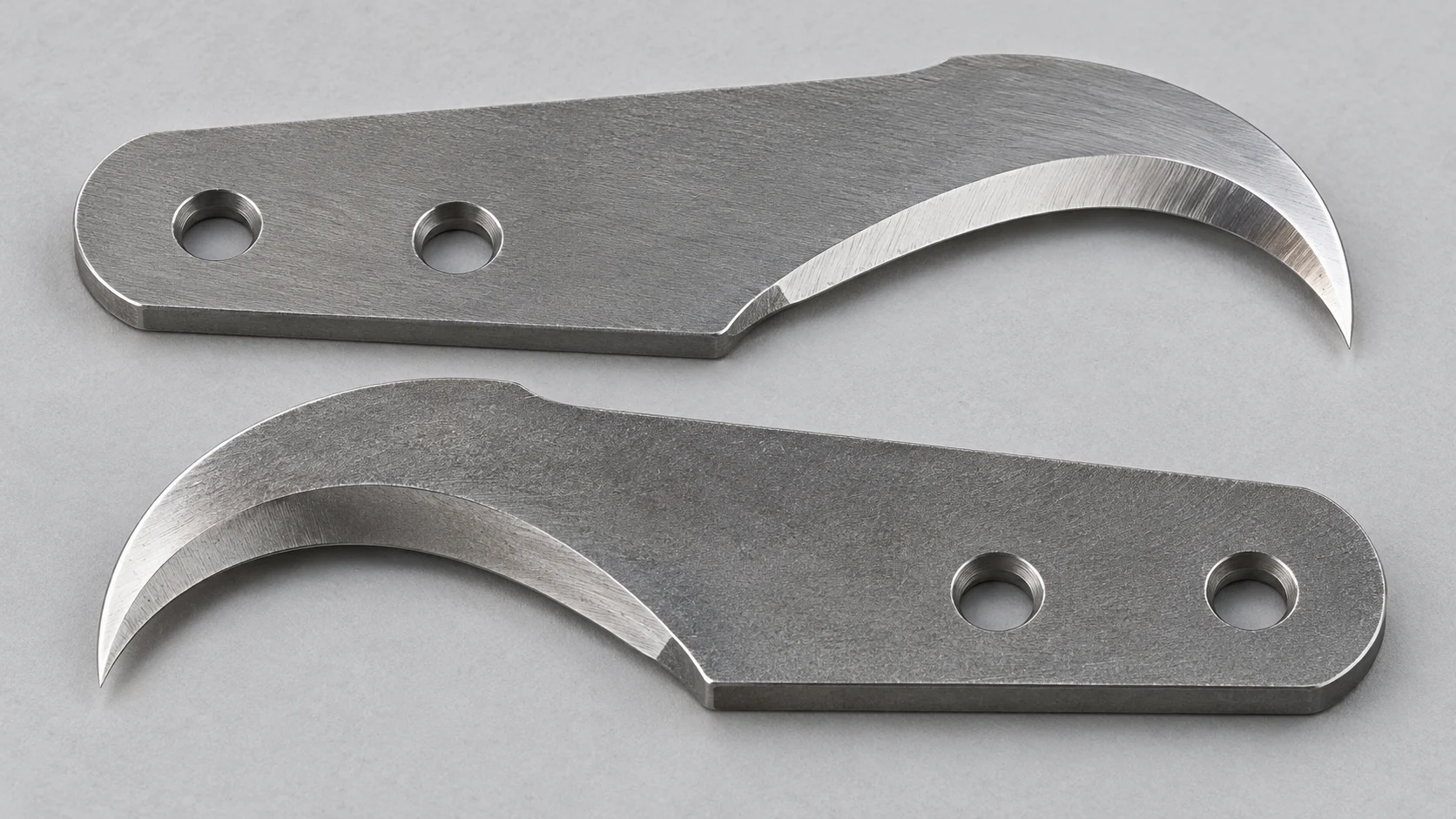
Working From an Old Sample: Preserve What Is Known
A used sample gives you physical evidence of mounting features and shape. It may also contain wear, grinding changes or repairs that should not be copied into the replacement.
Separate your observations into three groups:
| Observation | How to record it |
|---|---|
| Feature believed to be original | Identify its basis, such as the machine manual or an earlier drawing |
| Current measured feature | Label it as a measurement of the used sample |
| Known alteration | Describe sharpening, repaired holes, chipped tips or modified edges |
For a curved blade, a missing tip or worn contour can obscure the original cutting path. For a straight blade, repeated grinding can move the cutting edge relative to the mounting holes. Neither problem is solved simply by tracing the sample’s outline.
Take full-part photographs before sending the sample. Agree on identification, handling and return arrangements. Removal and measurement should follow the equipment’s prescribed isolation procedure through qualified personnel.
A sample-based inquiry can start before every detail is known. Production approval should come after the replacement geometry has been resolved.
Use NJDETE’s Material List to Start a Specification Discussion
NJDETE’s straight and special-shaped blade catalogue lists 9CrSi, Cr12MoV, W6Mo5Cr4V2, W18Cr4V, 3Cr13, 4Cr13 and 7Cr17. The same section describes drawing- or sample-based customization and applications including paper, labels, rubber-related processing, food products and tobacco processing.
Source: NJDETE product catalogue, straight and special-shaped blade section, printed page 38.
The list identifies catalogue material options. It does not assign one grade to every application or establish a common hardness and heat-treatment specification for all knives.
To discuss material, provide:
- the material being cut, including coatings, fillers or contaminants;
- the cutting action and existing machine arrangement;
- the approved current knife material, if known;
- whether the observed problem is progressive wear, chipping or another defect;
- cleaning, moisture or other relevant exposure conditions.
For food-related equipment, distinguish a knife that cuts packaging from one that contacts food. Specify the actual contact and cleaning requirements. A steel name alone does not establish compliance with the requirements of a particular market or process.
For an exact replacement, start with the approved existing material specification. For a proposed change, agree on the grade and evaluation criteria explicitly. Avoid changing steel, bevel and operating conditions together if you need to understand which change affected the result.
Match Acceptance Checks to the Features That Matter
The inspection plan should reflect the approved design. If the critical issue is a profile relative to mounting holes, measuring only overall length will not establish conformity.
| Design concern | What the order should define |
|---|---|
| Mounting fit | Agreed hole/slot dimensions, locations and seating requirements |
| Profile position | The approved contour and its relationship to reference features |
| Cutting direction | Bevel face, edge geometry and part orientation |
| Material requirement | Agreed grade and any required documentation |
| Repeat supply | Drawing revision, part identity and change approval process |
Specify any hardness, surface or dimensional requirements with the technical reviewer. Do not add a precision number because it sounds impressive or assume the same requirement applies to every feature.
An installation check and an operating evaluation serve different purposes. First establish whether the part conforms to the order and fits the intended assembly. Then evaluate cutting results under defined conditions, using the machine’s proper setup procedure.
Close the Specification Before Releasing the Order
Before approving production, resolve these four questions:
- Which drawing is authoritative? Record the revision and remove superseded sketches from the order package.
- Which parts are distinct? Separate handed or otherwise different variants and their quantities.
- What has changed? Identify approved differences from the old knife, including material or edge changes.
- How will conformity be checked? Agree on the features and records relevant to the specification.
For a broader quotation comparison checklist, see the custom knife drawing and RFQ guide. Its examples use straight granulator knives; this article adds the profile and orientation requirements for special-shaped parts.
A Short Inquiry Template for Custom Profile Knives
Machine model and knife position:
Exact replacement or proposed modification:
Part number and drawing revision:
Overall size and units:
Profile, mounting and bevel information:
Used sample condition and sharpening history:
Material being cut and current blade specification:
Quantity of each variant:
Delivery destination and required timing:
If a field is unknown, say so. That is more useful than turning an uncertain value into an apparent manufacturing requirement.
Preguntas frecuentes
Can a rough sketch start an inquiry?
Yes. Use it to communicate the shape, mounting concept and known dimensions. Identify estimated values and missing information. A rough sketch can support the first discussion, but it should not silently become the final production specification.
Should I supply a 2D drawing or a 3D model?
Provide the available approved design files and ask which format the supplier can use. A model can describe shape, while a drawing communicates dimensions, tolerances and other requirements. Ensure both represent the same revision; a model alone may not convey the manufacturing specification.
Can one part number cover several similar knives?
Avoid it when there are functional differences. Different bevel faces, profiles, mounting patterns or materials need clear identification. Separate part references help procurement, inspection and future repeat orders distinguish the variants.
How should I organize repeat orders?
Keep the approved drawing revision, material specification, inspection requirements and quantity breakdown with the original order. Confirm whether anything has changed before reordering. Photographs are useful references, but they should not replace the controlled specification.
Send NJDETE Your Drawing or Sample Details
If you have a current drawing, include its revision and quantities. If you only have an old knife, provide both-face and side photographs, machine information and any known alterations.
Contact NJDETE about custom straight and special-shaped blades to discuss the requirements and quotation. Describe the part in the form, then use the email or WhatsApp details shown on the contact page to share drawings and photographs.