

Shredder Blade Wear: When to Resharpen and When to Replace
Release time: 2026-10-06
If your shredder takes longer to process the same material, buying a new set of cutters may feel like the quickest answer. But a worn edge, a damaged bore and a feeding problem require different solutions. Replacing the blades without identifying the cause can leave you with the same production problem—and a larger maintenance bill.
Consider resharpening when wear is limited to recoverable cutting surfaces and the cutter can remain within the equipment manufacturer’s approved geometry. Consider replacement when damage or material removal would leave the cutter outside those limits. Suspected cracks, distortion or an insecure shaft fit require assessment before the machine returns to service.
For a double-shaft shredder, the decision also involves the surrounding assembly. A sharp cutter that no longer matches its spacers, neighboring cutters or required clearances is not a successful repair.
Start with usable output, not the appearance of the edge
Your first question should be: What has changed in the process?
Compare the current run with an earlier run using comparable material, loading and output requirements. Record accepted output, operating time, interruptions and the reason for each stop. A decline in output with different feedstock does not isolate blade wear.
| What you notice | What to compare before blaming the blades | Why it matters to you |
|---|---|---|
| Less material processed per hour | Feed dimensions, material composition and actual loaded running time | A change in feed can look like a cutter problem |
| More reversals or interruptions | Contamination, loading pattern and fault history | Repeated interruptions need a cause, not just a new edge |
| More material rejected downstream | Your output acceptance criteria and the downstream process | Gross discharge weight can hide a reduction in useful output |
| Wear concentrated in one area | Feed distribution, cutter positions and assembly condition | Replacing every cutter may overlook a local cause |
Use consistent definitions when you track capacity:
Accepted throughput = mass meeting your output requirement ÷ the time window you have defined.
For example, 600 kg of accepted material over a four-hour production window is 150 kg/h for that window. If the shredder was actually processing material for only three hours, its accepted throughput during processing was 200 kg/h. These are illustrative calculations, not NJDETE performance figures. Record both when downtime is part of your problem.
This distinction helps you decide whether to investigate cutting performance, interruptions or a mismatch between the equipment and the job. For a broader equipment decision, see our double-shaft shredder selection guide.
Identify the damage before choosing a remedy
Wear and breakage are not interchangeable descriptions. Tool-steel producer Uddeholm distinguishes wear, chipping and cracking among common cold-work failure mechanisms. That distinction is useful when describing a returned cutter; it does not diagnose your machine from a photograph. For a dedicated fault guide, see why shredder blades chip or crack before choosing a remedy.
The following is a practical inspection framework, not a substitute for the cutter’s approved service limits.
| Observed condition | The decision it raises | Information worth keeping |
|---|---|---|
| Gradual edge rounding or surface wear | Can the working profile be restored within approved dimensions? | Consistent photographs, dimensions and previous grinding history |
| Localized chips | Can all damage be removed while preserving a serviceable profile? | Location, extent and whether neighboring cutters show similar damage |
| Suspected cracks or missing sections | Does the component need rejection or specialist examination? | Photographs and operating events before removal |
| Distortion or abnormal bore wear | Can the cutter still seat and transmit load as designed? | Bore condition, mounting details and shaft observations |
| Strongly uneven wear across the set | Is there an assembly or operating issue behind the pattern? | Cutter order, orientation and feed distribution |
Before physical inspection, follow the machine’s isolation and stored-energy procedure. Keep hands out of the cutting chamber until the required safe condition has been established.
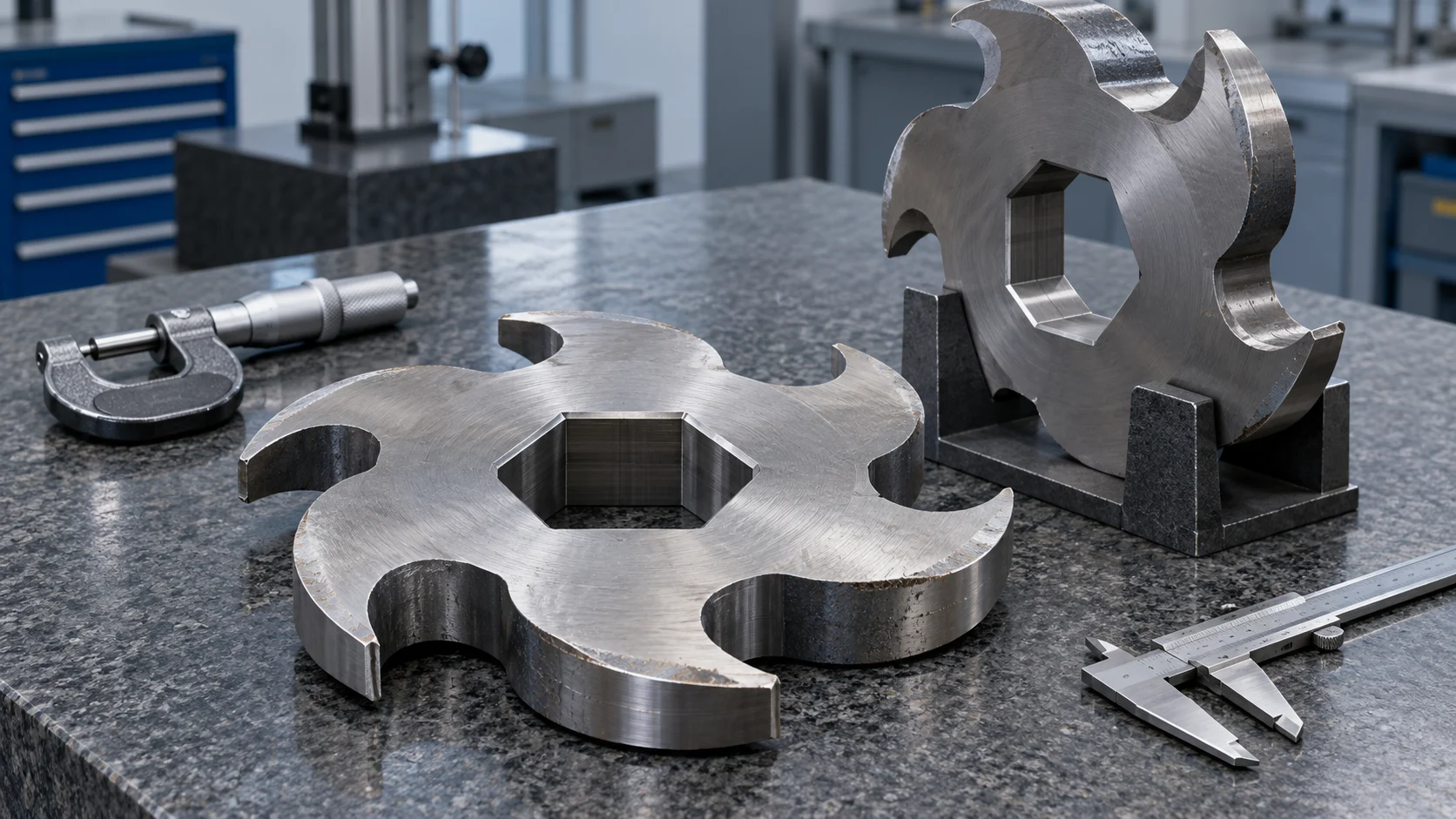
AI-generated editorial illustration; not a NJDETE inspection record. Photograph your actual cutter and retain its assembly position when requesting an assessment.
Video
Watch the supplied video on YouTube.
When resharpening is worth evaluating
Resharpening is a useful option only when it returns the cutter to a usable condition. A visually sharp edge is one part of that assessment.
Before approving the work, ask the equipment manufacturer or qualified regrinding provider to confirm:
- Permitted surfaces and profile. Which surfaces may be ground, and what geometry must remain?
- Remaining dimensions. What are the minimum acceptable dimensions for this specific cutter design?
- Damage removal. Can the affected region be removed completely within those limits?
- Assembly compatibility. Will the finished cutter remain compatible with the required cutter, spacer and counter-knife arrangement?
- Acceptance checks. What dimensions and condition checks will be recorded before the cutter is released?
Grinding is a controlled manufacturing operation. Uddeholm’s Grinding of Tool Steel guide explains why grinding practice must suit the tool steel. A workshop’s ability to make an edge sharp is not, by itself, evidence that it can restore your cutter correctly.
Avoid asking only, “How many times can this blade be sharpened?” The more useful question is, “What usable geometry remains after this proposed grind?” Previous material removal and current damage affect the answer. There is no defensible universal number of regrinds for all shredder cutters.
If dimensions are incomplete, use our guide to measuring shredder blades for replacement to organize the information before requesting a recommendation.
When replacement is the stronger option
Replacement becomes the stronger option when the proposed repair cannot meet the approved geometry, the mounting condition is compromised, or damage cannot be removed within the permitted limits. Suspected cracking calls for assessment; do not treat a crack as ordinary dullness and resume operation after cosmetic grinding.
Replacement may also make commercial sense when recovery, transport and the expected interruption cost more than a suitable replacement arrangement. Compare complete options, not just the grinding invoice against the price of a new cutter.
| Compare these items | Resharpening option | Replacement option |
|---|---|---|
| Part eligibility | Confirm recoverable condition and remaining geometry | Confirm drawing, fit and material specification |
| Machine availability | Include removal, inspection, grinding and return | Include confirmed availability or production time |
| Assembly work | Identify any adjustments the approved repair requires | Identify matching cutters, spacers or other parts required |
| Recurring failure | Address why the previous set deteriorated | Address the same cause before installing new parts |
For procurement, the useful outcome is a compatible, documented cutter arrangement. Start with the NJDETE double-shaft shredder blades page, then supply the drawing and condition information needed to discuss your specific machine.
Should you replace one cutter or the whole set?
One damaged cutter does not automatically mean every cutter is unusable. Equally, one new cutter is not automatically compatible with the remaining worn set.
The decision depends on the measured geometry, wear distribution and the manufacturer’s assembly requirements. Ask whether the replacement can match the intended working arrangement—not merely whether it has the same nominal outside diameter.
Retain the positions and orientation of removed cutters and spacers. If parts are mixed before inspection, you may lose useful evidence about localized wear and assembly condition. Discuss partial replacement using a set-level record rather than an isolated photograph.
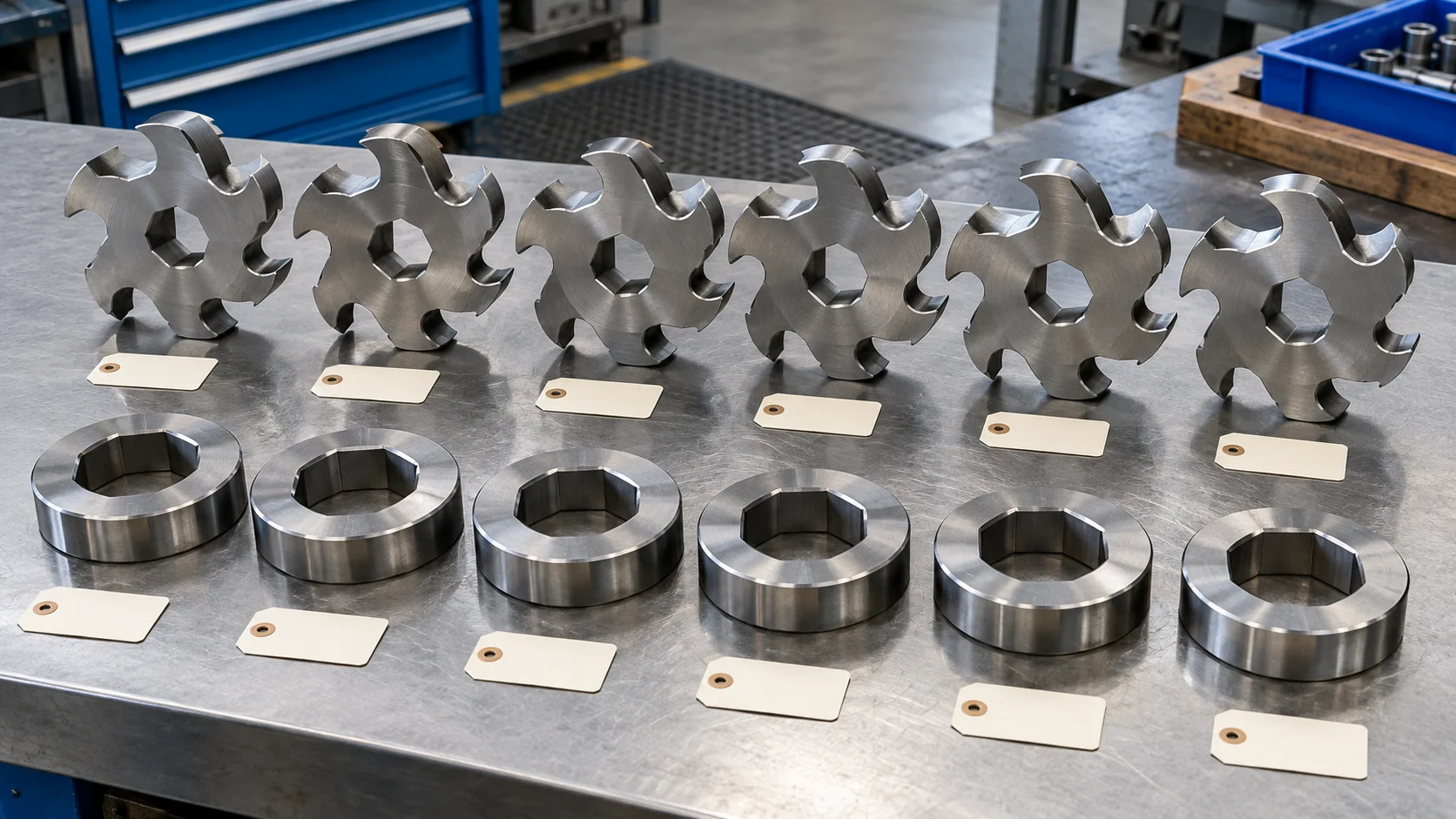
AI-generated editorial illustration; not a NJDETE service record. Actual cutter and spacer arrangements depend on the machine design.
For the wider maintenance job, including preparation and purchasing information, use the shredder blade replacement guide.
Improve the next purchase with the evidence you already have
You do not need a laboratory report to start a useful supplier discussion. A clear description of the problem is more valuable than an unsupported request for “the hardest steel available.”
If edges gradually wear, describe the material and contamination. If teeth chip repeatedly, include the loading conditions and any unusual events. If wear is uneven, show the full arrangement. Those observations help frame the questions about geometry, material and operating conditions; they do not independently establish the cause.
Prepare one enquiry with:
- Machine identification and an approved cutter drawing, if available.
- The material processed, typical feed dimensions and known contamination.
- Overall cutter photographs, close-ups of damage and a position record.
- Current dimensions and any previous grinding history.
- Accepted output and interruption records from comparable production runs.
- The parts required and your planned maintenance window.
If you have no maintenance history, begin with the current condition. Mark unknown information as unknown and keep the removed parts available for assessment. A short, honest record is a better purchasing basis than a guessed material grade or service-life figure.
Frequently asked questions
Should I buy harder replacement shredder blades to prevent wear?
Do not select on hardness alone. First establish whether your main problem is gradual wear, chipping, deformation or another condition. Ask the supplier to explain how the proposed material, heat treatment and cutter geometry address that problem. A hardness number without the operating context does not establish suitability.
Can I use an old drawing after several resharpening cycles?
Keep the original approved drawing as a reference, but identify it as the original geometry. Add the current measured condition and grinding history where available. Ask which dimensions the supplier needs to match and whether the rest of the installed assembly has changed. Do not silently substitute worn measurements for the design dimensions.
How should I decide how many spare cutters to keep?
Use confirmed replenishment time, the frequency and pattern of previous replacements, and the cost of an unplanned stop. Ask whether individual spare cutters can be matched to the installed arrangement or whether a prepared set is more practical. There is no universal spare quantity that fits every shredder.
What if I cannot tell whether a mark is a crack?
Treat it as unresolved damage and arrange assessment before returning the component to service. Provide close-up photographs and the circumstances in which the mark was found. A photograph may help triage the issue, but it cannot always establish the depth or nature of a defect.
Get a replacement enquiry ready for review
If replacement appears necessary, send NJDETE your cutter drawing, condition photographs and machine details. Include what you process and what has changed in production so that your enquiry covers the job the cutter must do—not just the shape of the part.