

Granulator Rotor Knives vs Bed Knives: A Replacement Buyer’s Guide
Release time: 2026-10-07
A replacement knife that does not fit can keep your granulator out of production longer than the blade change itself. Before you compare prices, separate the order into rotor knives and bed knives. Give each part its own drawing reference and quantity—even if you want a single price for the complete set.
Rotor knives turn with the rotor. Bed knives, also called stationary or stator knives, stay fixed in the cutting chamber during operation. The two work together to cut the plastic. They are different parts, and matching the blade length alone is not enough to order either one.
For most replacement enquiries, the details that decide fit are the mounting pattern, blade dimensions, bevel orientation and position of the cutting edge. Get those right first. Material selection comes next.
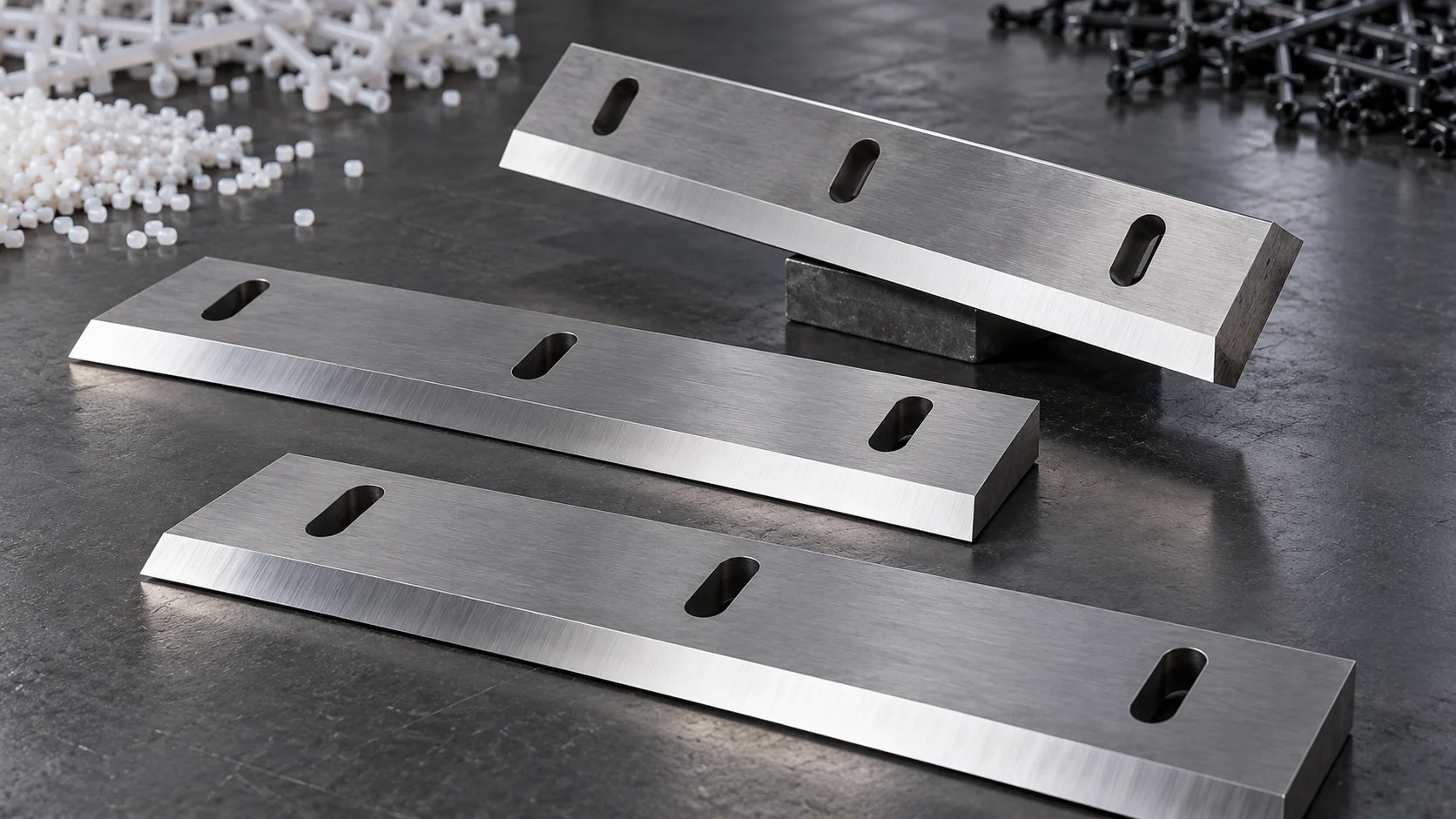
Generic knife illustration; dimensions and mounting details vary by machine.
Granulator rotor knives vs bed knives: what are you buying?
A quotation for “one set of granulator blades” needs a parts list. Without it, two suppliers may be pricing different quantities or leaving out the stationary knives.
| Detail | Rotor knives | Bed knives |
|---|---|---|
| Location | Mounted on the rotating assembly | Mounted at stationary positions in the chamber |
| Other common name | Rotating knives | Stationary knives or stator knives |
| Drawing must identify | Rotor mounting interface and cutting-edge orientation | Bed mounting interface and cutting-edge orientation |
| Quantity | Depends on the rotor configuration | Depends on the chamber configuration |
| Replacement check | Fit to the rotor and relationship to the bed knives | Fit to the bed and relationship to the rotor knives |
A bed knife stays stationary while the machine runs, but its mounting may allow adjustment during setup. Adjustment methods vary. For example, Conair describes pre-adjustment of the rotor-to-bed-knife gap on its 17 Series Viper granulators. Use your own machine documentation to establish which parts move during adjustment and how the gap is set.
When comparing quotes, ask each supplier to list the rotor knives, bed knives and any other included parts separately. This makes a missing item easier to spot before the order is placed.
Have the drawing? Send it. Only have an old knife? Say so.
An approved drawing gives the supplier nominal dimensions and tolerances. A used knife shows the condition of a part after service. Both can be useful, but they answer different questions.
If the sample has been reground, tell the supplier. Otherwise, the reduced width or altered edge position may be mistaken for the original specification. Include an unused spare or the original drawing if either is available.
For knives made from samples, agree who will approve the resulting drawing before production. That drawing then becomes a useful reference for repeat orders.
| Send this information | Why the supplier needs it |
|---|---|
| Machine manufacturer, model and identification | To identify the equipment and any relevant configuration differences |
| Rotor or bed knife designation | To distinguish parts that may look similar on the bench |
| Length, width and thickness | To define the blade envelope and its fit in the mounting |
| Hole or slot dimensions and positions | To match the fasteners and adjustment arrangement |
| Bevel geometry and edge orientation | To reproduce the working edge in the correct position |
| Drawing revision, units and tolerances | To give manufacturing and inspection the same reference |
| Quantity for each part | To define the complete order |
| Regrinding history | To explain differences between a worn sample and the original design |
Photograph the broad face, mounting details and edge profile separately. Label rotor knives and bed knives before packing them. If the machine uses segmented or handed knives, keep the position references with the parts.
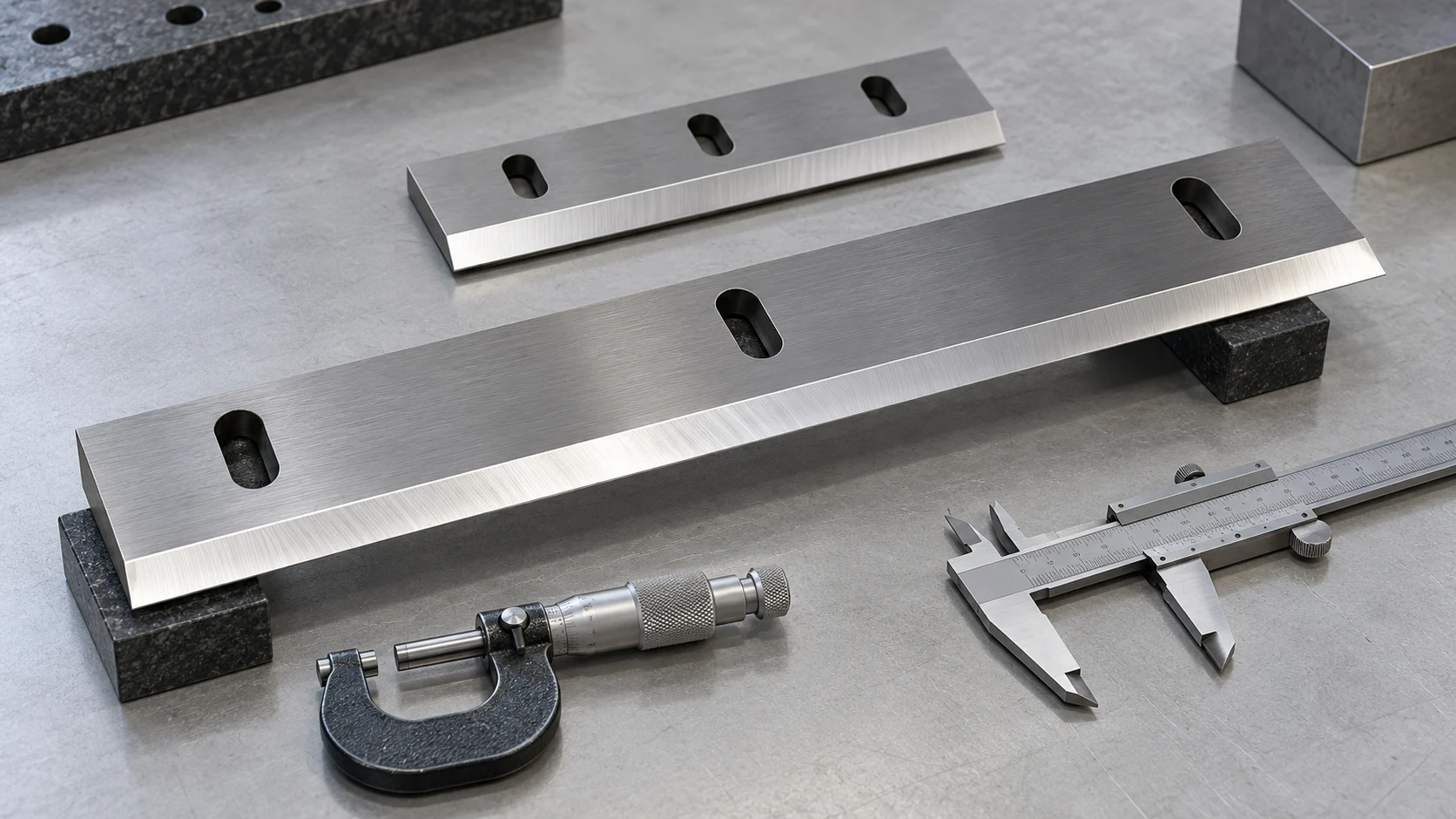
Slotted holes help adjustment—but do not make a knife universal
NJDETE’s plastic crusher blade specifications list slotted mounting holes and customizable length, width and thickness. These are useful starting points for a replacement enquiry.
The slots still need to be in the right place. The seating surface, fastener arrangement and cutting-edge position must also suit the machine. A knife that bolts into the holder but cannot reach the required setting is not a suitable replacement.
Send the mounting drawing with the blade drawing where possible. If a supplier proposes a change to the slot or knife dimensions, have it reviewed against the assembly before approving production.
Replace one knife, one group or the complete set?
You do not automatically need a full set because one knife is damaged. You do need to know whether the retained knives can work with the replacement at the specified setting.
| Condition | Buying decision |
|---|---|
| One damaged knife; the remaining parts are serviceable | Ask whether an individual replacement can match the retained arrangement |
| Both rotor and bed knives are worn | Compare assessed regrinding with replacement of both groups |
| Several previous regrinds, with no dimensional records | Establish the current geometry before repeating an old order |
| Planned shutdown with little time for correction | Check the replacement parts and quantities before taking the machine out of service |
Ask what “matched set” means in the quotation. It may refer to a common drawing revision, controlled finished dimensions or identified installation positions. Have the agreed requirement written into the order.
On receipt, check part identification, quantity and agreed dimensions while there is still time to resolve discrepancies. Do not leave the first comparison with the drawing until the maintenance team has dismantled the machine.
What if output falls after changing the knives?
Start with what changed. If the problem began immediately after replacement, check the supplied parts and installation before ordering a different steel grade. For a structured checklist covering clearance, feedstock and screens, see plastic granulator cutting problems: what to check.
Have qualified personnel work through the following under the machine’s safe maintenance procedure:
- Compare the installed knives with the ordered drawings, including orientation and mounting details.
- Check seating, fastening and the prescribed cutting gap.
- Review screen condition and any change in feedstock or feeding practice.
- Compare accepted output and interruptions using similar production conditions.
A slower run is not enough to isolate a blade problem if you have also switched from clean runners to bulky rejected housings. Our injection molding scrap recycling guide covers that distinction in more detail.
Keep the production record short: material processed, screen used, accepted output, operating time and reason for each stop. This gives the supplier something concrete to investigate.
Which cutting gap should you use?
Use the machine manufacturer’s specified clearance for the exact rotor and knife arrangement. There is no universal gap for every plastic granulator.
For a replacement order, establish whether the finished knife dimensions allow that setting and how it will be checked after installation or regrinding. The specified gap and fastening procedure belong with the machine’s maintenance instructions.
Before accessing the chamber, qualified personnel must follow the required isolation, stored-energy and rotor-restraint procedures. This article is a purchasing guide, not an installation procedure.
Choosing SKD11, Cr12MoV or 9CrSi
NJDETE’s product-specific specification lists SKD11, Cr12MoV and 9CrSi tool steel, along with precision grinding and heat treatment. The choice should start with the job: polymer, filler content, contamination, feed thickness and the condition of the previous knives.
Describe the failure in plain terms. Did the edges gradually round off? Did chips appear after an unusual load? Was wear concentrated at one end? Those observations help the supplier frame its recommendation.
Do not select a replacement solely because its quoted hardness is higher. Ask how the proposed material and heat treatment suit the application, and make the ordered specification clear. Compare quotations against the same dimensions, material requirements and inspection requirements; otherwise a lower price may cover a different part.
What to include in your enquiry
You can use the following as an email checklist:
- Machine: manufacturer, model and identification.
- Rotor knives: drawing reference, revision and quantity.
- Bed knives: drawing reference, revision and quantity.
- Reference parts: new spare, used sample or photographs; note previous regrinding.
- Material processed: polymer, fillers, contamination and typical feed dimensions.
- Reason for replacement: planned change, gradual wear, damage or poor cutting after a previous change.
- Order requirements: specified material, inspection documents, destination and required delivery date.
If a field is unknown, leave it marked as unknown. A supplier can ask for the missing information; a guessed dimension or material grade can become an expensive misunderstanding.
Frequently asked questions
Are plastic crusher blades and granulator knives the same thing?
Supplier descriptions often use these terms for overlapping products. Identify the actual cutting arrangement and part drawing rather than relying on the name. Straight rotor and bed knives should not be confused with the cutter discs used in a double-shaft shredder.
Can I get a quotation from one sample knife?
A sample can help identify that part. It may not identify the opposing knife or every item in the set. State whether the sample is a rotor or bed knife, whether it has been reground, and which other parts you plan to retain. Include machine information and the required quantities.
Should my drawing use inches or millimeters?
Either can be specified, but make the units explicit. Preserve the approved nominal dimensions and tolerances; do not round converted dimensions for convenience. Use the same units and drawing revision in the quotation and inspection requirements.
Can I keep using the same knives when changing to another plastic?
Review the new material with the equipment and blade suppliers. Fillers, contamination and section thickness can change the demands on the knives even when the parts still fit the machine. Include the new feedstock details when asking whether the existing specification remains suitable.
Send the part details for a replacement quotation
For custom straight knives, review the NJDETE plastic crusher and granulator blade page. For a full preparation list, see our drawing and quotation checklist for custom granulator knives. Then send your drawings and separate rotor-knife and bed-knife quantities.
If you only have used parts, include clear photographs and their regrinding history. This helps establish which details are available and what needs resolving before a replacement order can be finalized.