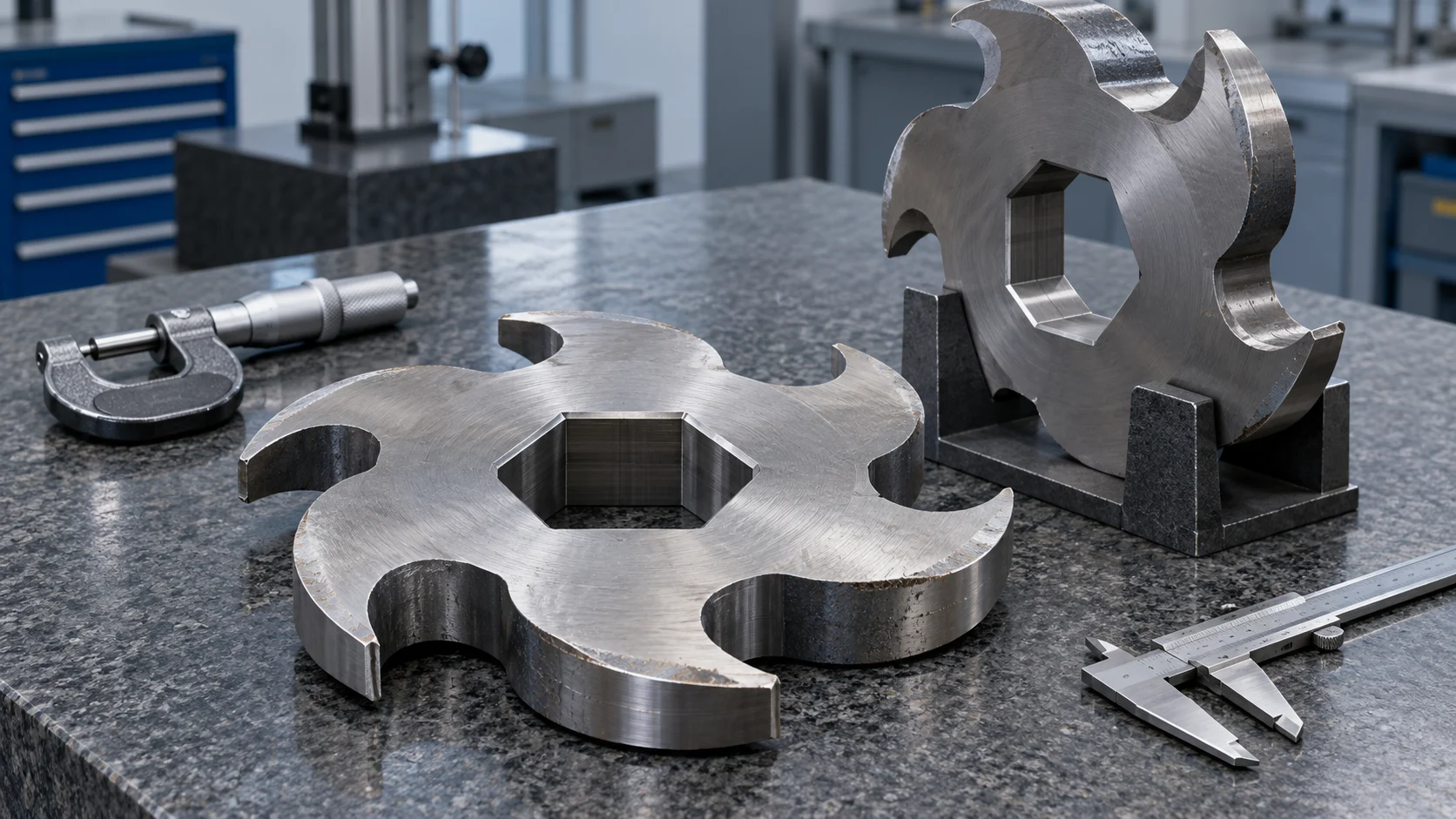


Plastic Granulator Cutting Problems: What to Check Before Replacing the Blades
Release time: 2026-10-10
If your plastic granulator starts producing more dust, uneven regrind or less usable output, buying another set of knives may not solve the problem. First establish when the change began and what changed with it.
If cutting quality deteriorated immediately after a knife change, start with the replacement specification, seating and prescribed knife clearance. If performance declined gradually, compare edge condition, feedstock and screen condition against the last satisfactory run. More than one cause can be present.
This guide helps you organize that investigation before ordering replacement plastic crusher blades. It applies to machines that cut plastic with rotor knives and stationary bed knives, rather than melt-pelletizing equipment.
Choose Your Starting Point: After a Knife Change or During Production
A problem that starts with a knife change calls for an installation and specification review. A problem that develops during use calls for a wear, feedstock and discharge review. This distinction keeps you from paying for another set of knives before identifying what the replacement needs to correct.
Route A: Cutting Became Worse Immediately After Replacement or Regrinding
- Confirm the part. Match the drawing revision, rotor or bed position, thickness, mounting pattern and bevel orientation. A sharp edge on the wrong geometry is still the wrong replacement.
- Check the seating and adjustment. Have qualified maintenance personnel verify the assembly under the machine procedure. An adjustment slot cannot compensate for an incorrect seating face or cutting-edge position.
- Verify the knife gap across the specified positions. Record the readings, rather than only writing “gap checked.” A setting at one location does not establish the condition of the entire knife arrangement.
- Confirm the feed and screen configuration. If the material or screen also changed, the run is not a direct comparison with the previous knives.
If the specification or installation is unresolved, settle that before changing steel grade. If all these checks pass but the problem remains, escalate the complete records for a machine and application review.
Route B: Cutting Became Worse Gradually
- Map the wear. Compare the rotor and bed knives. Record rounding, chips and whether deterioration is uniform or concentrated at one position.
- Check what entered the machine. Record fillers, dirt, foreign metal, thickness and any feed changes. Contaminated scrap and clean molding runners impose different conditions.
- Inspect the screen and discharge. Record blocked or worn openings and any material buildup under the machine’s maintenance procedure.
- Compare accepted output under consistent conditions. Keep rejected material and stoppages visible in the record.
If wear is uniform, an assessment of sharpening and remaining knife geometry may be appropriate. Local chips or uneven deterioration call for investigating contamination, loading and assembly condition before simply ordering a harder knife.
Unusual impact noise, vibration or suspected interference is a stop-and-investigate condition. Before chamber access, follow the machine’s shutdown, energy-isolation and access procedure. These routes organize the investigation; they do not replace maintenance instructions.
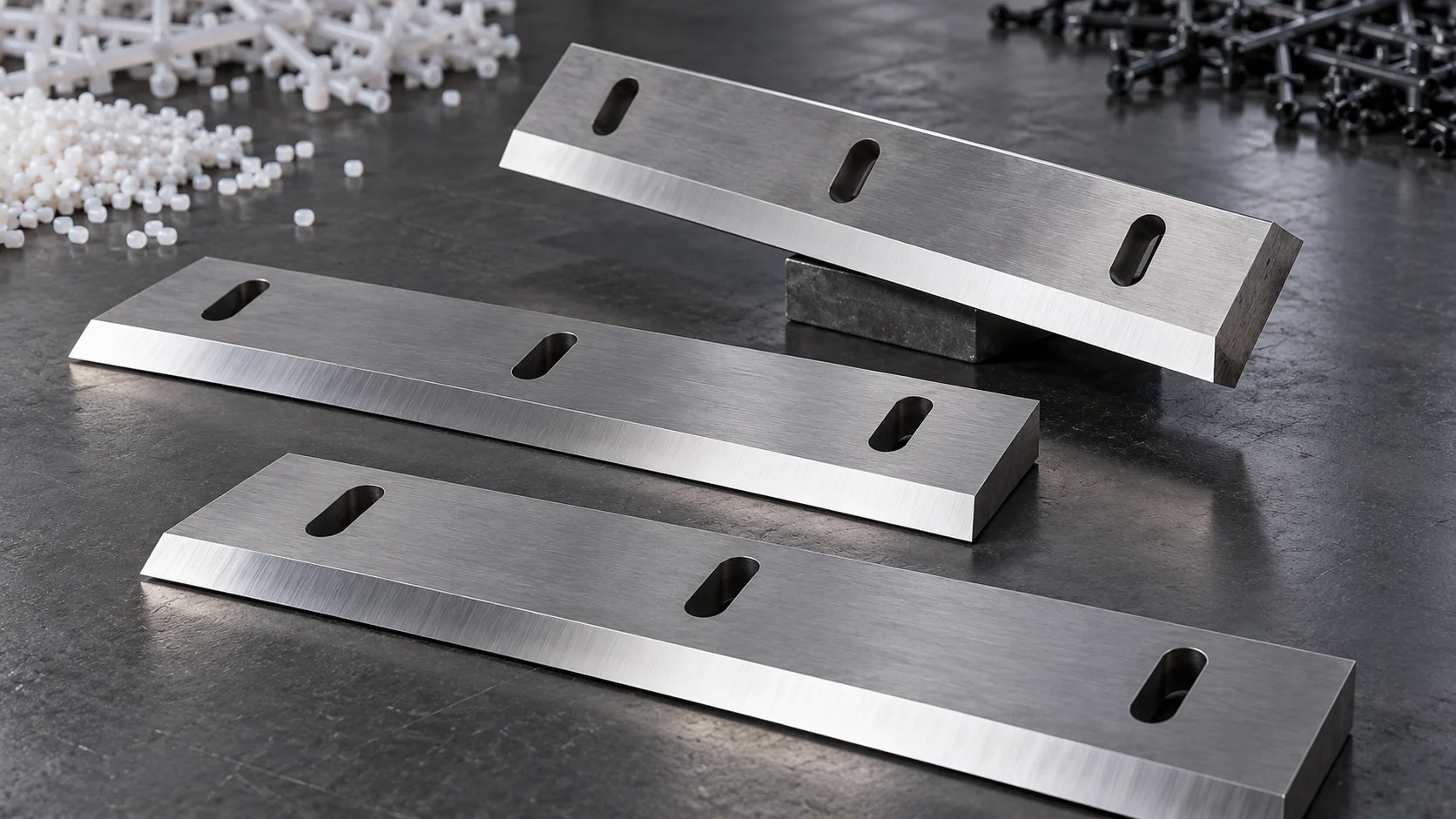
Match the Symptom to a Check, Not an Assumption
Dust, torn pieces and lower output can have overlapping causes. Record the symptom, then check the parts of the cutting and discharge system that could explain it.
| Symptom | Possible contributors | What to record or inspect |
|---|---|---|
| Plastic tears or folds rather than cutting consistently | Worn edges, unsuitable geometry, incorrect setting or a feed change | Edge condition, actual feed form and the approved knife arrangement |
| More fines or dust than before | Changes in cutting condition, feedstock or how long material remains in the chamber | Comparable output samples, knives, screen condition and discharge behavior |
| Long or uneven pieces | Screen damage or unsuitable openings, knife condition, or a changed material | Screen identity and condition, sample shape and cutting setup |
| Less usable output | Feed restrictions, deterioration in cutting, screen blockage or downstream limitations | Feed and discharge records, screen condition and accepted output quantity |
| Chipped edges | Hard contamination, impact loading, setup problems or an unsuitable specification | Damage location, feed contamination and assembly information |
| Heat, smearing or sticking | Feed temperature, buildup, cutting condition or discharge problems | Material temperature where known, deposits and when the symptom begins |
Treat this as a list of hypotheses to check. For example, excess fines do not prove that the steel grade is wrong, and longer pieces do not prove that the knives are blunt.
Check Rotor Knives and Bed Knives as a Working Pair
A sound rotor knife cannot compensate for every problem in the stationary knife or its mounting. Inspect both sides of the cutting pair and preserve their separate part identities.
Look for rounded edges, local chips, cracks, uneven wear and deposits. Note whether damage affects all knives or only one position. A photograph should show the affected location as well as the complete knife; an isolated close-up can hide where the problem sits in the assembly.
Next, compare the parts with the approved drawing or machine specification. Overall length alone is insufficient. Thickness, hole or slot positions, bevel orientation and the location of the cutting edge relative to the seating face can change how the part works.
For the difference between rotating and stationary parts, see rotor knives vs bed knives. Keep each part’s measurements and quantity separate when preparing an order.
Use the Machine Specification for Knife Clearance
There is no single knife-gap value that should be copied into every plastic granulator. Use the requirement and checking procedure for your exact machine, rotor and knife arrangement.
Published machine settings show why the exact configuration matters. In the 8 Series granulator manual UGG053-0517, standard-material clearance guidance is 0.15–0.25 mm, while the film guidance is 0.10–0.25 mm. The manual also states that the guidance depends on material type and form. These values describe that documented equipment family; they are not settings to apply to an unidentified machine.
For a buyer, the useful conclusion is not “use 0.20 mm.” It is ask which manual, material category and knife arrangement support the proposed setting. A quotation or replacement proposal should preserve that connection.
| Information to resolve | What it means for your replacement decision |
|---|---|
| Exact machine and knife arrangement | Establishes which setting and geometry apply |
| Standard rigid feed or film guidance | Prevents treating materially different cutting tasks as identical |
| Readings at the prescribed positions | Helps reveal variation that one measurement would miss |
| Remaining dimensions after sharpening | Establishes whether the approved setting can still be restored |
For your machine, qualified personnel should verify the specified setting at the positions required by its procedure, rather than assuming one accessible point represents the whole cutting arrangement. Seating, adjustment and remaining knife dimensions after regrinding all need to be considered.
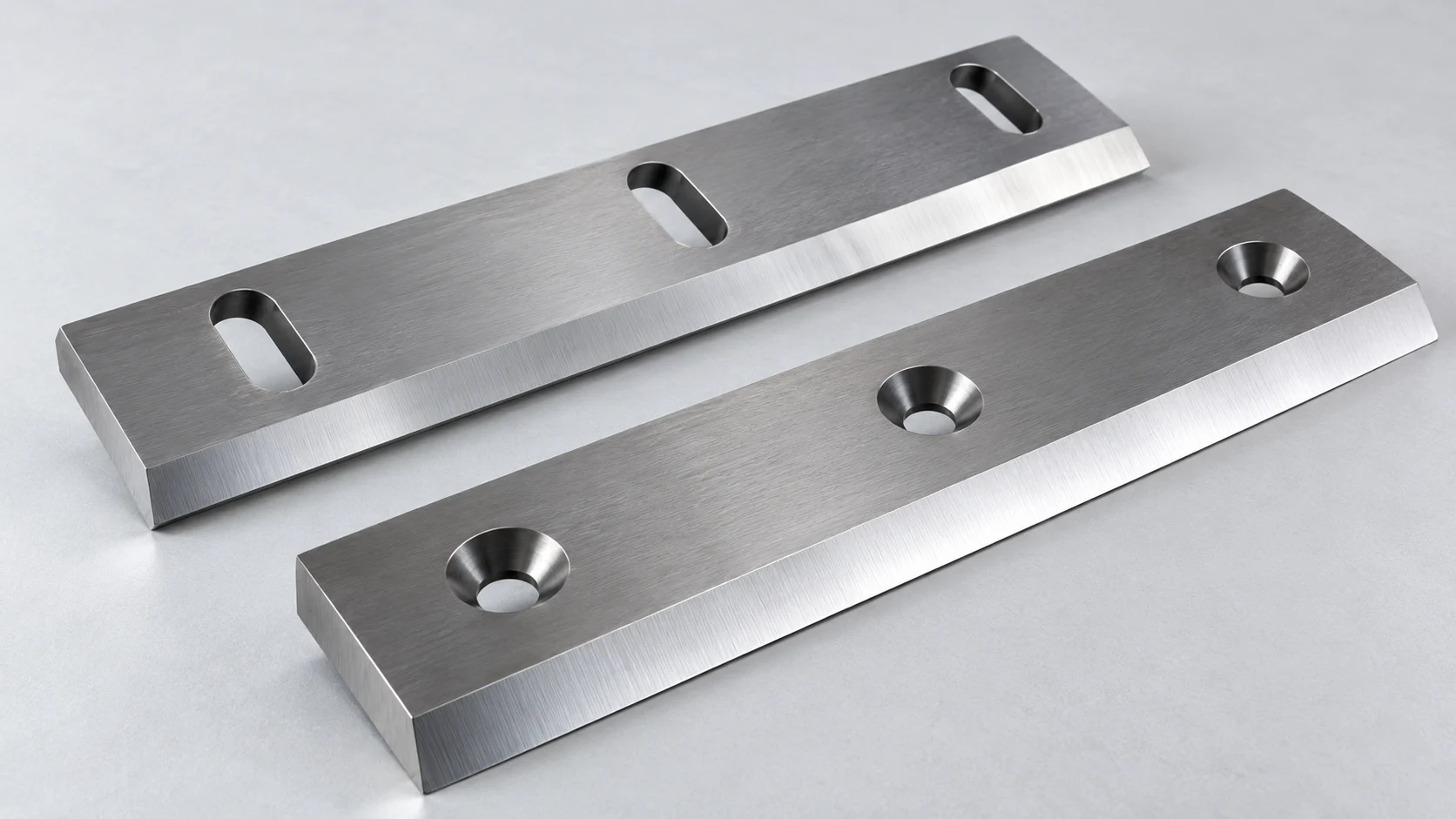
A slotted mounting hole provides adjustment within a designed arrangement. It does not make a knife compatible with any machine, or establish the correct operating gap.
Compare the Feedstock Before Changing the Blade Material
A material change can explain a cutting problem even when the polymer name stays the same. Clean molding runners and filled, contaminated or thicker parts are different operating inputs.
Record the polymer, known fillers, maximum section thickness, feed form and contaminants. Include whether parts arrive loose, bundled or at a different temperature. If you changed the feed rate or handling method, record that too.
NJDETE’s current plastic crusher blade product page lists SKD11, Cr12MoV and 9CrSi, along with custom dimensions and slotted adjustment holes. These published options are a starting point for specifying a blade, not a universal ranking of materials.
Before requesting a different steel, explain what the current knife is doing: gradual rounding, localized chipping, corrosion or another observed condition. Include the cutting material and machine arrangement. “Use a harder blade” leaves out the information needed to assess the proposal.
Include the Screen and Discharge in the Investigation
More dust with lower output calls for checking both cutting and discharge. Long pieces or a changed size distribution also make screen condition worth investigating.
As knife edges wear, cutting becomes less clean and the relationship between the knives and screen can change. In some arrangements, low-bulk-density material such as film can accumulate at the screen instead of leaving the chamber efficiently. Screen openings can also enlarge through wear, allowing a different size distribution to pass. These mechanisms explain why fitting sharper knives alone does not address every regrind problem.
Confirm that the installed screen is the specified part and inspect it for damage, deposits and blocked openings using the machine’s procedure. Also check whether downstream equipment or collection conditions changed.
Compare the output requirement with what you actually measure. Screen openings are one part of size control; they should not be treated as a promise that every discharged particle will have identical dimensions.
For a repeatable comparison, collect output samples over the same period and under recorded conditions. A photograph of one handful can show appearance, but it does not quantify the whole production run.
Measure Usable Output, Not Just Material Entering the Hopper
If your concern is capacity, record accepted output over a defined time. Feeding material into the machine is not the same as producing regrind your next process can use.
A basic comparison is:
Usable output rate = accepted output mass ÷ elapsed comparison time.
Choose and record a consistent time basis. If it includes stoppages, say so; if it includes running time only, report those stoppages separately. Otherwise two apparently different output rates may simply use different definitions.
| Record | Why you need it |
|---|---|
| Machine and knife identification | Confirms which configuration produced the result |
| Polymer, fillers and feed dimensions | Makes the material comparison meaningful |
| Knife condition and last replacement/regrinding | Helps distinguish installation changes from progressive wear |
| Approved clearance and verification record | Establishes the setting used for the comparison |
| Screen identity and condition | Records the discharge configuration |
| Comparison duration and accepted output mass | Provides the basis for usable output rate |
| Stoppages and rejected material | Shows losses that a simple feed estimate misses |
| Output photographs or retained samples | Allows a consistent quality comparison |
For example, 180 kg of accepted regrind over a 45-minute comparison gives 240 kg/h. This is an illustrative calculation, not a machine capacity claim. If you exclude stoppages from the denominator, label the result as a running-time rate; it cannot be compared directly with a rate based on total elapsed time.
You can begin with existing production records. Keep measured results separate from estimates, then use the same recording method for the next comparison.
Decide Whether to Correct the Setup, Regrind or Replace
Choose correction when fit or setup is unresolved, assess sharpening when approved geometry can be retained, and replace when acceptable repair is no longer possible. Operating hours alone do not establish any of these outcomes.
| Finding | Next action | What to settle before spending on new knives |
|---|---|---|
| Wrong part, bevel or mounting interface | Correct the specification | Approved drawing and rotor/bed identity |
| Correct part but setting unresolved | Complete the maintenance review | Seating and prescribed clearance verification |
| Wear potentially removable | Assess regrinding | Minimum usable dimensions and approved edge geometry |
| Damage or insufficient remaining material | Assess replacement | Damage extent and correct replacement specification |
| Repeated damage with contamination or changed feed | Review the operating cause and specification | Feed condition, loading and any proposed material/design change |
The replacement purchase should solve the identified requirement. Otherwise a new knife may reproduce the same problem.
- Correct the specification or setup first when the problem began after a change and the part identity, seating or setting remains unresolved.
- Assess regrinding when wear can potentially be removed while retaining the knife’s approved geometry, adjustment range and usable dimensions. The assessment needs the relevant limits.
- Assess replacement when damage or remaining dimensions prevent an acceptable repair, or the current parts cannot meet the approved specification.
- Review the material or design separately when a documented operating change creates a different requirement. Identify the proposed change rather than mixing it into an “exact replacement” order.
If inspection identifies cracks, interference or another unsafe condition, keep the machine out of service until the responsible maintenance personnel resolve it under the applicable procedure.
Send NJDETE the Problem and the Part Information Together
For a replacement-blade inquiry, send enough information to connect the required part with the operating problem. A defect photograph alone cannot define the replacement, and a drawing alone may not explain why you want a change.
Use the granulator knife drawing and RFQ guide to prepare machine identification, separate rotor and bed knife details, a drawing or identified sample, and the required quantities. Add the symptom, when it started, feedstock information and any completed checks.
If you have only a used knife, state its regrinding history where known. Do not present worn dimensions as confirmed original dimensions.
Send your knife drawing, machine details and cutting-problem photos to NJDETE for a replacement-blade inquiry. Identify whether you need an exact replacement or want a specification change assessed.
Frequently Asked Questions
What should I send if the knives look sharp but the regrind is poor?
Send the machine identification, knife specification, output photos, feedstock description and timing of the problem. Include any completed clearance and screen checks. A visually sharp edge does not establish correct geometry, installation or suitability for the current feed.
Can I compare two blade offers using steel grade alone?
No. Compare the drawing revision, dimensions, mounting features, edge geometry, quantities and any agreed inspection requirements as well. Identical material names do not establish that both quotations cover the same finished parts.
Should I order rotor knives and bed knives together?
Inspect and identify both. Whether you need an individual part or a matched replacement set depends on their condition and the machine’s requirements. Supply separate part details and quantities instead of assuming both knife types are interchangeable.
What if I do not have a measured throughput record?
Start with the information available: the material, machine, symptom, approximate timing and output samples. Label estimates clearly. For a later comparison, record accepted output and elapsed time using the same conditions and time basis.