

اختيار آلة تقطيع البراميل البلاستيكية: البراميل الكاملة المصنوعة من البولي إيثيلين عالي الكثافة (HDPE) والمخرجات
تاريخ الإصدار: 15 أكتوبر 2026
Choose a plastic drum shredder by the largest accepted drum, its stiffest sections and the output your next process requires. If eliminating pre-cutting matters, make whole-drum feeding an explicit acceptance condition. Establish the material condition, attachments and permitted preparation before comparing drive power or machine size.
A nominal drum volume is insufficient for selection. The body must enter the loading arrangement, engage the cutters and discharge in a useful form. A thick top rim, separate lid or metal closing ring can also make a drum a different task from a piece of ordinary HDPE wall material.
Approve the complete handling and cutting arrangement against representative drums. The practical result is clear: which drums can enter, what preparation remains, and what material leaves within the available working time.
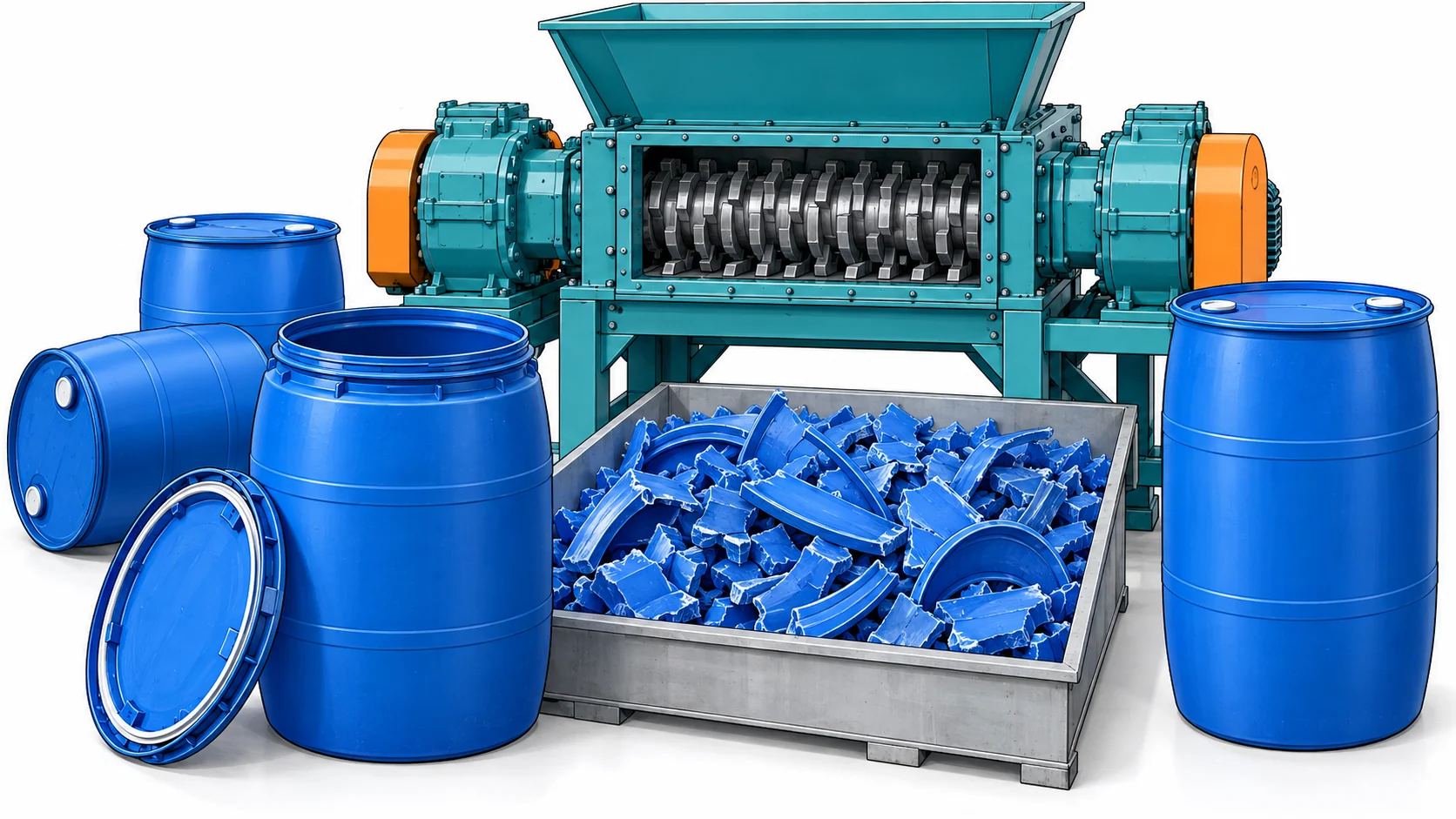
Concept illustrations show drum forms and equipment arrangements for discussion. They are not records of a tested NJDETE installation.
Can the Configuration Accept Your Whole HDPE Drums?
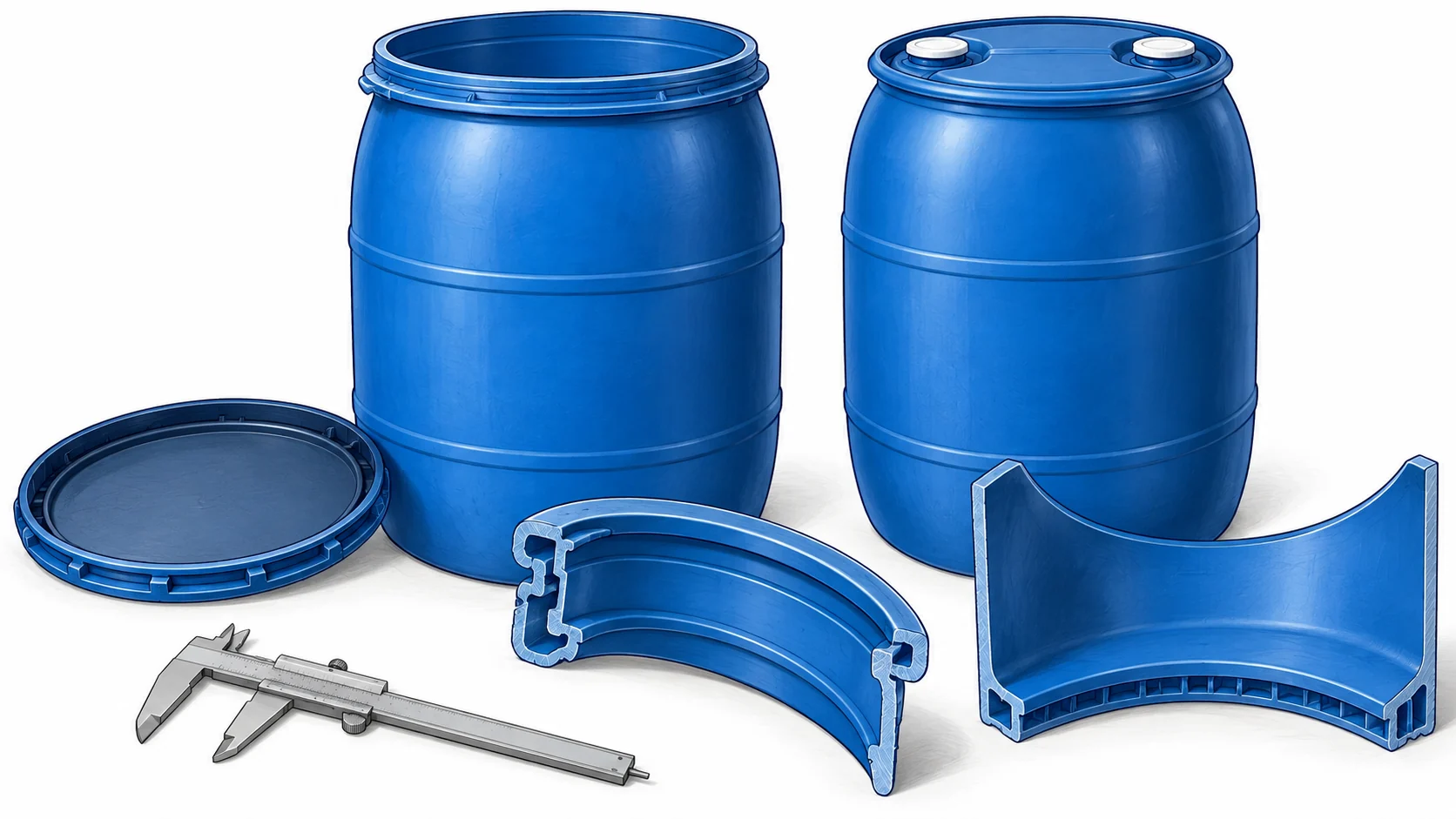
Start with the maximum outside diameter and overall height, including projecting handles, rims or other features. Record whether the normal feed is an open-head drum with a removable lid, a closed-head drum, a distorted reject or an already prepared section.
Descriptions such as “200-liter drum” or “55-gallon drum” describe nominal volume. They do not establish identical external geometry, wall sections or loading requirements. Send photographs and measured dimensions for the actual items.
| Drum feature | المعلومات المطلوب تقديمها | What must be established |
|---|---|---|
| Overall envelope | Largest diameter, height and projections | Whether the intended loading path accepts the whole item |
| Body wall | Normal and maximum known wall sections | Which material condition the cutting arrangement must handle |
| Top and base | Rims, molded reinforcements and thick transitions | Whether the difficult sections are included in evaluation |
| Head and closures | Open-head or closed-head form; lids and bungs | Which components remain with the body during processing |
| Physical condition | Whole, flattened, distorted, nested or sectioned | What preparation and presentation are permitted |
| Material identity | Confirmed polymer, liners and additional components | What belongs in the accepted feed stream |
A Hopper Opening Is Only One Check
A drum fitting into the hopper does not prove it will reach and engage the cutting system consistently. Its orientation, stiffness, support and the proposed feeding method all belong in the assessment. Document any feed-assistance equipment as part of the configuration.
Likewise, a cutting-chamber dimension is not an approved maximum drum diameter. Obtain a written feed envelope for the proposed arrangement, then verify it with representative material. Keep the loading procedure and guarding in place during evaluation.
Include Rims and Bases in the Sample
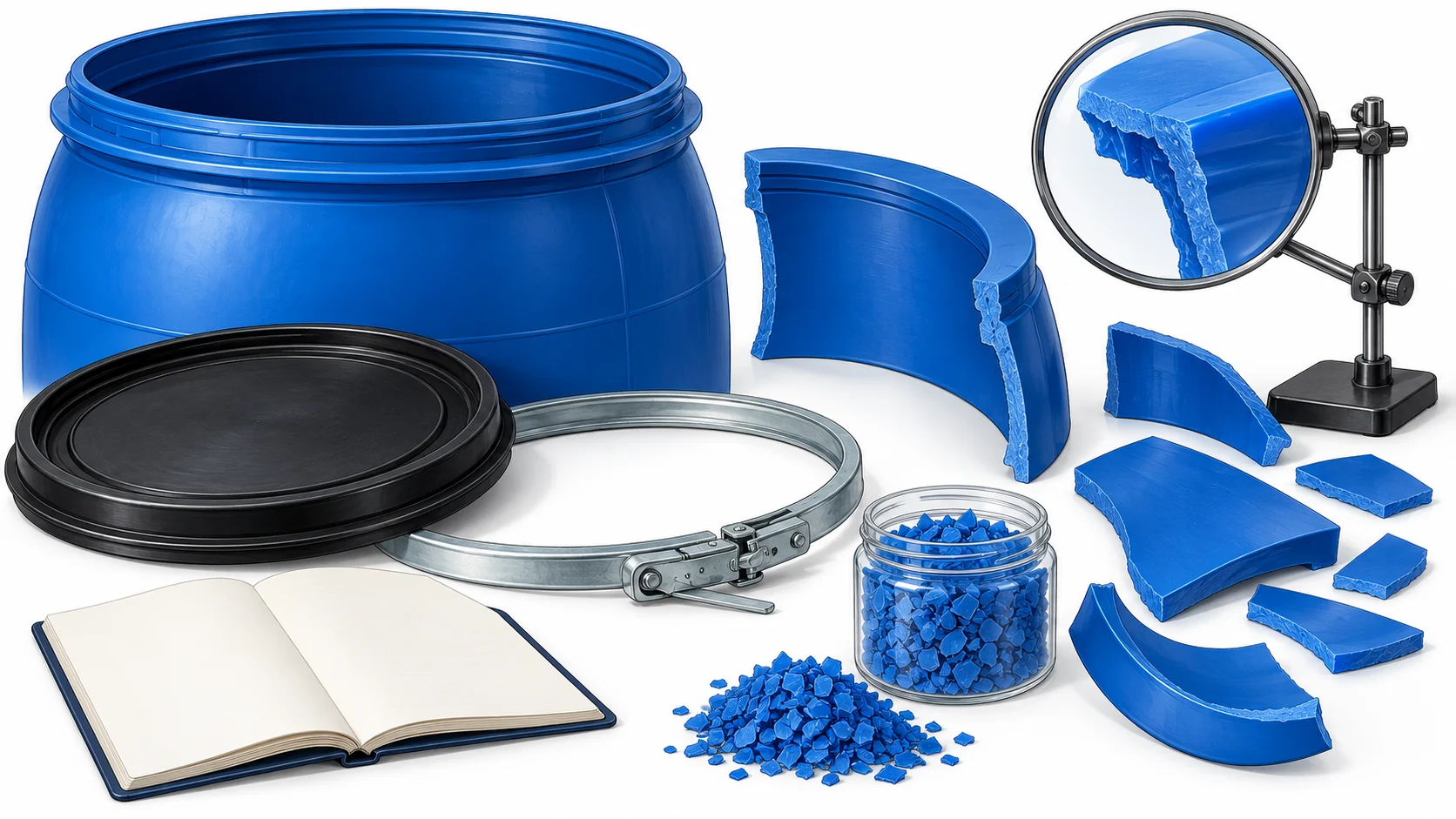
A trial with thin sidewall pieces leaves the reinforced sections unresolved. Include the top rim, bottom transitions and other difficult routine features in the material record. If those sections require preparation, define that work explicitly.
For the wider material and equipment framework, use the دليل اختيار آلات تقطيع النفايات البلاستيكية. This drum assessment adds the whole-item geometry and stiff sections that the polymer name alone does not describe.
Define Attachments and Residue Conditions Before Evaluation
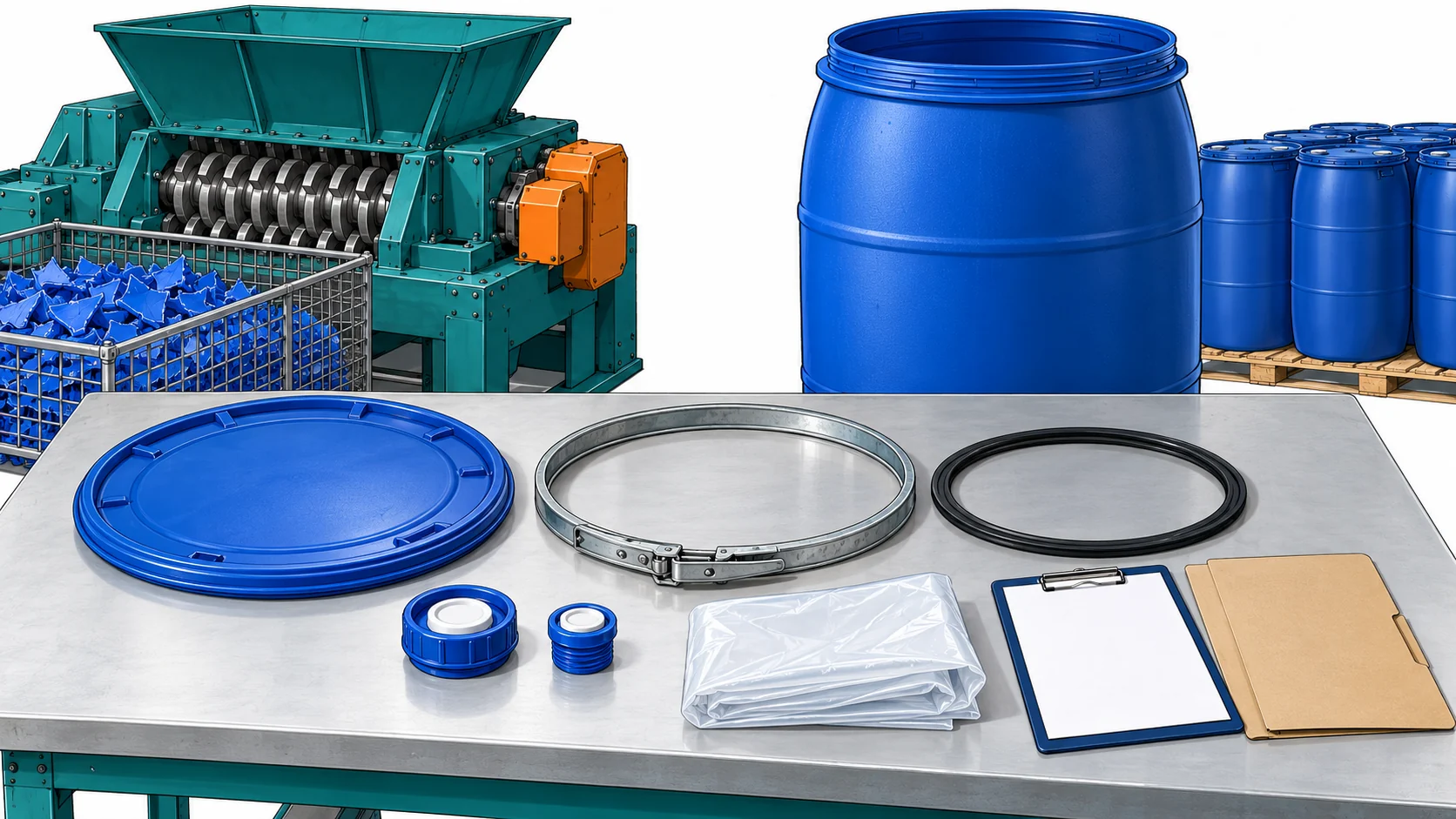
Separate the drum body from its accessories in the specification. A removable plastic lid, a metal closing ring, a gasket and a liner should each be identified. Record which components are removed before feeding and which are proposed for assessment with the body.
Do not treat general capability for selected metal-containing waste as approval to feed every closing ring or fitting. Obtain application confirmation for the actual component and the intended configuration. Removing excluded attachments may also be necessary to meet the next process’s material requirements.
Material History Is Part of the Feed Specification
For used drums, provide the previous contents and the agreed condition after appropriate preparation. A container that appears empty is not necessarily free of residues. The United States EPA’s used-drum management overview explains why previous contents and remaining material matter in industrial-container handling.
Keep unidentified, pressurized or inadequately assessed used containers outside a general plastic-shredding trial. Establish the appropriate handling route with responsible site personnel before mechanical processing. This equipment selection guide does not provide a drum-cleaning or decontamination procedure.
For the operating comparison, make the accepted condition reproducible: the evaluated body, closures, excluded attachments and preparation records should describe the feed your operation will actually deliver.
Whole Drums or Prepared Sections: Which Route Fits Your Operation?
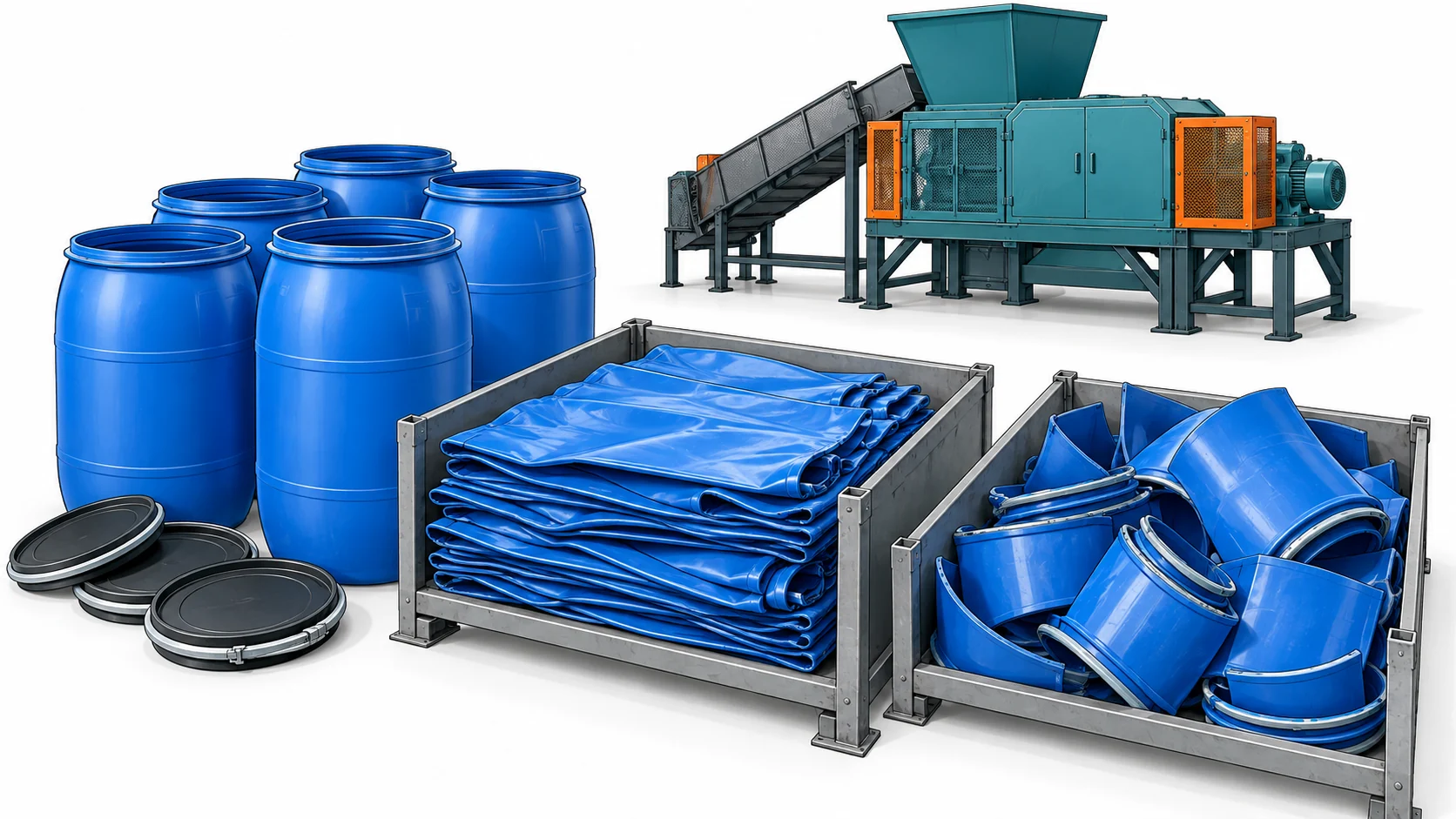
Compare the total work required by each route. Whole-drum feeding may address a preparation task, while a configuration for prepared sections may suit an operation that already has a suitable preparation process. The comparison needs to include both handling and accepted output.
| Route | When to assess it | Condition to put in the acceptance record |
|---|---|---|
| Whole accepted drums | Avoiding routine body preparation is a project requirement | Actual drum dimensions, accepted attachments and approved loading method |
| Flattened or otherwise prepared drums | A defined preparation arrangement already exists or is acceptable | Preparation method, resulting feed form, staffing and elapsed time |
| Defined body sections | The selected equipment is being assessed for sections | Maximum section dimensions, remaining reinforced areas and preparation work |
| Multiple drum types | The normal stream includes different geometries or materials | Separate accepted feed descriptions and evidence for each routine type |
Keep Original and Prepared Dimensions Separate
Record the whole drum alongside the dimensions of the feed after preparation. A successful run on sections establishes performance for those sections. It leaves whole-drum suitability open until that condition is separately assessed.
Also record the form in which the prepared pieces wait for processing. Nested sections, folded walls and loose irregular pieces may present different loading conditions. Use the normal presentation in the evaluation.
Compare the Complete Cutting and Feeding Arrangement
Single-shaft, double-shaft and other systems can have different feed, cutter and sizing arrangements. The shaft description alone does not establish compatibility with your drums. Identify the particular hopper, feed assistance, cutting system and discharge arrangement being compared.
For an NJDETE configuration discussion, the double-shaft shredder overview describes the published machine range. Its general specifications are a starting point for review; they do not establish an untested whole-drum feed range or drum-specific throughput.
For example, the public comparison lists a 500 × 400 mm cutting chamber for the 500 configurations. This is a published equipment dimension, not a declared whole-drum diameter limit. Compare the actual drum and the proposed loading path before deciding whether whole items or prepared sections are appropriate.
Define the Output Your Receiving Process Can Accept
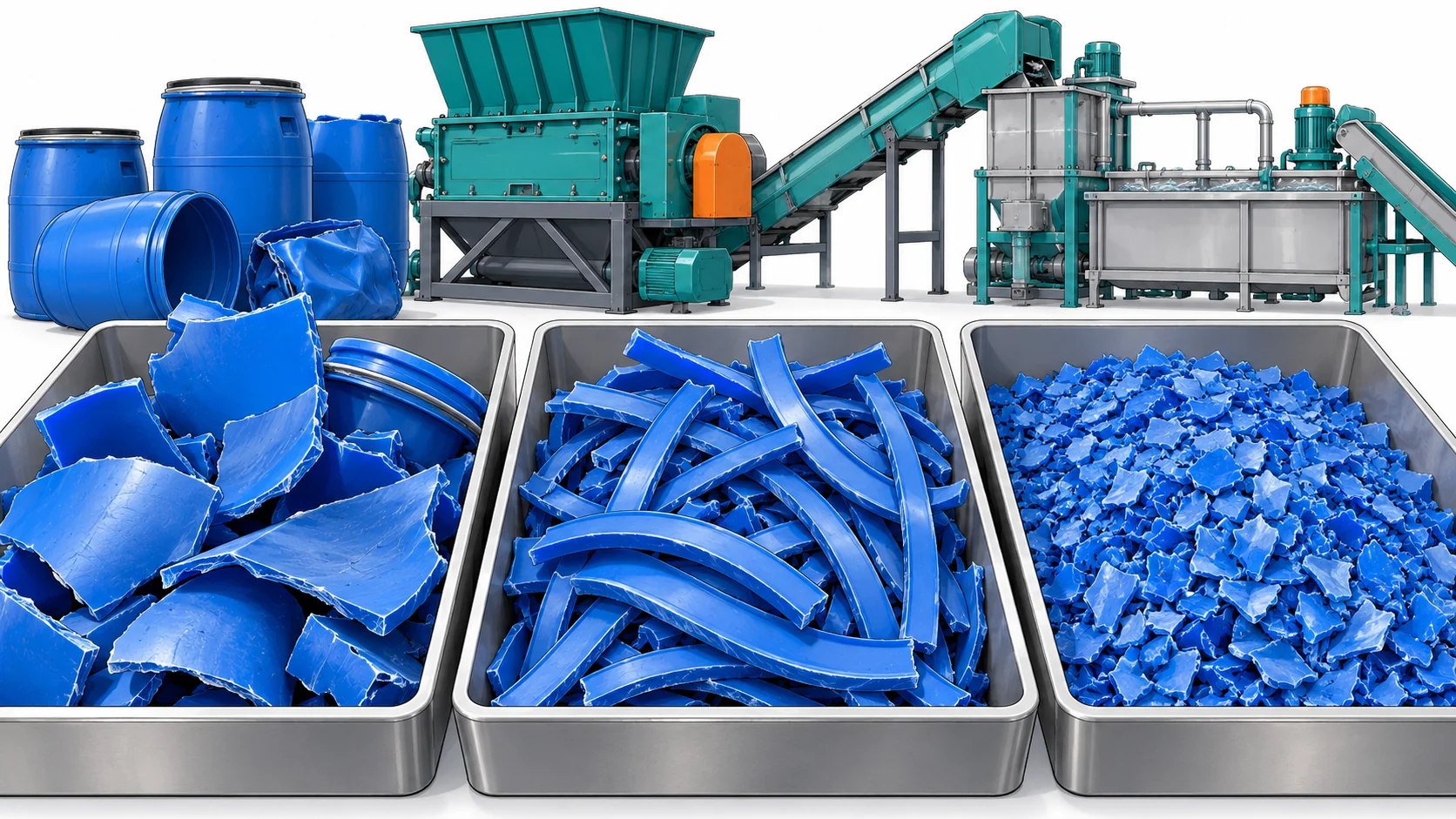
Specify the next operation before selecting around a cutter thickness or screen opening. Storage, washing, secondary granulation and further material recovery can require different output forms. “Small pieces” leaves the decision unresolved.
Ask the receiving operation to define its accepted dimensions and form, including restrictions on long curved strips, reinforced rim pieces and oversize material. Add contamination and other-polymer limits where relevant.
Primary Reduction and Controlled Regrind Are Different Targets
A primary reduction stage may discharge irregular pieces suitable for a defined handling or further-processing task. If the receiving process requires a more controlled fraction, assess the complete sizing arrangement and any secondary cutting or screening it needs.
Cutter thickness alone does not define every dimension of a discharged drum fragment. A selected handful of pieces also cannot establish the whole batch’s distribution. Agree how representative output will be sampled and how oversize or unsuitable shapes will be identified.
Identify the Work Remaining After Cutting
Used-drum processing may require separate cleaning, separation and drying stages, depending on the feed condition and final material specification. Cutting does not itself establish cleanliness, polymer separation or suitability for a particular reuse.
Keep each stage’s responsibility clear. If the next machine cannot accept a curved rim section without additional preparation, include that work in the comparison. The output requirement should prevent a successful cutting demonstration from simply moving the handling problem downstream.
Compare Daily Results Using the Same Work Boundary
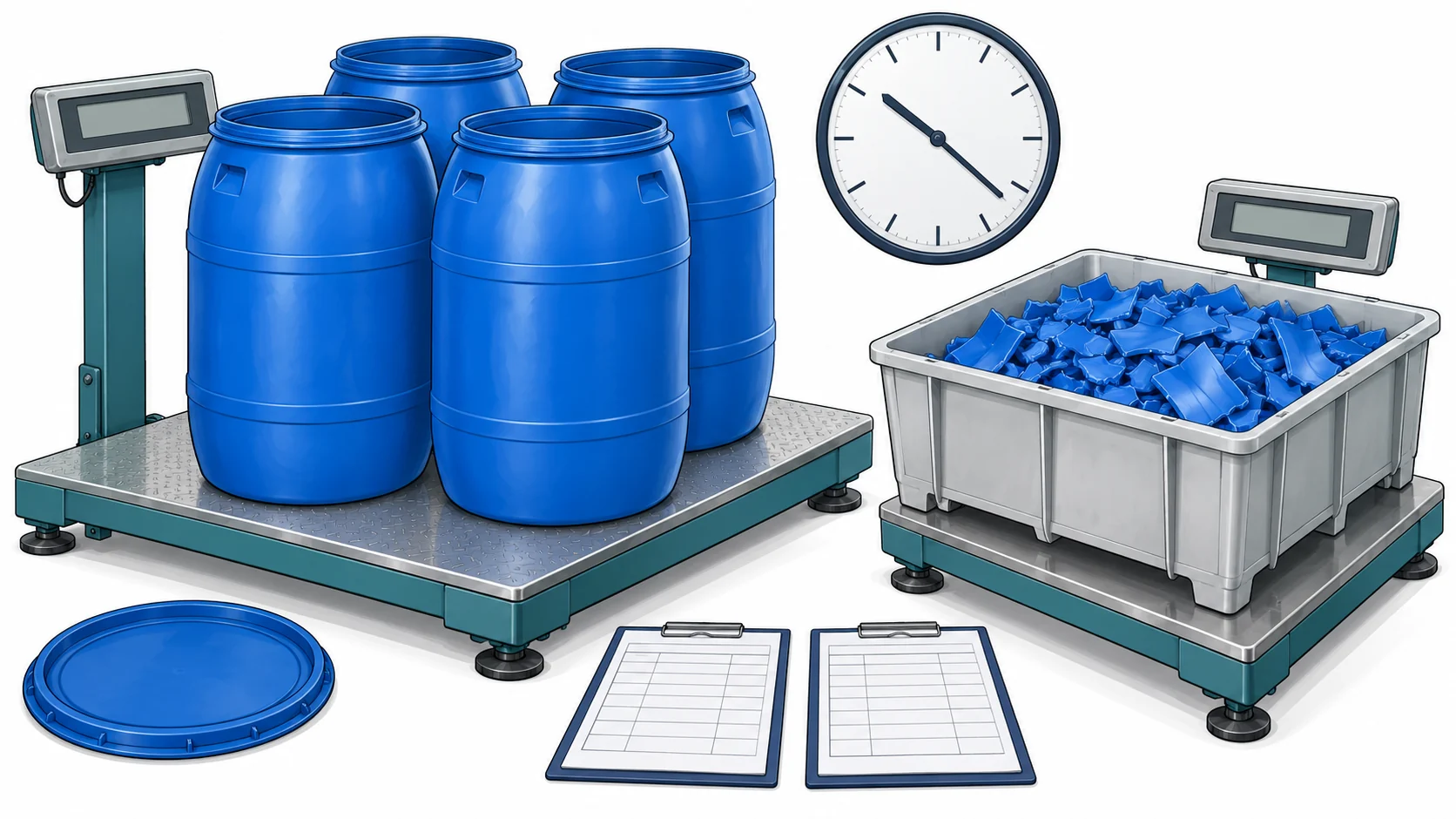
Set a daily target and the time available to meet it. Record both drum count and material mass when they are useful to the operation, but avoid converting between them using an assumed universal drum weight.
Different drum bodies, lids and attached components can change the mass represented by the same number of items. The agreed preparation and weighing condition also matters. Identify whether a figure describes whole input, prepared polymer or accepted discharged material.
Include the Preparation You Will Actually Perform
For each route, record the work for receiving, sorting, accepted preparation, loading, cutting and discharge. State whether these tasks occur sequentially or in parallel, and what staffing or handling equipment is involved.
Use the same boundary when comparing results. A short cutting-only rate cannot be compared directly with a rate that includes preparation and loading. The دليل سعة آلات التقطيع الصناعية explains the general time-and-output calculation.
Count Accepted Output at a Defined Point
Record input mass, accepted output, oversize, excluded components and material retained in the system. Where another pass is required, count final accepted mass once and include the extra processing time in the stated boundary.
When subsequent washing or separation removes residues or other components, distinguish the cutting-stage result from recovered-polymer output. State the measurement point, material condition and included activities whenever reporting a capacity figure.
What Should the Drum Trial and Acceptance Record Prove?
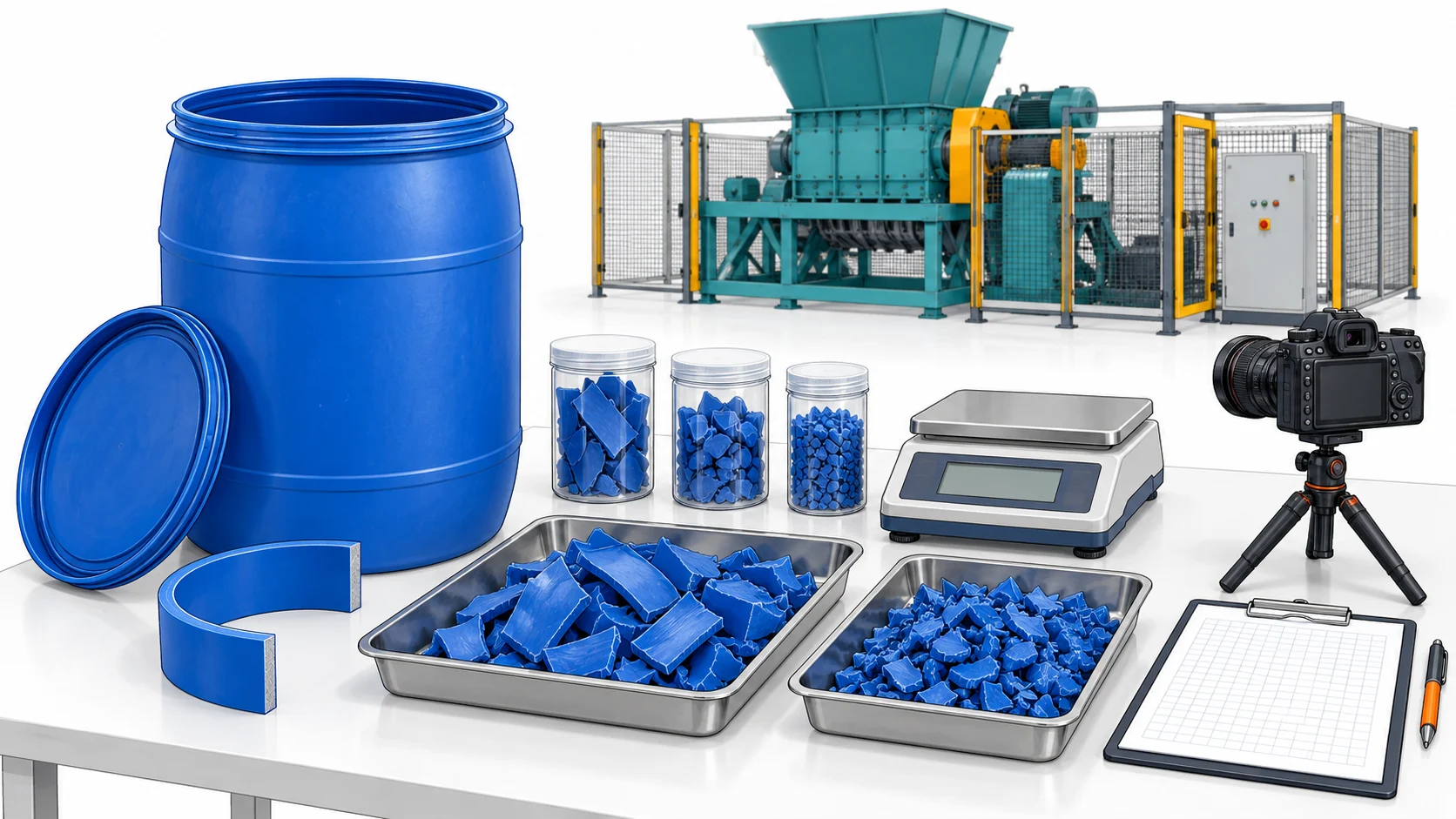
Agree the intended result before the trial. Use representative accepted drums, including the largest normal body and difficult routine rim or base features. Record the particular configuration so the evidence remains associated with the equipment evaluated.
| Acceptance item | Evidence to retain | Decision it supports |
|---|---|---|
| Feed acceptance | Original drum photographs, dimensions, material and condition | Which complete items or prepared sections are covered |
| Preparation scope | Removed components, preparation form, time and staffing | What work remains before the machine can process material |
| Feeding continuity | Footage of the normal loading sequence and recorded interruptions | Whether the operating arrangement can sustain the task |
| Cutting configuration | Feed system, drive, cutters, any screen and discharge details | Which version produced the observed result |
| Output acceptance | Representative pieces, oversize, remaining attachments and sampling method | Whether the receiving process can use the material |
| Daily operating result | Agreed weighing basis, accepted mass and elapsed time boundary | Whether the complete workflow meets the required output |
| Follow-up changes | Configuration revisions and affected results | What must be reconfirmed before final acceptance |
Define how a missed requirement will be addressed. Shorter prepared sections, a different feeding arrangement or another sizing stage can change both the machine result and the work your team performs. Reassess the affected acceptance items after a relevant change.
Keep the approved wear-parts information with the handover record. For a twin-shaft arrangement, the double-shaft shredder blade specification is a useful reference for discussing dimensions and matching components. A replacement drawing should identify the evaluated cutting arrangement rather than only a material grade.
Only trained, authorized personnel should conduct evaluation under the equipment instructions and site procedures. Use the approved loading arrangement, guards and interlocks. Before entering the cutting area for blockage clearing, inspection or service, authorized personnel must isolate hazardous energy, control stored energy and verify isolation under the applicable procedure. An emergency stop alone does not establish isolation.
الأسئلة الشائعة
Can a Plastic Drum Shredder Process 55-Gallon Drums Whole?
Only when the specific configuration has been assessed for the actual drum dimensions, sections, accepted condition and loading method. Nominal volume alone does not establish compatibility. Ask for a defined feed envelope and evidence for whole-item processing if that is a project requirement.
Can Metal Closing Rings Stay on Plastic Drums?
Do not assume they are accepted. Identify the ring, fasteners and other attachments, then confirm the permitted feed with the equipment and process specialists. Removal requirements should appear in the preparation and material-acceptance record.
Is a Machine Suitable for Plastic Drums Also Suitable for Steel Drums?
That requires a separate application assessment. Drum material, wall construction, attachments and previous contents can change the task. Evidence for an HDPE body does not establish steel-drum capability.
Why Can Shredded Drums Contain Long Curved Pieces?
The material form depends on the drum geometry, presentation and complete cutting or sizing arrangement. Define which shapes the next process can accept, inspect representative output and determine whether another sizing step is required. Do not infer final particle dimensions from cutter thickness alone.
Does Shredding Produce Clean HDPE Regrind?
Shredding performs size reduction. Cleanliness, component separation, moisture and final reuse suitability depend on the input and subsequent processing. Specify those requirements separately and identify which stage will achieve each one.
Should Capacity Be Stated as Drums per Hour or Kilograms per Hour?
Both can help when the drum type and measurement basis are defined. Use actual counts and weights from the agreed feed condition. State accepted output, included tasks and elapsed time so results remain comparable across different drums and preparation routes.
Prepare the Drum Brief for a Configuration Review
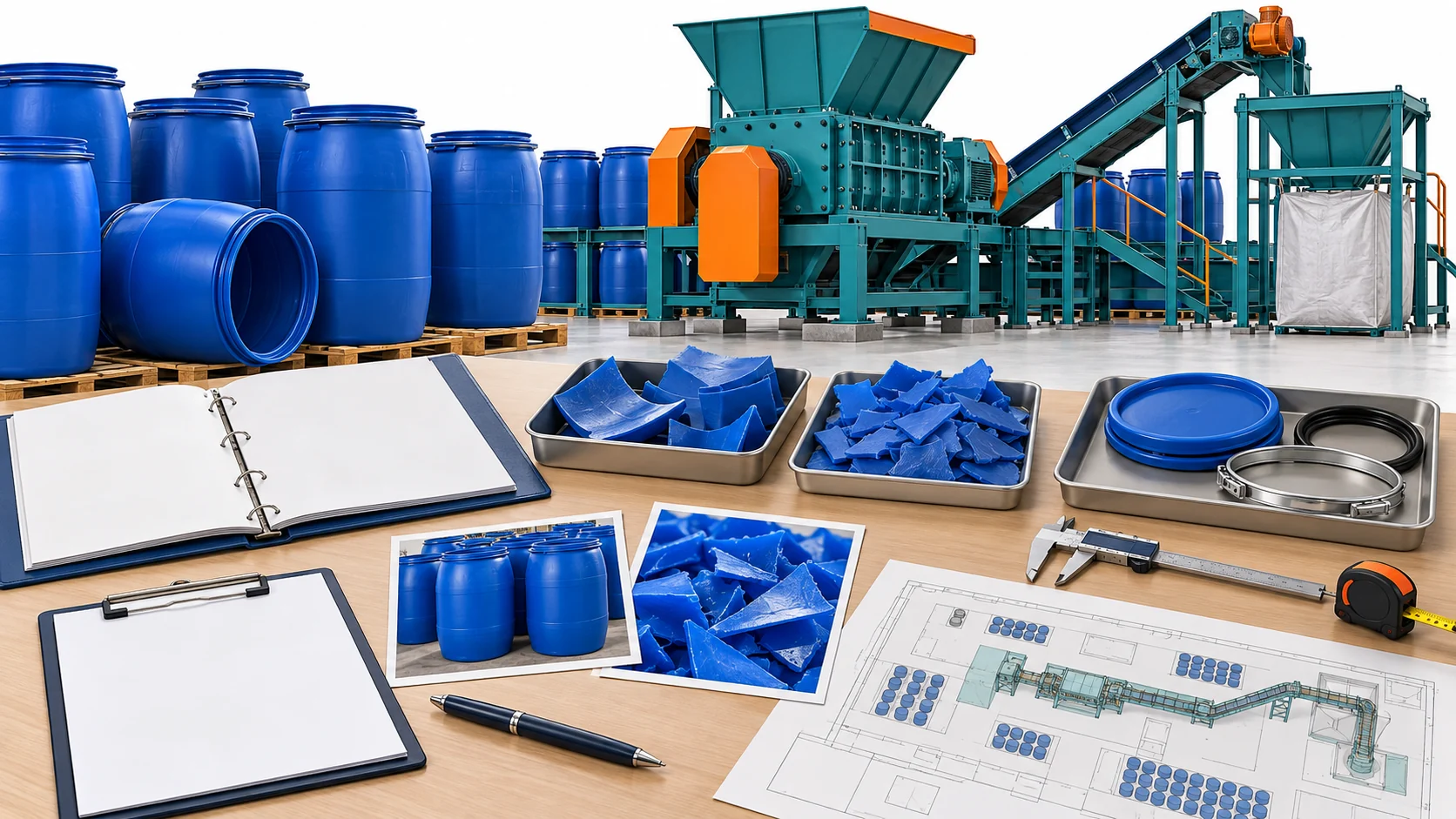
Prepare photographs and dimensions of the largest normal drum, confirmed polymer, wall and rim details, closures, other attachments and the accepted condition after appropriate preparation. Include the daily quantity, available working window and the receiving operation’s material requirements.
State whether whole-drum feeding is essential. If preparation is acceptable, define the available process and its working limits. Add installation power, loading access, discharge handling and space information for the arrangement under review.
Use those records to request an NJDETE configuration review. Ask the response to identify the accepted feed, preparation scope, proposed equipment and the evidence needed to confirm output. A useful decision connects the drum you receive with the material your next process can actually use.