

آلات التقطيع ذات المحورين
Release time: 2026-09-15
Double-Shaft Shredder Machines for Waste Recycling
Double-shaft shredder machines reduce bulky or mixed materials by pulling them between two counter-rotating cutter shafts. Their low-speed, high-torque shearing action makes them a practical first-stage size-reduction option for plastics, rubber, wood, cartons, selected electronic waste and suitable industrial scrap.
NJDETE supplies a range of compact and industrial dual-shaft shredders, from a 1.5 kW Mini model for laboratory or small-batch work to 500 models with K97 or ZQ400 reducers. Motor configuration, cutting chamber, shaft, cutter thickness and voltage can be matched to the material and operating requirements. Browse the full مركز منتجات NJDETE or view the shredder machine category before comparing individual models below.
Suggested caption: NJDETE 500 model double-shaft shredder with a 500 × 400 mm cutting chamber.
What Is a Double-Shaft Shredder Machine?
A double-shaft shredder—also called a twin-shaft or dual-shaft shredder—uses two parallel shafts fitted with intermeshing cutters. As the shafts rotate inward, the cutter hooks grip the feedstock and draw it into the chamber. The material is reduced by a combination of shearing, tearing and compression before discharging below the cutting unit.
This operating principle differs from a high-speed granulator. A granulator normally uses rotating and fixed knives for finer, more uniform size reduction, while a twin-shaft shredder is generally used for primary reduction of bulky, irregular or tough feedstock. In many recycling lines, shredding comes first and secondary granulation follows. For the downstream cutting stage, see NJDETE’s شفرات كسارة البلاستيك.
Quick answer
- Choose a Mini, 150 or 250 model for laboratory work, sampling, pilot projects and small-batch processing.
- Choose a 300 or 400 model when the feed size, batch volume or working duty requires a larger chamber and stronger drive.
- Choose a 500 model for a 500 × 400 mm chamber and heavier recycling or pretreatment duties.
- Do not select from motor power alone. Material composition, largest feed dimensions, contamination, target discharge size, duty cycle and feeding method all affect the correct configuration.
- Do not assume that general “metal scrap” capability includes thick solid metal blocks. The current NJDETE machine specifications explicitly exclude massive or extra-large solid metal pieces.
How a Twin-Shaft Shredder Works
The drive system turns the two cutter shafts at low speed. Each cutter has hooks or teeth that engage the feedstock. Because adjacent cutters overlap, the material is repeatedly gripped and sheared as it moves through the chamber. Spacers control cutter positioning, while the frame, bearing housings and side plates keep the shaft assembly aligned.
A typical cycle is:
- Material enters the hopper and reaches the cutting chamber.
- Counter-rotating cutters grip and pull the material downward.
- Intermeshing cutter edges shear and tear the feedstock.
- Reduced material exits beneath the chamber.
- If the load rises sharply, a properly configured control system can stop or reverse the shafts to help clear a jam.
The actual result depends on the feedstock and the complete cutter arrangement. Cutter thickness is relevant to nominal strip width, but it does not by itself guarantee a finished particle size. Shape, orientation, elasticity and repeated passes can all change the discharged material. Ask for a material trial when the final size or downstream separation performance is critical.
Main Components That Determine Performance
حجرة القطع
The chamber sets the available feed opening and houses the cutter shafts, spacers and fixed elements. NJDETE lists chamber sizes from 120 × 200 mm on the Mini model to 500 × 400 mm on both 500 models. The largest material dimension must fit the hopper and chamber safely; oversized parts may need pre-cutting or a different feeding arrangement.
Shafts and cutters
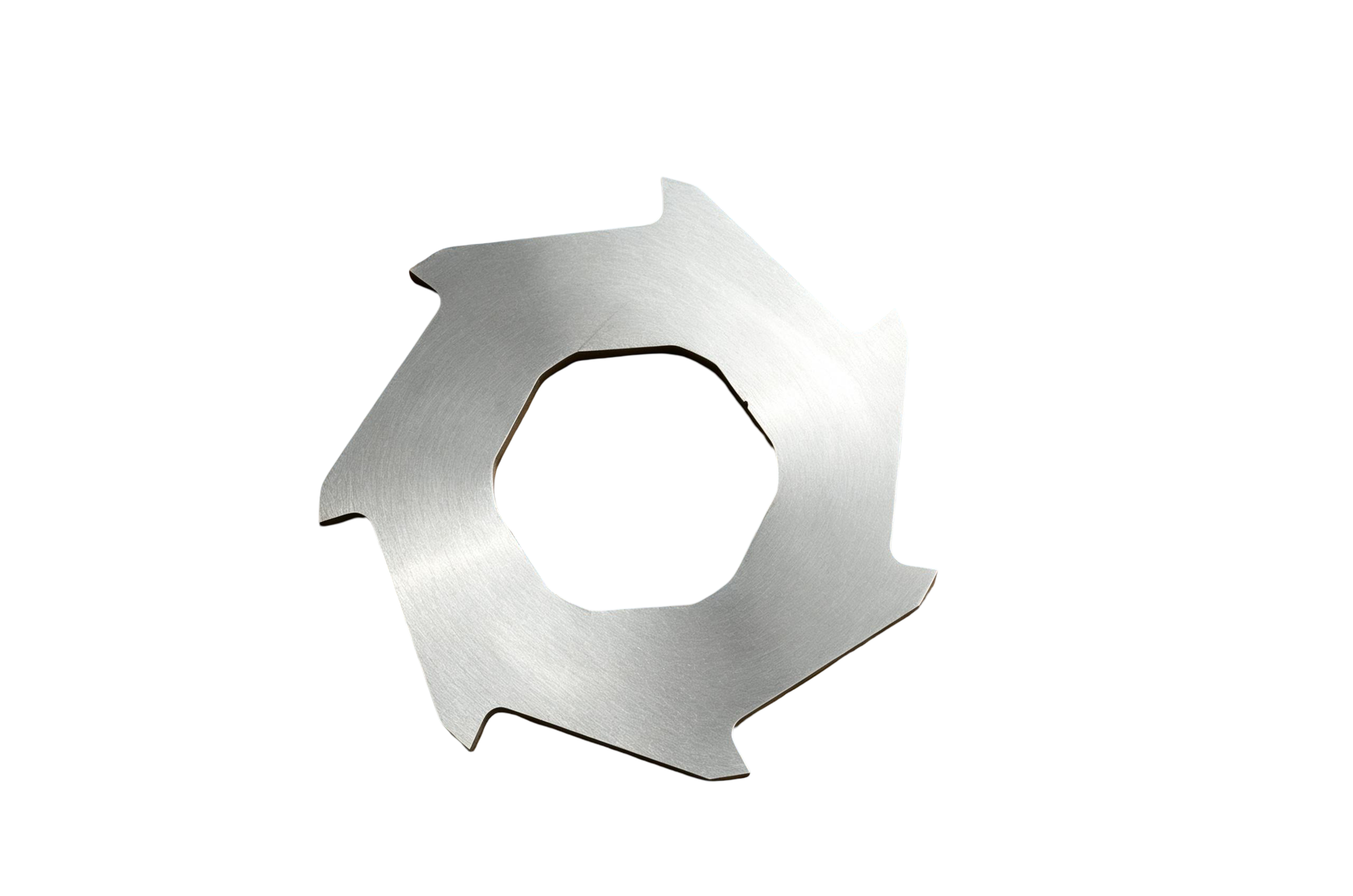
The two shafts transfer torque to the intermeshing blades. Shaft diameter, blade diameter, thickness, tooth geometry and cutter count must work as a system. NJDETE machine models use alloy tool-steel cutters with customizable thickness. Its current صفحة شفرات آلة التقطيع ذات المحورين lists 9CrSi and H13 as standard options, with other materials, outer diameters, bores, thicknesses and tooth forms available by request.
Suggested caption: Intermeshing cutter blades for low-speed, heavy-load twin-shaft shredding.
Motor and reducer
The motor supplies power; the reducer converts that input into the lower speed and higher torque needed at the cutter shafts. NJDETE’s range uses K-series reducers on the Mini through standard 500 model, while the 11 kW 500 variant uses a ZQ400 reducer. Several models offer a higher-power or dual-motor configuration. Final sizing should be based on the material test and duty requirements—not on a generic “more power is always better” assumption.
Controls and overload response
Shredders encounter changing loads as material density and orientation vary. Overload protection and automatic reverse logic can reduce prolonged stall conditions, but they do not make unsuitable feedstock safe to process. The quotation should state the control logic, electrical standard, safety interlocks, emergency stops and any required integration with upstream or downstream equipment.
NJDETE Double-Shaft Shredder Model Comparison
The specifications below reproduce the current supplied product data. They are useful for shortlisting, but they are not a substitute for application confirmation.
| الطراز | المحرك | مخفض | Shaft | Cutter specification | Chamber | Overall dimensions | Typical positioning |
|---|---|---|---|---|---|---|---|
| Compact Mini | 1.5 كيلوواط × 1 | K57 | قطر 45 × 560 مم × 2 | Ø100 × 10 mm × 12 | 120 × 200 ملم | 650 × 380 × 880 mm | Laboratory, pilot and small recycling work |
| 150 model | 3 kW × 1; 5.5 kW option | K77 | Ø85 × 560 mm × 2 | Ø180 × 10 mm × 15 | 150 × 350 ملم | 830 × 500 × 1450 mm | Sampling and small-batch processing |
| 250 model | 2.2 كيلوواط × 1 | K67 | Ø65 × 660 mm × 2 | Ø120 × 10 mm × 24 | 250 × 250 ملم | 800 × 430 × 1400 mm | Small-batch recycling and pretreatment |
| 300 model | 3 kW × 1; 5.5 kW option | K77 | قطر 85 × 650 مم × 2 | Ø180 × 10 mm × 15 | 300 × 350 mm | 1080 × 570 × 1400 mm | Small-to-medium recycling operations |
| 400 model | 5.5 kW × 1; dual-motor option | K87 | قطر 85 × 650 مم × 2 | Ø180 × 10 mm × 40 | 400 × 350 ملم | 1220 × 530 × 1600 mm | Medium-volume recycling and pretreatment |
| 500 model K97 | 7.5 kW × 1; dual-motor option | K97 | Ø85 × 780 mm × 2 | Ø200 × 10 mm × 48 | 500 × 400 ملم | Medium-to-heavier recycling duty | |
| 500 model ZQ400 | 11 kW × 1; dual-motor option | ZQ400 | Ø85 × 780 mm × 2 | Ø200 × 10 mm × 48 | 500 × 400 ملم | Higher-torque 500 configuration |
All listed models support customizable voltage and cutter thickness. The ZQ400 model’s overall dimensions should be confirmed in the final drawing.
Compact Mini model
الـ Compact Mini double-shaft shredder combines a 1.5 kW motor, K57 reducer and 120 × 200 mm chamber. Its small footprint makes it suitable for controlled sample preparation, laboratory evaluation, pilot work and low-volume in-house waste reduction.
Suggested caption: Compact Mini dual-shaft shredder for laboratory, pilot and small-batch applications.
150 and 250 models
الـ 150 model dual-shaft shredder uses a narrow 150 × 350 mm chamber and offers a 3 kW motor with a 5.5 kW option. The 250 model waste shredder uses a 250 × 250 mm chamber, 2.2 kW motor and 24 cutters. These are distinct configurations: compare the actual feed dimensions and cutting arrangement instead of treating model number as a simple capacity ranking.
Suggested caption: 150 model small dual-shaft shredder with a 150 × 350 mm chamber.
Suggested caption: 250 model dual-shaft waste shredder for small-batch recycling and pretreatment.
300 and 400 models
الـ 300 model industrial shredder has a 300 × 350 mm chamber and optional 5.5 kW motor. The 400 model high-torque shredder increases the chamber to 400 × 350 mm and uses 40 cutters, a K87 reducer and optional dual-motor configuration. Both are intended for recycling and waste-pretreatment duties where compact machines no longer provide the required chamber size or working configuration.
Suggested caption: 300 model double-shaft shredder for small-to-medium recycling operations.
Suggested caption: 400 model dual-shaft shredder with a 400 × 350 mm cutting chamber.
500 K97 and 500 ZQ400 models
Both 500 models use Ø85 × 780 mm twin shafts, Ø200 × 10 mm cutters and a 500 × 400 mm chamber. The 500 K97 model uses a 7.5 kW motor and K97 reducer. The 500 ZQ400 model uses an 11 kW motor and ZQ400 reducer. Because the chamber dimensions are the same, selection should be based on feedstock, duty cycle, drive requirements and test results rather than chamber size alone.
Suggested caption: 500 model twin-shaft shredder with an 11 kW motor and ZQ400 reducer.
What Materials Can a Double-Shaft Shredder Process?
Plastics
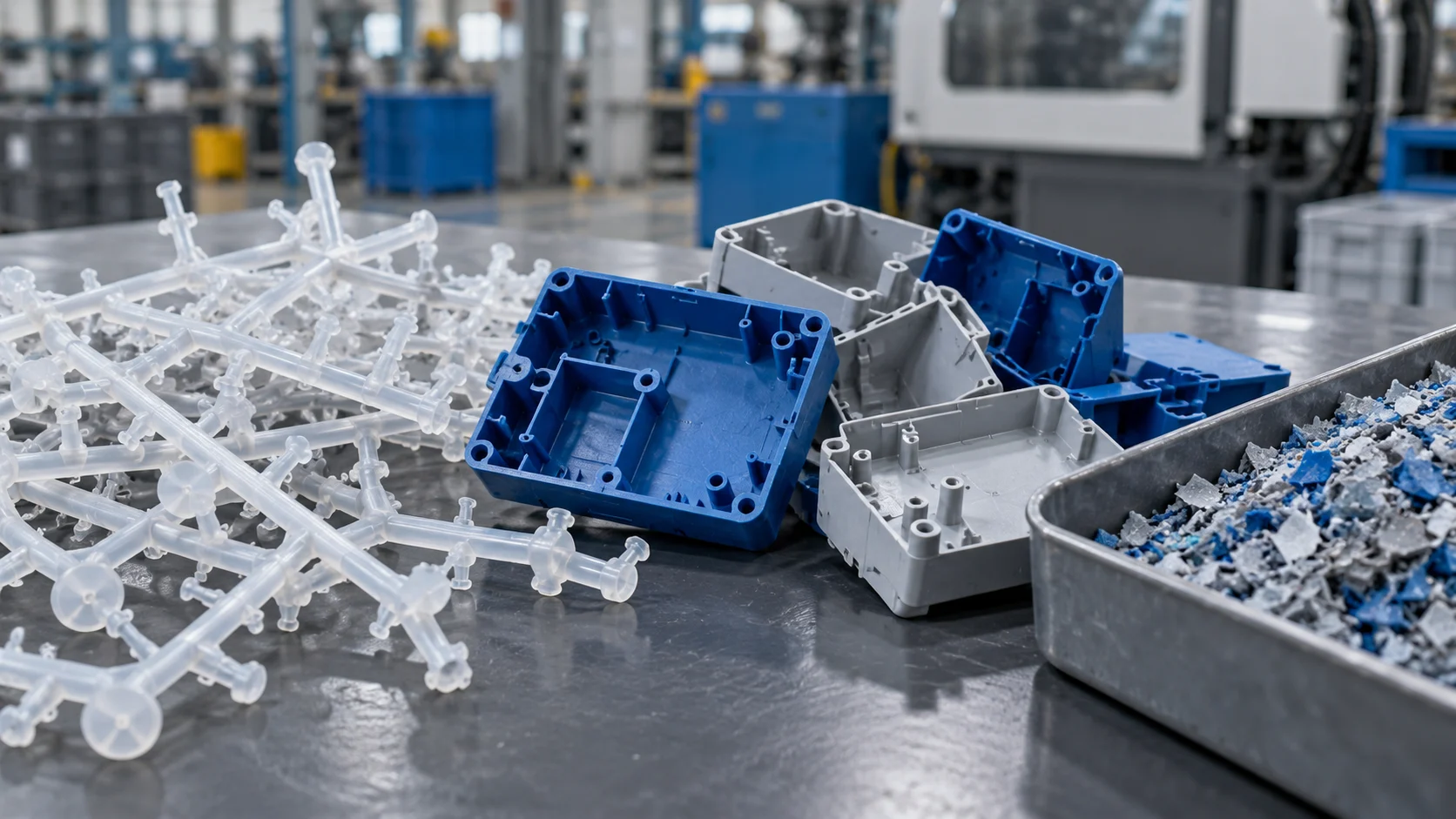
Potential feedstocks include plastic lumps, sprues, pipes, containers, film bundles and mixed production scrap. Thin flexible films behave differently from rigid thick-wall parts, so samples should be evaluated for wrapping, bridging and cutter engagement. A secondary granulator may be needed when the process requires a smaller or more uniform regrind.
المطاط
Rubber offcuts and selected rubber products can be reduced by the cutter hooks, but rubber’s elasticity can increase wrapping and rebound. Tell the supplier whether the feed contains steel reinforcement, textiles, dirt or other contaminants.
Wood and cartons
Wood offcuts, small pallets or packaging waste may be suitable when they fit the chamber and drive configuration. Remove hard foreign objects wherever possible. Nails, metal bands and dense knots can change cutter loading and wear.
E-waste and circuit boards
Selected e-waste and printed circuit boards can be processed as part of a controlled recycling line. The operator must identify batteries, capacitors, screens, hazardous components and valuable fractions before choosing a process. Dust extraction, downstream separation and local environmental requirements should be addressed at the system level.
Lithium-ion batteries
Some NJDETE model descriptions list lithium-ion batteries as an application, but battery shredding is not a general-purpose task. Cell chemistry, state of charge, residual energy, damaged-cell condition, atmosphere, temperature monitoring, fire suppression, gas handling and downstream treatment require a specialist process design. Do not feed lithium-ion batteries into a standard shredder configuration without a documented hazard assessment and written application approval.
Industrial scrap and light metal pieces
The machines may handle suitable industrial scraps and selected metal-containing waste, subject to testing. They are not intended for massive, thick, solid metal blocks. Provide material photos, composition, wall thickness, maximum dimensions and contamination details before quotation.
How to Select the Right Double-Shaft Shredder
1. Define the feedstock precisely
Avoid broad descriptions such as “plastic waste” or “metal scrap.” State the polymer or material type, bulk density, hardness, toughness, moisture, contaminants and whether the material is loose, bundled or nested. Send representative photos and samples where possible.
2. Measure the largest feed dimensions
Record the maximum length, width, thickness and unit weight—not only average size. The cutting chamber must accept the material safely, while the hopper must prevent bridging and uncontrolled ejection.
3. State the required process result
Explain why the material is being shredded. Volume reduction, liberation, secure destruction, conveying, sorting and secondary granulation can require different cutter arrangements. A target described only as “small pieces” is not enough for engineering selection.
4. Confirm real throughput by test
Throughput varies with material and configuration. The supplied NJDETE specification set does not state validated kilograms-per-hour values, so this article does not invent them. Request a trial using representative material and document feed method, run time, reversals, motor loading and discharged size distribution.
5. Match duty cycle and feeding method
Intermittent hand feeding, scheduled batch work and continuous conveyor feeding impose different thermal and mechanical demands. State expected operating hours per shift, starts per hour and integration requirements.
6. Confirm utilities, controls and site constraints
Provide the installation voltage, frequency and phase, along with space, access, foundation, dust-control and discharge-conveyor requirements. NJDETE lists customizable voltage, but the final electrical package must be written into the quotation.
7. Review maintainability and wear parts
Confirm access to the chamber, blade removal procedure, bearing arrangement, lubrication points, recommended spare parts and expected service support. Ask for the final cutter drawing and record the steel grade and heat-treatment specification for future replacement.
Cutter Selection and Customization
Cutter performance depends on more than hardness. A very hard blade may resist abrasion but can be less tolerant of impact; a tougher grade can be preferable for feedstock with shock loads. NJDETE lists 9CrSi and H13 alloy tool steel on its blade page and can customize material, thickness, bore and tooth shape.
Before approving the blade specification, confirm:
- Feed material and abrasive contaminants
- Required cutter diameter and bore
- Cutter thickness and spacer arrangement
- Tooth count, hook profile and engagement
- Target hardness and heat-treatment record
- Shaft interface and dimensional tolerance
- Regrinding or replacement strategy
For more detail, review NJDETE’s custom double-shaft shredder blades و company manufacturing overview.
Operation and Maintenance Checklist
Always follow the machine-specific manual and local safety rules. A general preventive checklist includes:
- Inspect the hopper and chamber for foreign objects before startup.
- Verify guards, emergency stops, interlocks and overload functions.
- Check fasteners, reducer oil level, bearings and lubrication points at the specified intervals.
- Monitor unusual vibration, sound, heat and repeated reversal events.
- Keep cutter edges, spacers and side clearances within the manufacturer’s limits.
- Isolate and lock out all energy sources before clearing jams or entering a guarded area.
- Record material type, operating hours, reversals and maintenance actions to identify wear trends.
- Use approved lifting and support methods when removing shafts, cutters or chamber panels.
If jams become frequent, investigate the feedstock and configuration instead of relying on repeated reversing as normal operation. Oversized pieces, wrapping material, foreign metal, worn cutters or inappropriate tooth geometry can all increase stoppages.
Why Work With NJDETE?
شركة نانجينغ ديتي للأدوات الآلية المحدودة is based in Nanjing, Jiangsu, China and focuses on shredder machines and industrial cutting knives. The available machine range covers compact through 500-size twin-shaft configurations, while voltage, cutter thickness and selected drive options can be customized.
For an application review, prepare the feedstock description, maximum dimensions, desired result, operating schedule, electrical supply and site constraints. Then contact NJDETE for model confirmation, a material-test plan and a written quotation.
الأسئلة الشائعة
What is the difference between a double-shaft shredder and a single-shaft shredder?
A double-shaft shredder uses two intermeshing cutter shafts to grip and shear material. A single-shaft machine generally uses one rotor working against fixed knives and may include a hydraulic pusher. The best choice depends on material behavior, feed form and required output—not simply the number of shafts.
Is a twin-shaft shredder the same as a dual-shaft shredder?
Yes. “Twin-shaft,” “dual-shaft” and “double-shaft” are commonly used for the same basic two-shaft shredding principle.
Which NJDETE model is suitable for laboratory testing?
The Compact Mini and 150 models are positioned for laboratory, sample, pilot and small-batch work. Final selection still depends on the material dimensions, hazards and required result.
Can these shredders process metal?
They may process suitable light metal pieces or metal-containing industrial scrap after application review. Current NJDETE specifications state that the machines are not intended for massive or extra-large thick solid metal blocks.
Can a double-shaft shredder produce a uniform final particle size?
Not necessarily. Cutter thickness influences the cut, but feed shape, material elasticity, cutter geometry and the number of passes also affect output. A downstream screen or granulator may be required for a tighter particle-size range.
How do I choose between the 500 K97 and 500 ZQ400 models?
Both have a 500 × 400 mm chamber and the same listed shaft and cutter dimensions. The K97 version uses a 7.5 kW motor, while the ZQ400 version uses an 11 kW motor and ZQ400 reducer. Select after reviewing torque demand, material tests, duty cycle and electrical requirements with the supplier.
Can cutter thickness and voltage be customized?
Yes. The current NJDETE specifications list customizable cutter thickness and voltage across the range. Record both items in the signed technical agreement.
What information is needed for a quotation?
Provide material type, composition, photos or video, maximum dimensions, unit weight, expected feed rate, desired output, working hours, feeding method, voltage/frequency/phase and installation constraints. Representative samples are strongly recommended when performance is critical.
Request an Application Review
Need help selecting a double-shaft shredder machine? Explore the complete NJDETE product range or send the technical team your material details. Include representative photos, maximum feed dimensions, target result, operating schedule and electrical supply so the recommended machine and cutter configuration can be evaluated against your real process.