

كيفية اختيار آلة تمزيق ذات عمودين لموادك
Release time: 2026-09-16
Choosing a double shaft shredder by model number or motor power alone can lead to poor results. Two materials of the same size may behave very differently inside a cutting chamber. A hollow plastic container, a rubber offcut, a circuit board and a dense metal block do not create the same cutting load—even when their outside dimensions look similar.
The right selection starts with the material and the required result. Buyers should define the feed dimensions, bulk density, hardness, contamination, target output size, operating hours and downstream process before choosing the motor, reducer, shaft, cutters or chamber.
This guide compares the current NJDETE double-shaft shredder range and explains the technical questions a recycling plant, workshop, equipment integrator or research facility should answer before requesting a quotation. If you first need an overview of the machine type, working principle and available configurations, visit NJDETE double-shaft shredder machines or browse the industrial shredder product category.
Technical transparency: The specifications in this article come from NJDETE’s current product data. Actual throughput is not stated because it depends on the material, feed method, cutter thickness, tooth profile, motor configuration and required output. NJDETE recommends confirming the application and, where necessary, testing representative feed material before final model selection.
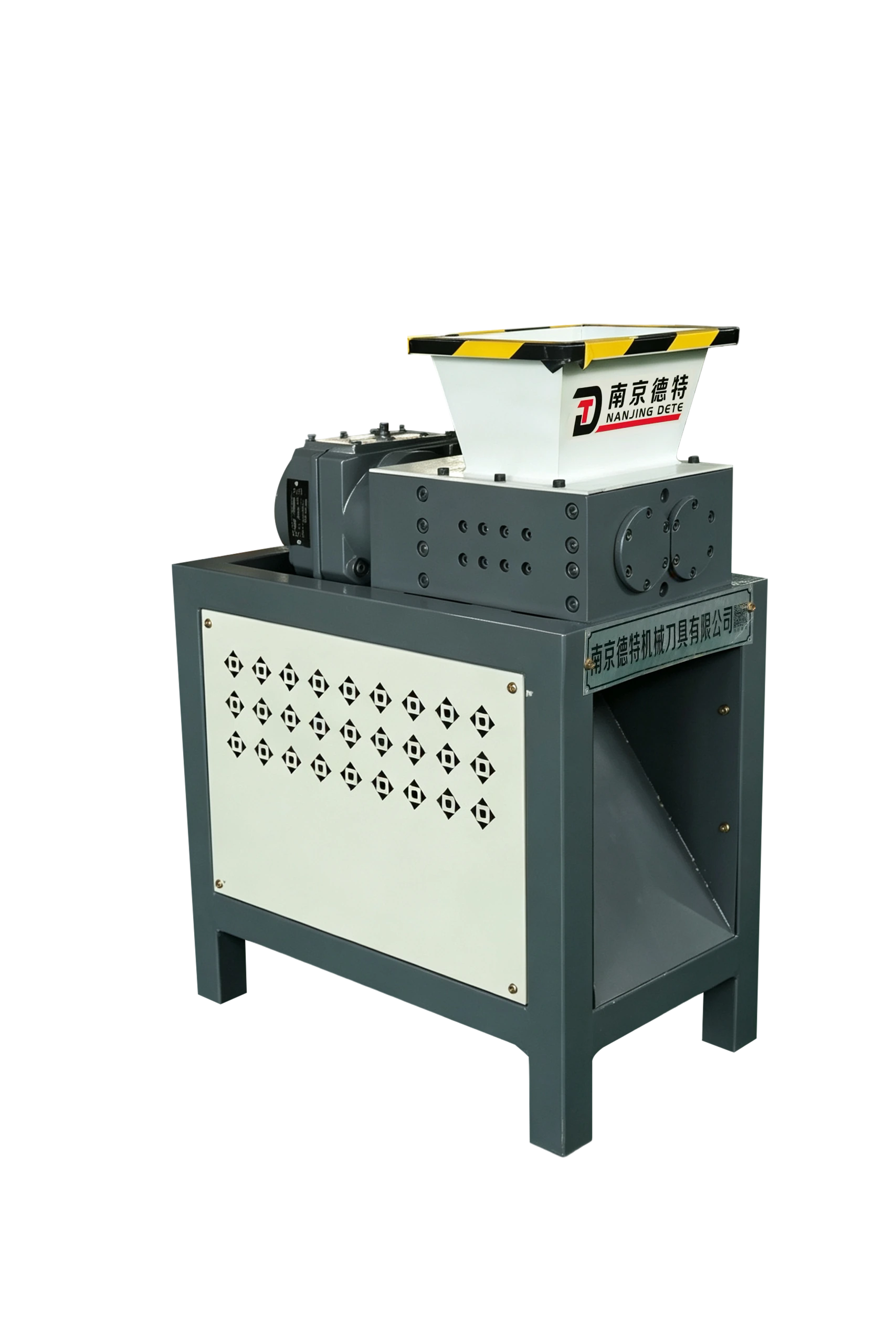
A 500 model double-shaft shredder with a 500 × 400 mm cutting chamber. Final configuration must be matched to the feedstock and duty cycle.
What Is a Double-Shaft Shredder?
A double-shaft shredder—also called a dual-shaft, twin-shaft or two-shaft shredder—uses two counter-rotating cutter shafts to grip and reduce material through shearing, tearing and compression.
The low-speed cutting principle is suited to primary size reduction and waste pretreatment. Depending on the machine configuration and cutter design, a double-shaft shredder may process materials such as:
- Plastic bottles, molded scrap, pipes and production offcuts
- Rubber scraps and selected tire-derived materials
- Wood pieces, pallets and cartons
- Printed circuit boards and selected electronic waste
- Light industrial scrap and mixed production waste
- Samples and small batches for laboratory or pilot work
Not every double-shaft shredder can process every material in this list. Thick solid metal blocks, oversized dense objects, hazardous components and battery materials require application-specific evaluation. The feed may also need sorting, discharge control, dust collection, fire protection or downstream separation equipment.
For primary reduction, a twin-shaft machine is usually selected for its gripping and tearing action. If the process instead needs a finer and more uniform regrind, a granulator fitted with suitable شفرات كسارة البلاستيك may be required after shredding.
Start With Six Application Questions
An equipment supplier cannot make a dependable selection from the material name alone. Before comparing shredder models, prepare answers to these six questions.
1. What exactly is the feed material?
State the material composition, not only a broad category such as “plastic” or “metal.” For example:
- PET bottles or HDPE containers
- Plastic film or injection-molding sprues
- Natural rubber or fiber-reinforced rubber
- Bare circuit boards or mixed electronic assemblies
- Thin aluminum scrap or dense steel components
Photographs and short videos are useful, but representative samples provide better evidence when the material is difficult to describe.
2. What are the maximum feed dimensions?
Provide the maximum length, width and thickness, together with the typical size range. The cutting chamber must physically accept the feed, but chamber size alone does not guarantee successful shredding. Long flexible materials may wrap around the shafts, while thick rigid pieces may require more torque or a different cutter profile.
3. What throughput do you need?
Specify the target in kilograms per hour or tons per hour and state whether the machine will operate intermittently or continuously. Avoid selecting from a generic capacity claim without knowing the test material and test conditions.
4. What output size is required?
The cutter thickness and tooth arrangement influence the discharged piece size. NJDETE lists standard cutter thicknesses in its current configurations, while custom thickness is available. However, output is also affected by material behavior, cutter overlap, feed orientation and whether a sizing screen or downstream granulator is used.
5. How many hours will the shredder operate?
A machine used for occasional sample preparation has a different duty requirement from a unit feeding a recycling line through multiple shifts. Operating schedule affects motor selection, reducer loading, bearing protection, cooling, maintenance access and the number of spare cutters required.
6. What happens after shredding?
Clarify whether the objective is volume reduction, material liberation, granulator feeding, sorting, transport, disposal or preparation for another recycling process. The required downstream result may change the recommended cutter and discharge configuration.
NJDETE Double-Shaft Shredder Model Comparison
The following table reproduces the key specifications supplied for NJDETE’s current range. Dimensions are shown in millimeters unless otherwise stated.
| Model/configuration | المحرك | مخفض | Main shafts | Cutter specification | حجرة القطع | Overall dimensions | Typical positioning |
|---|---|---|---|---|---|---|---|
| Compact Mini | 1.5 كيلوواط × 1 | K57 × 1 | Ø45 × 560 × 2 | Ø100 × 10, 12 pieces | 120 × 200 | 650 × 380 × 880 | Small recycling, in-house waste, samples and pilot tests |
| 150 Model | 3 kW × 1; 5.5 kW option | K77 × 1 | Ø85 × 560 × 2 | Ø180 × 10, 15 pieces | 150 × 350 | 830 × 500 × 1450 | Laboratory tests, sample preparation and light-duty small batches |
| 250 Model | 2.2 كيلوواط × 1 | K67 × 1 | Ø65 × 660 × 2 | Ø120 × 10, 24 pieces | 250 × 250 | 800 × 430 × 1400 | Small-batch recycling and waste pretreatment |
| 300 Model | 3 kW × 1; 5.5 kW option | K77 × 1 | Ø85 × 650 × 2 | Ø180 × 10, 15 pieces | 300 × 350 | 1080 × 570 × 1400 | Small-to-medium recycling and pretreatment work |
| 400 Model | 5.5 kW × 1; dual-motor option | K87 × 1 | Ø85 × 650 × 2 | Ø180 × 10, 40 pieces | 400 × 350 | 1220 × 530 × 1600 | Medium-volume waste processing |
| 500 Model, K97 | 7.5 kW × 1; dual-motor option | K97 × 1 | Ø85 × 780 × 2 | Ø200 × 10, 48 pieces | 500 × 400 | 1320 × 550 × 1600 | Medium-to-higher-volume recycling applications |
| 500 Model, ZQ400 | 11 kW × 1; dual-motor option | ZQ400 | Ø85 × 780 × 2 | Ø200 × 10, 48 pieces | 500 × 400 | Confirm with supplier | Continuous small-to-medium recycling and waste pretreatment |
All listed models support customizable voltage. Cutter thickness and cutter material can be configured according to the application. The standard cutter material is described as alloy tool steel.
An important point about model numbers
The model number is not a universal capacity rating, and it is not a strict motor-power sequence. For example, the listed 250 model uses a 2.2 kW motor, while the 150 model uses a 3 kW motor with a 5.5 kW option. The models also differ in shaft diameter, shaft length, cutter diameter, cutter count, reducer and chamber geometry.
This is why a buyer should compare the complete configuration—not assume that a larger model number automatically means more torque, more throughput or better suitability for a hard material.
The Compact Mini uses a 120 × 200 mm chamber and is intended for controlled, small-scale work rather than high-volume production.
How to Compare the Main Technical Components
حجرة القطع
The chamber dimensions provide a first check against feed size. NJDETE’s current range extends from a 120 × 200 mm chamber on the Compact Mini to a 500 × 400 mm chamber on the 500 models.
A larger chamber may accept bulkier feed, but the final selection must also account for shaft strength, available torque, cutter geometry and feed behavior. A large but light carton and a smaller dense metal part place very different demands on the machine.
Motor and reducer
Motor power is only one part of the drive system. The reducer converts motor output into the low-speed torque required at the cutter shafts. NJDETE’s current configurations use K-series reducers on the Compact Mini through the 500 K97 version, with a ZQ400 reducer listed for the 11 kW 500 configuration.
When discussing the drive, ask the supplier to confirm:
- Motor quantity and rated power
- Local voltage and frequency
- Shaft speed and available torque
- Reducer model and service factor
- Overload and automatic-reverse logic
- Starting method and control cabinet specification
- Suitability for intermittent or continuous operation
The product data notes intelligent overload protection. The final quotation should define the specific control logic and electrical components included in the selected configuration.
Shaft dimensions
The range lists shaft diameters from 45 mm on the Compact Mini to 85 mm on several larger models, with shaft lengths from 560 to 780 mm. Shaft dimensions affect working width and mechanical strength, but they must be evaluated together with material load, cutter arrangement, bearing design and drive torque.
Cutter diameter, thickness and tooth profile
Current standard cutter diameters range from 100 to 200 mm, and the listed standard thickness is 10 mm. NJDETE also offers customized thickness.
Thicker cutters may produce larger strips or chunks in some applications, while thinner cutters may provide a smaller nominal cutting width. This is not an absolute output guarantee: tooth count, hook geometry, overlap, spacer arrangement and material deformation also affect the result.
For a custom cutter proposal, provide:
- Material being shredded
- Target output and downstream process
- Cutter outside diameter and thickness, if replacing an existing set
- Inner bore, keyway or spline details
- Tooth count and hook profile
- Shaft and spacer dimensions
- Drawing, sample or clear photographs where available
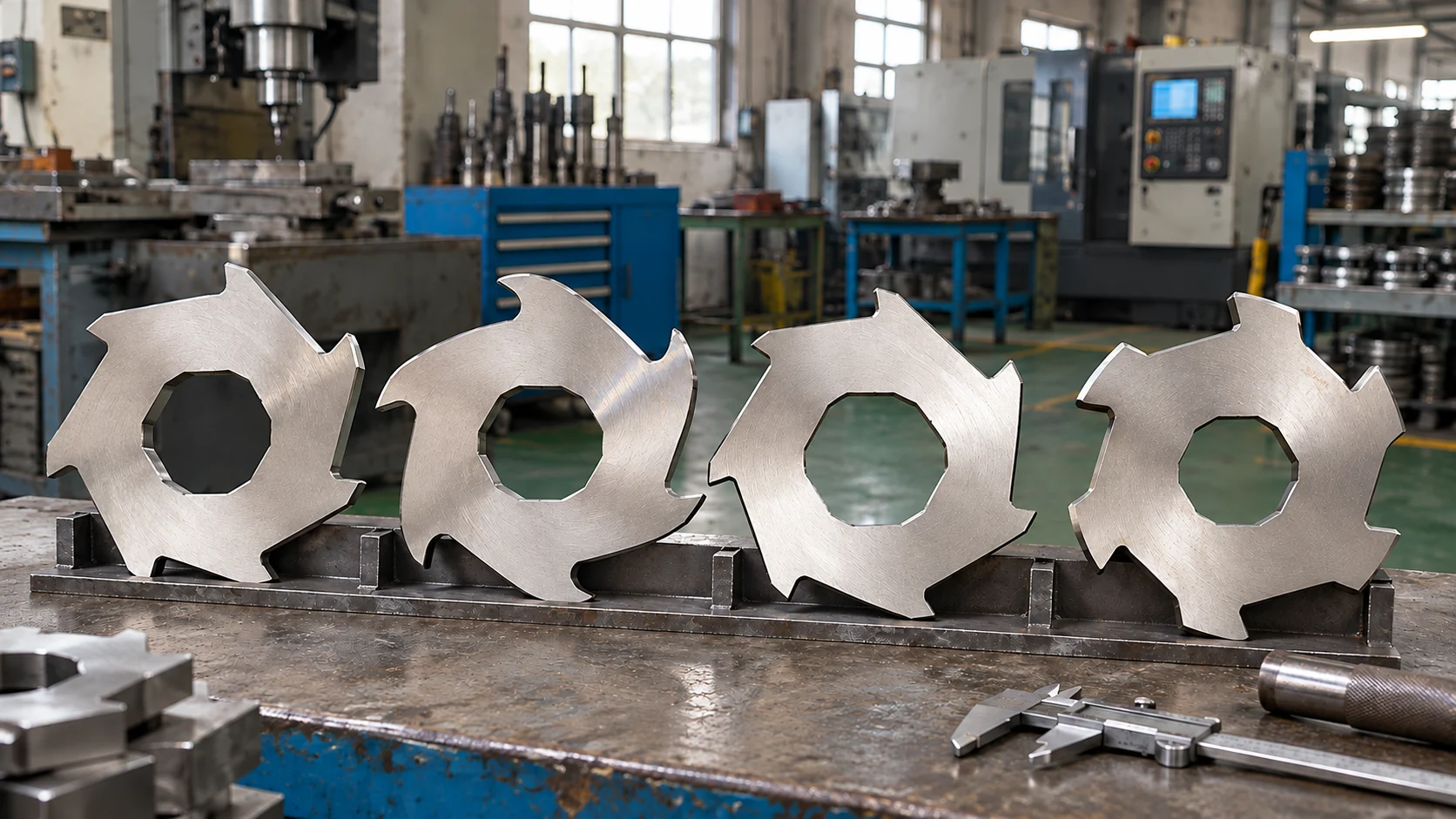
NJDETE also supplies double-shaft shredder cutter blades with customizable outside diameter, bore, thickness, material and tooth profile.
Cutter thickness, hook profile, overlap and spacer arrangement must be evaluated as one cutting system.
Which NJDETE Model Fits Which Type of Project?
The following guidance is a starting point, not a substitute for application review.
Compact Mini: samples, pilot trials and small in-house waste
الـ 1.5 kW Compact Mini has the smallest listed chamber and cutters in the range. Its compact footprint makes it the logical first model to evaluate for low-volume workshops, laboratory sample preparation, pilot projects and occasional in-house waste reduction.
It should not be selected for a difficult material simply because the pieces fit inside the chamber. Dense, hard or impact-heavy feed requires a load assessment.
150 Model: light-duty test and small-batch work
الـ 150 model uses Ø85 mm shafts and Ø180 mm cutters in the supplied configuration, with 3 kW standard power and a 5.5 kW option. It is positioned for laboratory testing, sample preparation and light-duty small batches involving plastics, rubber scrap, selected circuit boards and other manageable feed.
The supplied product note specifically excludes heavy, thick metal blocks.
250 Model: compact recycling with a wider shaft arrangement
الـ 250 model combines a 250 × 250 mm chamber with Ø65 × 660 mm shafts and 24 Ø120 mm cutters. Its geometry differs substantially from the 150 model, even though the motor rating is lower in the listed configuration.
This model may be considered for small recycling workshops and pretreatment tasks involving plastics, rubber, cardboard, selected circuit boards and small electronic waste. A material test is advisable when feed density or contamination varies.
300 Model: small-to-medium waste pretreatment
الـ 300 model increases the chamber to 300 × 350 mm and uses Ø85 × 650 mm shafts. It is listed with a 3 kW motor and a 5.5 kW option. It can be evaluated for plastics, rubber, wood, cardboard and selected electronic or industrial scraps.
As with the smaller models, it is not intended for large, solid, thick metal blocks under the supplied application description.
400 Model: medium-volume processing with more cutters
الـ 400 model uses a 400 × 350 mm chamber, 40 cutters and a K87 reducer. A dual-motor option is listed. This configuration is positioned for medium-volume recycling and pretreatment involving plastics, rubber, wood, cartons and selected electronic or industrial waste.
For continuous feeding, buyers should confirm the drive duty, controls, discharge arrangement and planned maintenance interval in the formal technical agreement.
The 400 model provides a 400 × 350 mm chamber, 40 cutters and an optional dual-motor configuration.
500 Models: larger chamber with two drive choices
Both 500 configurations use a 500 × 400 mm chamber, Ø85 × 780 mm shafts and 48 Ø200 × 10 mm cutters. The main difference in the supplied data is the drive:
- 7.5 kW motor with K97 reducer
- 11 kW motor with ZQ400 reducer
Both list a possible dual-motor arrangement. These models are positioned for recycling facilities and waste pretreatment involving plastics, rubber, wood, pallets, cartons, electronic waste and general industrial scrap.
The product information does not recommend them for extra-large, solid, thick metal blocks or massive metal ingots. Buyers processing metal should submit exact material dimensions and composition before selection.
Compare the 500 model with K97 reducer وـ 500 model with ZQ400 reducer using the same representative material and documented test conditions.
The 500 ZQ400 configuration uses an 11 kW motor; chamber size alone should not be used to select between the two 500 versions.
Special Note on Circuit Boards and Lithium-Ion Batteries
The supplied application descriptions mention circuit boards and lithium-ion batteries for several models. These materials should not be treated as ordinary waste.
Battery shredding can involve residual electrical energy, flammable electrolyte, reactive material, dust and thermal events. A complete battery-processing solution may require controlled discharge, inerting, ventilation, fire detection and suppression, gas treatment, dust collection, explosion-risk assessment and compliant material handling.
Before using a shredder for batteries, the buyer and supplier should define the battery chemistry, state of charge, module or cell format, pretreatment method, feed rate and site safety requirements. A machine listing alone is not evidence that a complete battery-recycling process is safe or compliant in a particular country.
When Should You Choose a Granulator Instead?
A double-shaft shredder is commonly used for primary size reduction. If the process requires smaller and more uniform particles, a downstream granulator or plastic crusher may be more suitable.
NJDETE also manufactures plastic crusher blades in SKD11, Cr12MoV and 9CrSi tool steel options. The supplied blade design uses slotted mounting holes so the cutting clearance can be adjusted. Custom length, width and thickness are available for different plastic crusher models.
A two-stage line may therefore use:
- A double-shaft shredder to reduce bulky feed;
- A granulator or crusher to produce a smaller, more controlled particle size;
- Separation, conveying or collection equipment according to the recycling process.
The correct sequence depends on the feed and the required end product.
Replacement Cutters and Wear-Part Planning
The cutter is a wear component. Its service life depends on the feed material, contaminants, hardness, cutter material, heat treatment, edge geometry, shaft speed and maintenance practice.
NJDETE’s dual-shaft cutters can be customized in thickness, outside diameter, inner bore and tooth shape. The current product data lists 9CrSi and H13 alloy tool steel, with other materials available by request.
Before ordering replacement cutters, record:
- Shredder manufacturer and model
- Cutter outside diameter and thickness
- Inner bore and shaft connection
- Tooth number and tooth geometry
- Spacer thickness and arrangement
- Existing cutter material and hardness, if known
- Material being processed
- Wear pattern, chipping or deformation observed
- Quantity required and whether a complete matched set is needed
A drawing is preferred. Where no drawing exists, a worn sample, equipment model and measured dimensions can support technical review, but critical dimensions should be confirmed before production.
What to Include in a Shredder RFQ
A detailed request for quotation shortens technical clarification and reduces selection risk. Include the following information:
| RFQ item | المعلومات المطلوب تقديمها |
|---|---|
| Feed material | Exact composition and product form |
| Feed dimensions | Typical and maximum L × W × T |
| Bulk density | kg/m³ if available |
| Contamination | Metal, stones, glass, liquids, sand or other foreign matter |
| Target throughput | kg/h or t/h under expected operating conditions |
| Target output | Required size range and downstream process |
| Operating schedule | Hours per day, shifts and continuous/intermittent use |
| Feeding method | Manual, hopper, conveyor or grab |
| Electrical supply | Voltage, frequency and phase |
| Site requirements | Indoor/outdoor, dust, temperature and safety requirements |
| Documentation | Drawing, photos, video and representative sample availability |
Questions to Ask Before Purchase
Before approving a double-shaft shredder, ask the supplier to confirm the following in writing:
- What material and feed dimensions were used to estimate throughput?
- What cutter material, hardness, thickness and tooth profile are included?
- What are the motor, reducer, shaft speed and control specifications?
- How does overload protection and automatic reversing work?
- Which materials or objects must not enter the chamber?
- What spare cutters, spacers, bearings and seals are recommended?
- What acceptance test will be performed with the buyer’s material?
- What drawings, manuals, wiring documents and maintenance instructions are supplied?
- What packaging, installation and remote support are included?
- Which specifications may change when the voltage or motor configuration is customized?
الأسئلة الشائعة
Is a double-shaft shredder the same as a twin-shaft shredder?
In most industrial equipment searches, double-shaft, dual-shaft, twin-shaft and two-shaft shredder refer to the same general machine type: two counter-rotating cutter shafts. The exact chamber, drive and cutter design still vary by manufacturer and application.
Can one double-shaft shredder process plastic, rubber, wood and electronic waste?
A configurable machine platform may be applied to several material categories, but one cutter and drive configuration is not automatically suitable for all of them. The supplier should match the cutter material, tooth profile, power and protection system to the actual feed.
Does a higher motor power always mean higher throughput?
No. Throughput also depends on material behavior, chamber size, shaft speed, cutter geometry, feeding method and target output. Motor power should not be evaluated in isolation.
How does cutter thickness affect output size?
Cutter thickness influences nominal cutting width, but it does not independently determine final particle size. Tooth geometry, cutter overlap, material deformation, feed orientation and downstream screening also affect the result.
Can the voltage be customized?
Yes. NJDETE’s supplied specifications list customizable voltage. The final motor, electrical components, frequency and phase should be confirmed for the installation country.
Can NJDETE customize double-shaft shredder cutters?
Yes. The supplied product data lists customizable cutter thickness, outside diameter, inner bore, material and tooth shape. Buyers should provide a drawing, sample, machine model or confirmed dimensions.
Which model is suitable for thick solid metal blocks?
The supplied application notes do not recommend the listed mini through 500 configurations for heavy, extra-large or thick solid metal blocks. Submit the exact metal composition and dimensions for engineering review rather than assuming suitability.
Should buyers request a material test?
Testing is recommended when feed properties vary, the material is difficult to describe, the required output is strict, or the application involves high impact, contamination, electronics or batteries. Acceptance criteria should be agreed before production.
Request a Technical Recommendation
Review the NJDETE manufacturing background و request an application review with the following information:
- Material name and composition
- Photos or a short feeding video
- Typical and maximum feed size
- Required throughput and output size
- Daily operating hours
- Installation voltage and country
For replacement cutters, also provide the blade drawing, outside diameter, thickness, inner bore, tooth profile, spacer information and required quantity.
Contact NJDETE:
Website: https://njdete.com/
Telephone: +86 025-57260202
Email: 19895855570@163.com
Address: Huaxi South Road, Mingjue Industrial Park, Shiqiu Town, Lishui District, Nanjing, Jiangsu, China