

Plastic Cutting Blades: Types, Applications and Selection
Release time: 2026-10-20
Plastic Cutting Blades: Types, Applications and Selection
Choose a plastic cutting blade by the operation first. Slitting a moving film web, cutting a rigid sheet to length and reducing rejected parts into regrind require different knife arrangements. The polymer name alone does not identify the right blade.
For a replacement, begin with the machine drawing or an identifiable original knife. For a process change, begin with a material sample and a definition of an acceptable cut. Steel grade and hardness matter, but they come after the cutting method and mechanical fit have been established.
This guide covers industrial machine knives used in plastic converting and recycling. It is intended to help buyers describe an application clearly enough to obtain a meaningful technical proposal.
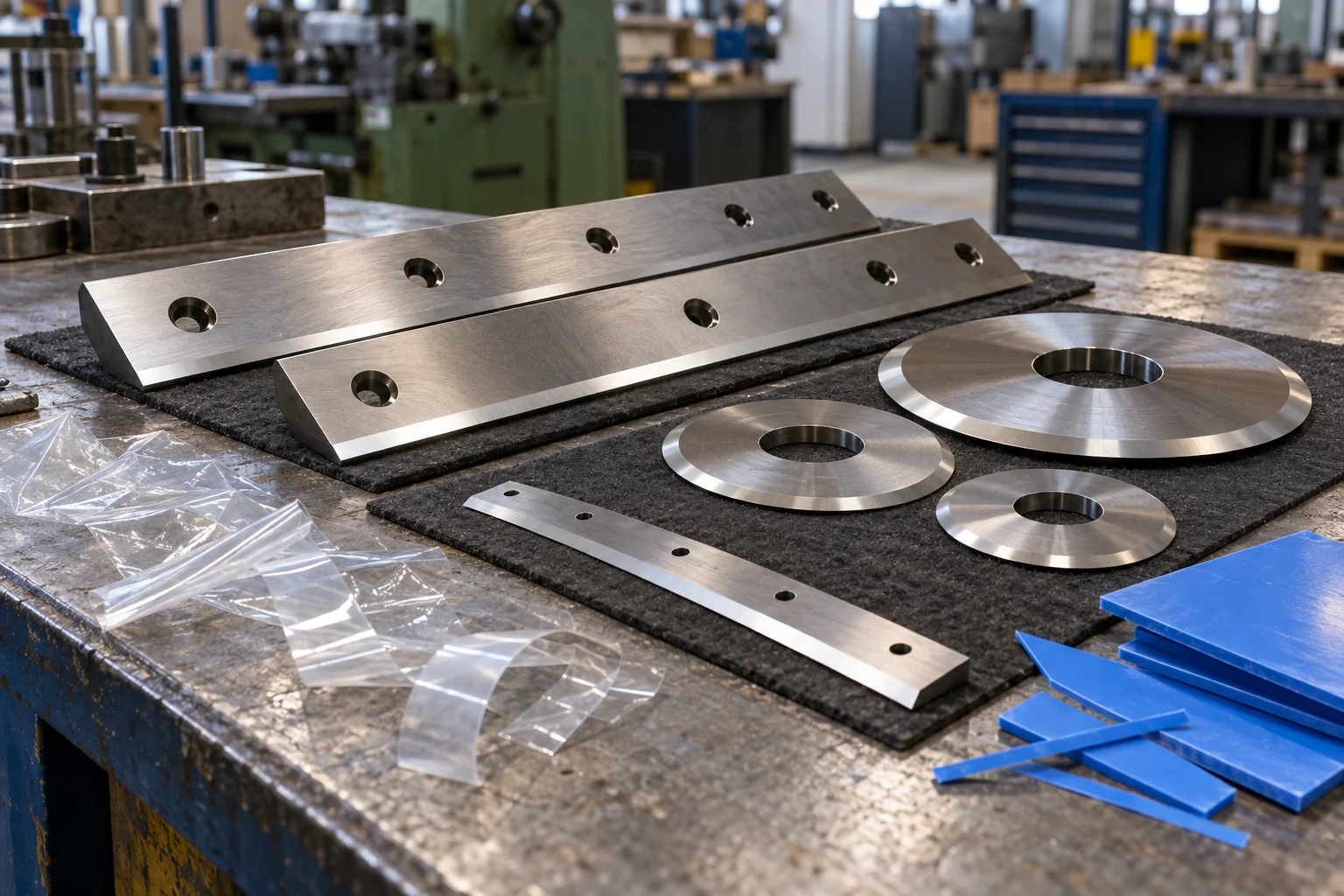
Illustrative blade and material arrangement. Shapes are examples, not dimensioned product drawings.
Which type of plastic cutting blade does the job require?
Separate the required result into a finished cut, a prepared blank or recycled feedstock. Then identify how the existing machine makes that result.
| Operation | Knife arrangement to identify | What to describe in the enquiry |
|---|---|---|
| Slitting a moving film or web | Razor, rotary shear or crush-cut system, as applicable | Web construction, thickness, width, support and edge requirement |
| Cutting sheet or trim to length | The machine’s straight, rotary or other specified cutting arrangement | Material condition, support, cut direction and acceptable deformation |
| Granulating runners, parts or offcuts | Rotor knives working with stationary bed knives | Machine model, complete knife set, mounting details and feed |
| Primary shredding of bulky scrap | The installed shredder’s cutter and counter-cutter system | Part dimensions, cutter arrangement, shaft fit and downstream requirement |
| A heated cutting operation | The existing process’s specified blade and heating arrangement | Material, process purpose, operating conditions and mounting interface |
These are equipment families, not interchangeable blade shapes. A circular knife used in web converting and a toothed cutter disc used in a shredder can both look round in a photograph while having very different functions.
Film slitting: identify the method before ordering a knife
Razor slitting passes a sharp blade through a moving web. Rotary shear slitting uses cooperating cutting edges. Crush cutting presses a knife against a supporting anvil surface. DIENES documents these as separate cutting approaches, with application-specific selection. Sources: DIENES reference guide y slitting systems overview.
For a buyer, the useful question is what the machine and material require together. Provide the whole film construction, including coating, lamination or adhesive layers where known. “PE film” may leave out the feature that causes the cutting difficulty.
Also describe the defect you are trying to avoid. A rough slit edge, a width variation and a web that tears during winding are different acceptance problems. Include a photograph with the machine direction marked, plus a retained sample where possible.
Confirm the holder and mating component, not just blade diameter. DIENES’s DS4 description, for example, treats the holder and interchangeable cutting head as part of the cutting system. That supports checking the assembly rather than assuming any similarly sized disc will work. Source: DIENES DS4.
Rigid sheet: specify the cut and the support
A sheet-cutting enquiry should include polymer, thickness range, width and whether the material is warm from production or stored at ambient conditions. State the required cut: straight separation, trimming or another defined profile.
Then describe how the material is supported and restrained. Ask the equipment supplier which blade geometry, clearances and settings belong to that arrangement. A change to the knife should not be used to disguise an unresolved support or alignment problem.
Define the acceptable edge in practical terms. Is a small burr permitted? Is whitening at the cut unacceptable? Must the blank stay flat for the next operation? Where appearance matters, agree on an approved physical sample instead of relying on the word “clean.”
A sample should represent the difficult end of the job, including the thickest material or a specified grade change. Record the exact sample identity so a later trial can reproduce it.
Recycling knives: distinguish granulation from primary shredding
In a conventional knife granulator, rotating knives cut against fixed knives to reduce suitable feed. The exact set and mounting arrangement belong to the machine design. Conair’s 18 Series manual illustrates this rotor-and-fixed-knife principle. Source: Conair 18 Series user guide, function description.
For replacement enquiries, identify rotor and bed knives separately. Give the quantity of each and explain whether the enquiry concerns a complete set or selected positions. The rotor knives versus bed knives guide explains the distinction.
Primary shredder cutters require a different description. For a double-shaft cutter set, the enquiry may need the shaft opening, cutter thickness, orientation and matching spacer information in addition to the outside profile. Use the double-shaft shredder blade product page for that product discussion.
Do not use “plastic cutting knife” as the only description when ordering either family. It leaves too much of the required fit undefined.
Material selection: ask what actually failed
Before changing steel grade, establish the reason the present blade needs replacement. Use the removed knife, feed samples and operating records to frame the discussion.
| Estado observado | Useful evidence to send | Question for the technical review |
|---|---|---|
| Gradual loss of edge quality | Comparable new and worn edges; processed material identity | Is the selected material and heat treatment appropriate for the wear mechanism? |
| Local chips or broken corners | Damage locations, mounting position and any recovered foreign object | Does impact, support or installation need investigation before a material change? |
| Repeated defects in the same position | Position map, mating part condition and assembly information | Is the problem associated with the machine interface rather than the whole grade? |
| Poor cut immediately after fitting | Drawing, installed configuration and the actual cut defect | Have geometry, orientation and the machine’s specified settings been verified? |
The table is an enquiry aid, not a diagnosis from appearance alone. Several causes can produce a similar damaged edge.
Material data should come from the specified grade’s technical documentation. BÖHLER identifies K110 as a D2-type cold-work tool steel and publishes its property and application information. That is useful background for a material discussion; it does not prove that a finished knife has the required heat treatment or that D2 is the best choice for every plastic. Source: BÖHLER K110.
Request the finished knife specification, including the agreed material designation and hardness requirement. Where traceability is part of the order, state which records must accompany the parts. Do not substitute the highest advertised hardness for an application assessment.
Measure the features that establish fit
A worn sample can help identify a knife, but its damaged edge may no longer represent the original geometry. An approved drawing is a stronger basis for manufacture. Where no drawing exists, agree on how the sample will be measured and which dimensions need confirmation before production.
For a straight knife, the important details may include length, width, thickness, hole or slot locations, countersinks, bevel orientation and the reference face used to locate it. For a circular knife, identify the outside diameter, bore or mounting feature, thickness, profile and its relationship to the mating component.
State units explicitly. Mark which face is shown in a photograph. A few clear photographs from different directions are more useful than one image with unreadable dimensions added over the cutting edge.
El custom straight and special-shaped blade guide provides a starting point for documenting a custom part. Availability and any changes to the original design still need confirmation against the actual enquiry.
Compare the cost per usable result
Compare quotes on an agreed basis: the same drawing revision, material specification, set quantity, inspection requirements and packing scope. Then consider how the knife is used.
For a film line, useful records might be accepted slit length, edge rejects and blade-change time. For sheet cutting, they might be accepted blanks and dimensional or appearance rejects. For granulation, use accepted regrind under a defined feed and machine configuration.
An evaluation can calculate blade-related cost per accepted unit, but the input data must come from a real, comparable run. Include the agreed knife cost, sharpening or replacement cost, and the relevant changeover labor. Keep other line losses visible instead of attributing every difference to the blade.
If one trial uses clean material and another uses a contaminated batch, the resulting life figures are not a fair material comparison. Keep a simple trial record with the batch, setup, knife identification, operating period and reason for stopping.
What to send with a plastic cutting blade enquiry
Provide enough information to identify both the part and the task:
- Machine manufacturer, model and the knife’s position.
- Approved drawing, original part number or a clearly identified sample.
- Material being cut, including thickness, layers, fillers and contamination where relevant.
- Current knife specification, if known, and the reason for replacement.
- Required quantity, complete-set composition and any left/right variants.
- Agreed inspection, identification, packing and delivery requirements.
For granulator replacements, begin with the plastic crusher blades and granulator knives page. For other geometries, use the custom-shaped blade category to start a drawing-based enquiry. Introducing a blade type in this guide does not establish that every design is available from NJDETE.
Preguntas frecuentes
What is the best blade for cutting plastic?
The answer depends on the operation, machine and material. Establish whether you need web slitting, sheet cutting, granulation or shredding. Then confirm the knife geometry and fit before evaluating a material change.
Are plastic cutting blades and granulator blades the same?
Granulator blades are one application within the wider term. Film slitting and sheet cutting use other arrangements. Identify the cutting process when searching or requesting a quote.
Can a harder blade solve chipping?
Hardness alone cannot establish the solution. Send the damaged knife and application details for review. Impact, geometry, support and installation may need investigation alongside material and heat treatment.
Can a replacement be made from a worn sample?
A sample can support identification and measurement, but worn or broken features need to be resolved. Agree on a drawing or documented dimensions before manufacture, particularly where the sample no longer shows the original edge.
Should rotor knives and bed knives be ordered together?
Identify the condition and replacement requirements of the complete cutting system. The appropriate order may be a matched set or specified parts, depending on the machine and its maintenance instructions. List each position and quantity instead of ordering an unspecified number of similar-looking knives.