

Plastic Recycling Machines: Types, Process and How to Choose
Release time: 2026-10-20
Plastic Recycling Machines: Types, Process and How to Choose
A plastic recycling machine may be a shredder, a granulator, a washing unit or an extrusion and pelletizing system. They do different jobs. The equipment you need depends on what arrives at the factory and what the next user will accept: clean regrind, washed flakes or recycled pellets.
Start with those two specifications. A recycler handling dirty collection film has a different project from an injection molder recovering clean, separated runners. Buying both projects around the same machine list usually creates unnecessary cost or leaves a process step unresolved.
This guide covers mechanical recycling of thermoplastic waste. It explains how to build an equipment enquiry around the material and the required output, rather than treating every plastic recycling project as a complete pelletizing line.
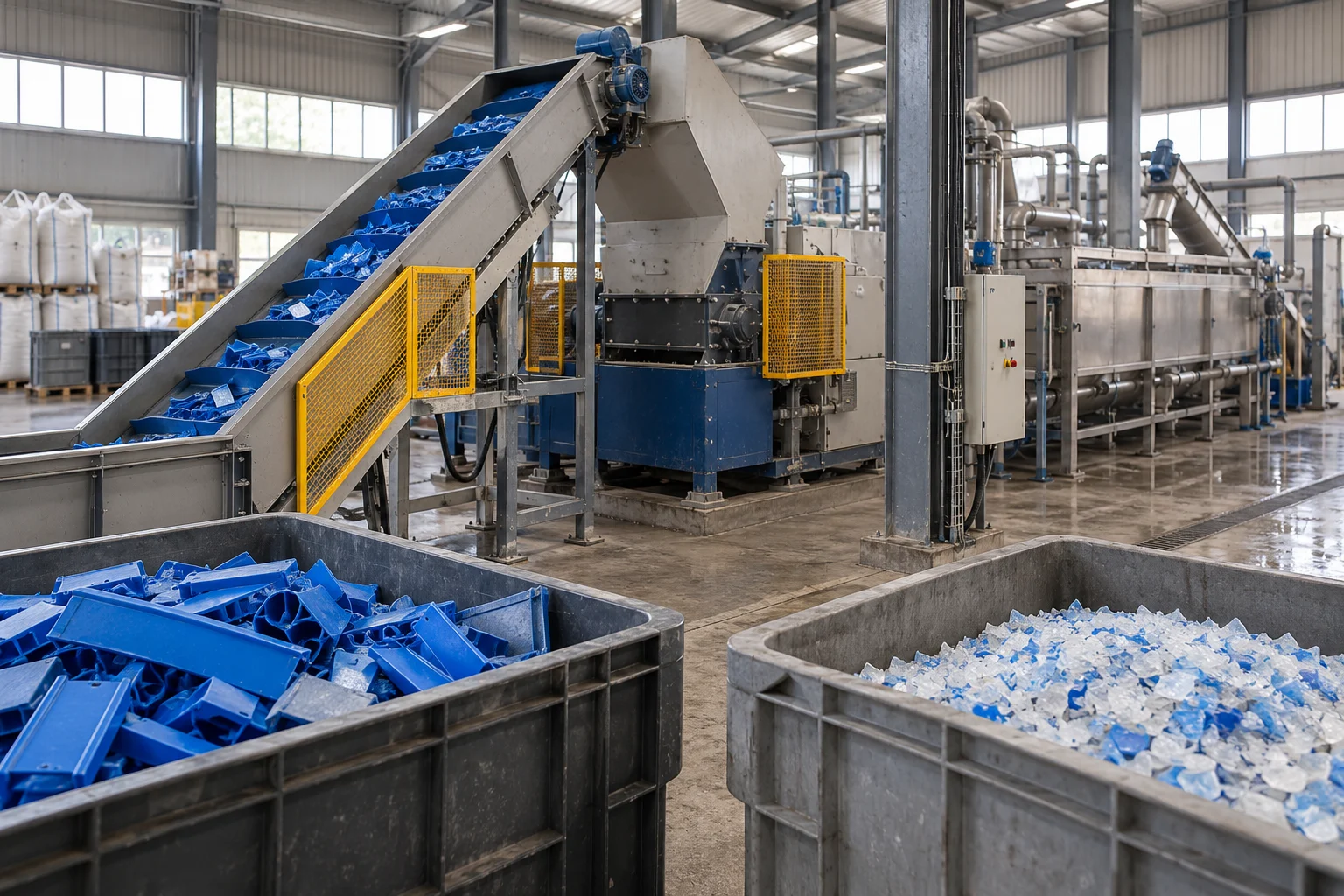
Illustrative workshop scene; it does not identify an installed NJDETE recycling line.
What machines are used in plastic recycling?
Use the table to identify the job each machine must perform. The rows describe possible functions, not a compulsory sequence for every plant.
| Equipment or process stage | Main job | What to establish before specifying it |
|---|---|---|
| Sorting and inspection equipment | Separate acceptable feed from unwanted material | Polymer, color, contamination and the agreed rejection rules |
| Bale opening and controlled feeding | Present material consistently to the next operation | Bale condition, loose-feed behavior and loading method |
| Измельчитель | Reduce bulky or difficult feed into manageable pieces | Largest part, wall thickness, feed form and the next machine’s intake |
| Granulator or plastic crusher | Cut suitable plastic feed into regrind | Cutting chamber, knife arrangement, sizing method and acceptable output |
| Separation and washing equipment | Remove specified dirt and unwanted fractions | Actual contamination and the buyer’s cleanliness requirement |
| Mechanical dewatering and drying equipment | Prepare washed material for handling or further processing | Polymer, flake or film form, and the next process’s moisture requirement |
| Extrusion, filtration and pelletizing equipment | Melt-process suitable feed and produce pellets | Material compatibility, melt quality and the pellet specification |
| Conveying, storage and collection equipment | Move and buffer material between operations | Bulk density, conveying distance, cleanout and available space |
A granulator makes cut pieces; an extrusion pelletizing system makes pellets from a melt. Suppliers sometimes use overlapping terminology, so confirm the physical process instead of relying on the word “granulator” alone.
For the equipment terminology, see the separate plastic shredder, crusher and granulator comparison. This article deals with the wider process around those machines.
Work backward from the material you intend to sell or reuse
“Recycled plastic” is not a complete output specification. Ask the receiving production department or customer what it actually needs.
For regrind, that might include a defined polymer stream, a usable particle-size range and restrictions on fines, metal, dust or other polymers. Washed flakes add cleanliness and moisture requirements. A pellet buyer may also specify melt-flow behavior, color, odor and other material properties.
Write these requirements before comparing machine prices. A line that produces more material outside the agreed specification has not solved the commercial problem.
This also helps determine where a project should stop. If an approved in-house process can use suitable regrind, investigate that route before adding a pelletizing stage. If the customer buys pellets, a size-reduction machine alone cannot deliver the required product.
Three feed streams, three different equipment discussions
Clean injection-molding runners and rejected parts
Begin with segregation. Record the resin grade, color, inserts and any reason a rejected part may be unsuitable for reuse. A clean runner collected at the press is a different feedstock from mixed scrap swept from the floor.
The first equipment question is whether the parts can be granulated directly, at the required rate, with manageable feeding and cleaning. Large, thick or awkward pieces may require another preparation stage, but that should follow a material assessment rather than a standard line diagram.
The production team must separately approve the regrind’s use in the intended product. Cutting a part into smaller pieces does not establish that its material remains suitable for every application.
Этот injection-molding scrap recycling guide covers this more focused equipment discussion.
Used PE film from collection or commercial waste
Specify how the film arrives: loose, baled, wet, printed, stretched or mixed with labels and other waste. A photograph of a clean piece cut from a bale tells less than a representative sample taken across the load.
Film projects need particular attention to feeding and cleaning. Lindner Washtech’s published post-consumer film process includes shredding, separation, washing and drying, with the treatment adapted to contamination. That is a useful example of why a film recycling enquiry should extend beyond cutter power. Source: Lindner Washtech, post-consumer films.
Ask what fraction will be rejected, how moisture is measured at the handover point, and what the next machine can accept. For the size-reduction stage, use the Руководство по выбору измельчителя пластиковой пленки.
Rigid HDPE or PP containers
Record the largest container, its thickness and its previous contents. Separate the requirements for clean production rejects from those for collected, contaminated containers. Feed with unknown or unsuitable residues needs its own assessment before it enters an ordinary recycling process.
Washing duty should follow the contamination and the intended reuse. Lindner’s HDPE process description similarly relates treatment to feed condition and the required application. It is a process example, not evidence of any particular NJDETE line configuration. Source: Lindner Washtech, rigid HDPE.
For whole containers, discuss intake and feeding with reference to the plastic drum shredder guide.
Do you need washing, drying and pelletizing?
Not automatically. Decide which specification each operation is needed to achieve.
| Question | What the answer changes |
|---|---|
| Is the separated scrap already acceptable for its intended reuse? | Whether a cleaning stage needs to be investigated |
| Will washing introduce water into the process? | Dewatering, drying, water handling and the moisture handover requirement |
| Does the next operation accept flakes or regrind? | Whether pellet production is required at all |
| Is the feed a compatible, controlled material stream? | Whether the proposed mechanical route can meet the intended material specification |
| Are printed, multilayer or mixed materials present? | The need for specialist evaluation, additional separation or a different outlet |
Extrusion recycling can include melt filtration and degassing. EREMA’s TVEplus description provides one manufacturer-specific example of these functions before pelletizing. It should not be read as a universal arrangement or a guarantee that an unknown waste mixture will become acceptable pellets. Source: EREMA, INTAREMA TVEplus.
Do not extend this thermoplastic process to cured thermoset parts simply because both materials are called plastic. Establish the polymer and a viable outlet first.
Calculate required throughput at a defined point
A daily production target needs an operating-time assumption and a yield assumption. Keep both visible.
Planning example, not a machine performance claim: a project needs 3,000 kg of accepted output per day. Assume six productive hours and an overall accepted-output yield of 80% from the weighed incoming feed.
- Required average accepted output: 3,000 ÷ 6 = 500 кг/ч.
- Required average incoming feed: 3,000 ÷ (6 × 0.80) = 625 kg/h.
Those figures describe the assumed material balance. They do not specify the rated capacity of a shredder, washer or extruder. Each supplier still needs to assess its stage against the actual feed, operating conditions and the agreed margin.
Keep the measurement basis consistent. Wet incoming waste and dry accepted product cannot be compared meaningfully without accounting for water and rejected fractions. Record where each weight is taken.
Check the handover between machines
A proposal can contain individually suitable machines and still leave a poor connection between them. Review the interfaces on one marked-up layout:
- Feed size and shape: will the preceding stage produce material the next stage can take reliably?
- Bulk density and buffer volume: is storage specified by useful volume as well as mass?
- Moisture and contamination: what is allowed at each handover point?
- Discharge and conveying: who supplies the chute, blower, conveyor or collection arrangement?
- Controls: who is responsible for stopping upstream feed when downstream equipment is unavailable?
- Cleaning and maintenance: can operators access the equipment without dismantling an unrelated part of the line?
Ask each supplier to mark its supply boundary. Include electrical connections, utilities, installation responsibilities and commissioning in the discussion. “Complete line” is too vague to serve as an acceptance document.
What should a useful material trial record?
Agree on a representative feed batch and a written output requirement. Retain photographs and samples of both. Record the tested configuration, measured feed, accepted output, rejected material and interruptions over the agreed period.
Do not compare a short clean-material demonstration with a quotation intended for variable, contaminated collection waste. If the project depends on regular grade changes, ask for the cleaning and changeover requirements as well as running output.
Этот Руководство по выбору измельчителя пластика explains the information needed for the first size-reduction enquiry. Replacement cutting tools can be discussed separately through the shredder blade и plastic crusher blade product pages.
Related NJDETE video
The following is a separate shredder video from NJDETE’s official channel. It is provided as related company footage, not as a demonstration of a complete recycling line or proof of a particular polymer, output quality or continuous capacity.
Часто задаваемые вопросы
Can one plastic recycling machine process every kind of waste?
A machine can cover more than one feedstock, but that does not establish a universal recycling process. Polymer, part shape, contamination, feeding and the required output all need to be within the assessed scope. Request evidence for the material you intend to process.
Is a shredder enough to make recycled pellets?
No. A shredder reduces size. Pellets produced from a melt require the relevant extrusion and pelletizing process. Some applications may use approved regrind without that extra stage; the receiving process decides what is acceptable.
Does clean factory scrap need washing?
It may not, if the material is properly separated and already meets the receiving process’s cleanliness specification. Confirm that specification and examine the actual handling conditions before omitting or adding equipment.
What information should go into the first enquiry?
Provide the material identity, representative feed photographs, largest dimensions, contamination, daily quantity, productive hours and required output. Add the available layout, utilities and the exact stage you want quoted. For an NJDETE shredder or replacement knife enquiry, use the relevant linked product or selection page so the request reaches the appropriate product discussion.